



Abstract
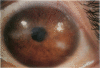
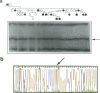
Autosomal dominant keratitis (ADK) is an eye disorder chiefly characterized by corneal opacification and vascularization and by foveal hypoplasia. Aniridia (shown recently to result from mutations in the PAX6 gene) has overlapping clinical findings and a similar pattern of inheritance with ADK. On the basis of these similarities, we used a candidate-gene approach to investigate whether mutations in the PAX6 gene also result in ADK. Significant linkage was found between two polymorphic loci in the PAX6 region and ADK in a family with 15 affected members in four generations (peak LOD score = 4.45; theta = .00 with D11S914), consistent with PAX6 mutations being responsible for ADK. SSCP analysis and direct sequencing revealed a mutation in the PAX6 exon 11 splice-acceptor site. The predicted consequent incorrect splicing results in truncation of the PAX6 proline-serine-threonine activation domain. The SeyNeu mouse results from a mutation in the Pax-6 exon 10 splice-donor site that produces a PAX6 protein truncated from the same point as occurs in our family with ADK. Therefore, the SeyNeu mouse is an excellent animal model of ADK. The finding that mutations in PAX6 underlie ADK, along with a recent report that mutations in PAX6 also underlie Peters anomaly, implicates PAX6 broadly in human anterior segment malformations.
Full text
PDF


Images in this article

Selected References
These references are in PubMed. This may not be the complete list of references from this article.
- Carothers A. M., Urlaub G., Grunberger D., Chasin L. A. Splicing mutants and their second-site suppressors at the dihydrofolate reductase locus in Chinese hamster ovary cells. Mol Cell Biol. 1993 Aug;13(8):5085–5098. doi: 10.1128/mcb.13.8.5085. [DOI] [PMC free article] [PubMed] [Google Scholar]
- Davis A., Cowell J. K. Mutations in the PAX6 gene in patients with hereditary aniridia. Hum Mol Genet. 1993 Dec;2(12):2093–2097. doi: 10.1093/hmg/2.12.2093. [DOI] [PubMed] [Google Scholar]
- Favor J., Neuhäuser-Klaus A., Ehling U. H. The effect of dose fractionation on the frequency of ethylnitrosourea-induced dominant cataract and recessive specific locus mutations in germ cells of the mouse. Mutat Res. 1988 Apr;198(2):269–275. doi: 10.1016/0027-5107(88)90003-6. [DOI] [PubMed] [Google Scholar]
- Fickenscher H. R., Chalepakis G., Gruss P. Murine Pax-2 protein is a sequence-specific trans-activator with expression in the genital system. DNA Cell Biol. 1993 Jun;12(5):381–391. doi: 10.1089/dna.1993.12.381. [DOI] [PubMed] [Google Scholar]
- Glaser T., Jepeal L., Edwards J. G., Young S. R., Favor J., Maas R. L. PAX6 gene dosage effect in a family with congenital cataracts, aniridia, anophthalmia and central nervous system defects. Nat Genet. 1994 Aug;7(4):463–471. doi: 10.1038/ng0894-463. [DOI] [PubMed] [Google Scholar]
- Glaser T., Lane J., Housman D. A mouse model of the aniridia-Wilms tumor deletion syndrome. Science. 1990 Nov 9;250(4982):823–827. doi: 10.1126/science.2173141. [DOI] [PubMed] [Google Scholar]
- Glaser T., Ton C. C., Mueller R., Petzl-Erler M. L., Oliver C., Nevin N. C., Housman D. E., Maas R. L. Absence of PAX6 gene mutations in Gillespie syndrome (partial aniridia, cerebellar ataxia, and mental retardation). Genomics. 1994 Jan 1;19(1):145–148. doi: 10.1006/geno.1994.1024. [DOI] [PubMed] [Google Scholar]
- Glaser T., Walton D. S., Maas R. L. Genomic structure, evolutionary conservation and aniridia mutations in the human PAX6 gene. Nat Genet. 1992 Nov;2(3):232–239. doi: 10.1038/ng1192-232. [DOI] [PubMed] [Google Scholar]
- Granek H., Baden H. P. Corneal involvement in epidermolysis bullosa simplex. Arch Ophthalmol. 1980 Mar;98(3):469–472. doi: 10.1001/archopht.1980.01020030465003. [DOI] [PubMed] [Google Scholar]
- Gruss P., Walther C. Pax in development. Cell. 1992 May 29;69(5):719–722. doi: 10.1016/0092-8674(92)90281-g. [DOI] [PubMed] [Google Scholar]
- Gyapay G., Morissette J., Vignal A., Dib C., Fizames C., Millasseau P., Marc S., Bernardi G., Lathrop M., Weissenbach J. The 1993-94 Généthon human genetic linkage map. Nat Genet. 1994 Jun;7(2 Spec No):246–339. doi: 10.1038/ng0694supp-246. [DOI] [PubMed] [Google Scholar]
- Hanson I. M., Fletcher J. M., Jordan T., Brown A., Taylor D., Adams R. J., Punnett H. H., van Heyningen V. Mutations at the PAX6 locus are found in heterogeneous anterior segment malformations including Peters' anomaly. Nat Genet. 1994 Feb;6(2):168–173. doi: 10.1038/ng0294-168. [DOI] [PubMed] [Google Scholar]
- Hanson I. M., Seawright A., Hardman K., Hodgson S., Zaletayev D., Fekete G., van Heyningen V. PAX6 mutations in aniridia. Hum Mol Genet. 1993 Jul;2(7):915–920. doi: 10.1093/hmg/2.7.915. [DOI] [PubMed] [Google Scholar]
- Hill R. E., Favor J., Hogan B. L., Ton C. C., Saunders G. F., Hanson I. M., Prosser J., Jordan T., Hastie N. D., van Heyningen V. Mouse small eye results from mutations in a paired-like homeobox-containing gene. Nature. 1991 Dec 19;354(6354):522–525. doi: 10.1038/354522a0. [DOI] [PubMed] [Google Scholar]
- Hill R. E., Hanson I. M. Molecular genetics of the Pax gene family. Curr Opin Cell Biol. 1992 Dec;4(6):967–972. doi: 10.1016/0955-0674(92)90126-w. [DOI] [PubMed] [Google Scholar]
- Hittner H. M., Riccardi V. M., Ferrell R. E., Borda R. R., Justice J., Jr Variable expressivity in autosomal dominant aniridia by clinical, electrophysiologic, and angiographic criteria. Am J Ophthalmol. 1980 Apr;89(4):531–539. doi: 10.1016/0002-9394(80)90062-8. [DOI] [PubMed] [Google Scholar]
- James M. R., Richard C. W., 3rd, Schott J. J., Yousry C., Clark K., Bell J., Terwilliger J. D., Hazan J., Dubay C., Vignal A. A radiation hybrid map of 506 STS markers spanning human chromosome 11. Nat Genet. 1994 Sep;8(1):70–76. doi: 10.1038/ng0994-70. [DOI] [PubMed] [Google Scholar]
- Jordan T., Hanson I., Zaletayev D., Hodgson S., Prosser J., Seawright A., Hastie N., van Heyningen V. The human PAX6 gene is mutated in two patients with aniridia. Nat Genet. 1992 Aug;1(5):328–332. doi: 10.1038/ng0892-328. [DOI] [PubMed] [Google Scholar]
- Kivlin J. D., Apple D. J., Olson R. J., Manthey R. Dominantly inherited keratitis. Arch Ophthalmol. 1986 Nov;104(11):1621–1623. doi: 10.1001/archopht.1986.01050230059031. [DOI] [PubMed] [Google Scholar]
- Kozmik Z., Kurzbauer R., Dörfler P., Busslinger M. Alternative splicing of Pax-8 gene transcripts is developmentally regulated and generates isoforms with different transactivation properties. Mol Cell Biol. 1993 Oct;13(10):6024–6035. doi: 10.1128/mcb.13.10.6024. [DOI] [PMC free article] [PubMed] [Google Scholar]
- Mannens M., Bleeker-Wagemakers E. M., Bliek J., Hoovers J., Mandjes I., van Tol S., Frants R. R., Heyting C., Westerveld A., Slater R. M. Autosomal dominant aniridia linked to the chromosome 11p13 markers catalase and D11S151 in a large Dutch family. Cytogenet Cell Genet. 1989;52(1-2):32–36. doi: 10.1159/000132834. [DOI] [PubMed] [Google Scholar]
- Martha A., Ferrell R. E., Mintz-Hittner H., Lyons L. A., Saunders G. F. Paired box mutations in familial and sporadic aniridia predicts truncated aniridia proteins. Am J Hum Genet. 1994 May;54(5):801–811. [PMC free article] [PubMed] [Google Scholar]
- Matsuo T., Osumi-Yamashita N., Noji S., Ohuchi H., Koyama E., Myokai F., Matsuo N., Taniguchi S., Doi H., Iseki S. A mutation in the Pax-6 gene in rat small eye is associated with impaired migration of midbrain crest cells. Nat Genet. 1993 Apr;3(4):299–304. doi: 10.1038/ng0493-299. [DOI] [PubMed] [Google Scholar]
- Mawhorter L. G., Ruttum M. S., Koenig S. B. Keratopathy in a family with the ectrodactyly-ectodermal dysplasia-clefting syndrome. Ophthalmology. 1985 Oct;92(10):1427–1431. doi: 10.1016/s0161-6420(85)33847-2. [DOI] [PubMed] [Google Scholar]
- Nichols B. E., Sheffield V. C., Stone E. M. A user-friendly Hypercard interface for human linkage analysis. Comput Appl Biosci. 1993 Dec;9(6):757–759. doi: 10.1093/bioinformatics/9.6.757. [DOI] [PubMed] [Google Scholar]
- Orita M., Suzuki Y., Sekiya T., Hayashi K. Rapid and sensitive detection of point mutations and DNA polymorphisms using the polymerase chain reaction. Genomics. 1989 Nov;5(4):874–879. doi: 10.1016/0888-7543(89)90129-8. [DOI] [PubMed] [Google Scholar]
- Pearce W. G., Mielke B. W., Hassard D. T., Climenhaga H. W., Climenhaga D. B., Hodges E. J. Autosomal dominant keratitis: a possible aniridia variant. Can J Ophthalmol. 1995 Apr;30(3):131–137. [PubMed] [Google Scholar]
- Plaza S., Dozier C., Saule S. Quail Pax-6 (Pax-QNR) encodes a transcription factor able to bind and trans-activate its own promoter. Cell Growth Differ. 1993 Dec;4(12):1041–1050. [PubMed] [Google Scholar]
- Riccardi V. M., Sujansky E., Smith A. C., Francke U. Chromosomal imbalance in the Aniridia-Wilms' tumor association: 11p interstitial deletion. Pediatrics. 1978 Apr;61(4):604–610. [PubMed] [Google Scholar]
- Ruusuvaara P., Setälä K. Keratoendotheliitis fugax hereditaria. A clinical and specular microscopic study of a family with dominant inflammatory corneal disease. Acta Ophthalmol (Copenh) 1987 Apr;65(2):159–169. doi: 10.1111/j.1755-3768.1987.tb06995.x. [DOI] [PubMed] [Google Scholar]
- Schmahl W., Knoedlseder M., Favor J., Davidson D. Defects of neuronal migration and the pathogenesis of cortical malformations are associated with Small eye (Sey) in the mouse, a point mutation at the Pax-6-locus. Acta Neuropathol. 1993;86(2):126–135. doi: 10.1007/BF00334879. [DOI] [PubMed] [Google Scholar]
- Senapathy P., Shapiro M. B., Harris N. L. Splice junctions, branch point sites, and exons: sequence statistics, identification, and applications to genome project. Methods Enzymol. 1990;183:252–278. doi: 10.1016/0076-6879(90)83018-5. [DOI] [PubMed] [Google Scholar]
- Shaw M. W., Falls H. F., Neel J. V. Congenital Aniridia. Am J Hum Genet. 1960 Dec;12(4 Pt 1):389–415. [PMC free article] [PubMed] [Google Scholar]
- Strachan T., Read A. P. PAX genes. Curr Opin Genet Dev. 1994 Jun;4(3):427–438. doi: 10.1016/0959-437x(94)90032-9. [DOI] [PubMed] [Google Scholar]
- Ton C. C., Hirvonen H., Miwa H., Weil M. M., Monaghan P., Jordan T., van Heyningen V., Hastie N. D., Meijers-Heijboer H., Drechsler M. Positional cloning and characterization of a paired box- and homeobox-containing gene from the aniridia region. Cell. 1991 Dec 20;67(6):1059–1074. doi: 10.1016/0092-8674(91)90284-6. [DOI] [PubMed] [Google Scholar]
- Wilson G. N., Squires R. H., Jr, Weinberg A. G. Keratitis, hepatitis, ichthyosis, and deafness: report and review of KID syndrome. Am J Med Genet. 1991 Sep 1;40(3):255–259. doi: 10.1002/ajmg.1320400302. [DOI] [PubMed] [Google Scholar]
- Zannini M., Francis-Lang H., Plachov D., Di Lauro R. Pax-8, a paired domain-containing protein, binds to a sequence overlapping the recognition site of a homeodomain and activates transcription from two thyroid-specific promoters. Mol Cell Biol. 1992 Sep;12(9):4230–4241. doi: 10.1128/mcb.12.9.4230. [DOI] [PMC free article] [PubMed] [Google Scholar]
- van der Meer-de Jong R., Dickinson M. E., Woychik R. P., Stubbs L., Hetherington C., Hogan B. L. Location of the gene involving the small eye mutation on mouse chromosome 2 suggests homology with human aniridia 2 (AN2). Genomics. 1990 Jun;7(2):270–275. doi: 10.1016/0888-7543(90)90550-e. [DOI] [PubMed] [Google Scholar]