



Abstract
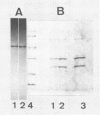
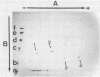
Two alternative forms of protocatechuate 3,4-dioxygenase (PCase) have been purified from Moraxella sp. strain GU2, a bacterium that is able to grow on guaiacol or various other phenolic compounds as the sole source of carbon and energy. One of these forms (PCase-P) was induced by protocatechuate and had an apparent molecular weight of 220,000. The second form (PCase-G) was induced by guaiacol or other phenolic compounds, such as 2-ethoxyphenol or 4-hydroxybenzoate. It appeared to be smaller (Mr 158,000), and its turnover number was about double that of the former enzyme. Both dioxygenases had similar properties and were built from the association of equal amounts of nonidentical subunits, alpha and beta, which were estimated to have molecular weights of 29,500 and 25,500, respectively. The (alpha beta)3 and (alpha beta)4 structures were suggested for PCases G and P, respectively. On the basis of two-dimensional gel electrophoresis, the alpha and beta polypeptides of PCase-G differed from those of PCase-P. Amino acid analysis supported this conclusion. Both PCases, however, had several other properties in common. It is proposed that both isoenzymes were generated from different sets of alpha and beta subunits, and the significance of these data is discussed.
Full text
PDF


Images in this article
Selected References
These references are in PubMed. This may not be the complete list of references from this article.
- Bradford M. M. A rapid and sensitive method for the quantitation of microgram quantities of protein utilizing the principle of protein-dye binding. Anal Biochem. 1976 May 7;72:248–254. doi: 10.1016/0003-2697(76)90527-3. [DOI] [PubMed] [Google Scholar]
- Bull C., Ballou D. P., Otsuka S. The reaction of oxygen with protocatechuate 3,4-dioxygenase from Pseudomonas putida. Characterization of a new oxygenated intermediate. J Biol Chem. 1981 Dec 25;256(24):12681–12686. [PubMed] [Google Scholar]
- Bull C., Ballou D. P. Purification and properties of protocatechuate 3,4-dioxygenase from Pseudomonas putida. A new iron to subunit stoichiometry. J Biol Chem. 1981 Dec 25;256(24):12673–12680. [PubMed] [Google Scholar]
- Bull C., Ballou D. P., Salmeen I. Raman spectrum of protocatechuate dioxygenase from Pseudomonas putida. New low frequency bands. Biochem Biophys Res Commun. 1979 Apr 13;87(3):836–841. doi: 10.1016/0006-291x(79)92033-3. [DOI] [PubMed] [Google Scholar]
- Cánovas J. L., Stanier R. Y. Regulation of the enzymes of the beta-ketoadipate pathway in Moraxella calcoacetica. 1. General aspects. Eur J Biochem. 1967 May;1(3):289–300. doi: 10.1007/978-3-662-25813-2_40. [DOI] [PubMed] [Google Scholar]
- DAVIS B. J. DISC ELECTROPHORESIS. II. METHOD AND APPLICATION TO HUMAN SERUM PROTEINS. Ann N Y Acad Sci. 1964 Dec 28;121:404–427. doi: 10.1111/j.1749-6632.1964.tb14213.x. [DOI] [PubMed] [Google Scholar]
- Dagley S. Catabolism of aromatic compounds by micro-organisms. Adv Microb Physiol. 1971;6(0):1–46. doi: 10.1016/s0065-2911(08)60066-1. [DOI] [PubMed] [Google Scholar]
- Dardas A., Gal D., Barrelle M., Sauret-Ignazi G., Sterjiades R., Pelmont J. The demethylation of guaiacol by a new bacterial cytochrome P-450. Arch Biochem Biophys. 1985 Feb 1;236(2):585–592. doi: 10.1016/0003-9861(85)90662-9. [DOI] [PubMed] [Google Scholar]
- Durham D. R., Stirling L. A., Ornston L. N., Perry J. J. Intergeneric evolutionary homology revealed by the study of protocatechuate 3,4-dioxygenase from Azotobacter vinelandii. Biochemistry. 1980 Jan 8;19(1):149–155. doi: 10.1021/bi00542a023. [DOI] [PubMed] [Google Scholar]
- Fujisawa H., Hayaishi O. Protocatechuate 3,4-dioxygenase. I. Crystallization and characterization. J Biol Chem. 1968 May 25;243(10):2673–2681. [PubMed] [Google Scholar]
- Fujisawa H., Uyeda M., Kojima Y., Nozaki M., Hayaishi O. Protocatechuate 3,4-dioxygenase. II. Electron spin resonance and spectral studies on interaction of substrates and enzyme. J Biol Chem. 1972 Jul 10;247(13):4414–4421. [PubMed] [Google Scholar]
- Hou C. T., Lillard M. O., Schwartz R. D. Protocatechuate 3, 4-dioxygenase from Acinetobacter calcoaceticus. Biochemistry. 1976 Feb 10;15(3):582–588. doi: 10.1021/bi00648a020. [DOI] [PubMed] [Google Scholar]
- Jouve H. M., Tessier S., Pelmont J. Purification and properties of the Proteus mirabilis catalase. Can J Biochem Cell Biol. 1983 Jan;61(1):8–14. doi: 10.1139/o83-002. [DOI] [PubMed] [Google Scholar]
- Kohlmiller N. A., Howard J. B. The primary structure of the alpha subunit of protocatechuate 3,4-dioxygenase. II. Isolation and sequence of overlap peptides and complete sequence. J Biol Chem. 1979 Aug 10;254(15):7309–7315. [PubMed] [Google Scholar]
- Laemmli U. K. Cleavage of structural proteins during the assembly of the head of bacteriophage T4. Nature. 1970 Aug 15;227(5259):680–685. doi: 10.1038/227680a0. [DOI] [PubMed] [Google Scholar]
- Ludwig M. L., Weber L. D., Ballou D. P. Characterization of crystals of protocatechuate 3,4-dioxygenase from Pseudomonas cepacia. J Biol Chem. 1984 Dec 10;259(23):14840–14842. [PubMed] [Google Scholar]
- May S. W., Oldham C. D., Mueller P. W., Padgette S. R., Sowell A. L. Protocatechuate 3,4-dioxygenase. Mechanistic implications of inhibition by the transition state analog, 2-hydroxyisonicotinic acid N-oxide. J Biol Chem. 1982 Nov 10;257(21):12746–12751. [PubMed] [Google Scholar]
- May S. W., Phillips R. S. Protocatechuate 3,4-dioxygenase: implications of ionization effects on binding and dissociation of halohydroxybenzoates and on catalytic turnover. Biochemistry. 1979 Dec 25;18(26):5933–5939. doi: 10.1021/bi00593a027. [DOI] [PubMed] [Google Scholar]
- O'Farrell P. H. High resolution two-dimensional electrophoresis of proteins. J Biol Chem. 1975 May 25;250(10):4007–4021. [PMC free article] [PubMed] [Google Scholar]
- Ornston L. N., Stanier R. Y. The conversion of catechol and protocatechuate to beta-ketoadipate by Pseudomonas putida. J Biol Chem. 1966 Aug 25;241(16):3776–3786. [PubMed] [Google Scholar]
- Ornston L. N. The conversion of catechol and protocatechuate to beta-ketoadipate by Pseudomonas putida. II. Enzymes of the protocatechuate pathway. J Biol Chem. 1966 Aug 25;241(16):3787–3794. [PubMed] [Google Scholar]
- Ornston L. N. The conversion of catechol and protocatechuate to beta-ketoadipate by Pseudomonas putida. IV. Regulation. J Biol Chem. 1966 Aug 25;241(16):3800–3810. [PubMed] [Google Scholar]
- Parke D., Ornston L. N. Enzymes of the beta-ketoadipate pathway are inducible in Rhizobium and Agrobacterium spp. and constitutive in Bradyrhizobium spp. J Bacteriol. 1986 Jan;165(1):288–292. doi: 10.1128/jb.165.1.288-292.1986. [DOI] [PMC free article] [PubMed] [Google Scholar]
- Que L., Jr, Epstein R. M. Resonance Raman studies on protocatechuate 3,4-dioxygenase-inhibitor complexes. Biochemistry. 1981 Apr 28;20(9):2545–2549. doi: 10.1021/bi00512a028. [DOI] [PubMed] [Google Scholar]
- Que L., Jr, Lipscomb J. D., Zimmermann R., Münck E., Orme-Johnson N. R., Orme-Johnson W. H. Mössbauer and EPR spectroscopy of protocatechuate 3,4-dioxygenase from Pseudomonas aeruginosa. Biochim Biophys Acta. 1976 Dec 8;452(2):320–334. doi: 10.1016/0005-2744(76)90182-0. [DOI] [PubMed] [Google Scholar]
- STANIER R. Y., INGRAHAM J. L. Protocatechuic acid oxidase. J Biol Chem. 1954 Oct;210(2):799–808. [PubMed] [Google Scholar]
- Walsh T. A., Ballou D. P. Halogenated protocatechuates as substrates for protocatechuate dioxygenase from Pseudomonas cepacia. J Biol Chem. 1983 Dec 10;258(23):14413–14421. [PubMed] [Google Scholar]
- Whittaker J. W., Lipscomb J. D. 17O-water and cyanide ligation by the active site iron of protocatechuate 3,4-dioxygenase. Evidence for displaceable ligands in the native enzyme and in complexes with inhibitors or transition state analogs. J Biol Chem. 1984 Apr 10;259(7):4487–4495. [PubMed] [Google Scholar]
- Whittaker J. W., Lipscomb J. D., Kent T. A., Münck E. Brevibacterium fuscum protocatechuate 3,4-dioxygenase. Purification, crystallization, and characterization. J Biol Chem. 1984 Apr 10;259(7):4466–4475. [PubMed] [Google Scholar]
- Whittaker J. W., Lipscomb J. D. Transition state analogs for protocatechuate 3,4-dioxygenase. Spectroscopic and kinetic studies of the binding reactions of ketonized substrate analogs. J Biol Chem. 1984 Apr 10;259(7):4476–4486. [PubMed] [Google Scholar]
- Wood J. M., Crawford R. L., Münck E., Zimmerman R., Lipscomb J. D., Stephens R. S., Bromley J. W., Que L., Jr, Howard J. B., Orme-Johnson W. H. Structure and function of dioxygenases. One approach to lignin degradation. J Agric Food Chem. 1977 Jul-Aug;25(4):698–704. doi: 10.1021/jf60212a028. [DOI] [PubMed] [Google Scholar]
- Yoshida R., Hori K., Fujiwara M., Saeki Y., Kagamiyama H. Nonidentical subunits of protocatechuate 3,4-dioxygenase. Biochemistry. 1976 Sep 7;15(18):4048–4053. doi: 10.1021/bi00663a020. [DOI] [PubMed] [Google Scholar]