



Abstract
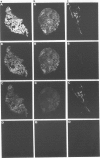
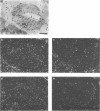
1 Receptor autoradiography using (-)-[125I]-cyanopindolol (CYP) was used to study the distribution of beta-adrenoceptor subtypes in human right atrial appendage, left atrial free wall, left ventricular papillary muscle and pericardium. 2 The binding of (-)-[125I]-CYP to slide-mounted tissue sections of human right atrial appendage was time-dependent (K1 = 4.11 +/- 1.01 X 10(8) M-1 min-1, K-1 = 1.47 +/- 0.25 X 10(-3) min-1, n = 3), saturable (42.02 +/- 2.96 pM, n = 4) and stereoselective with respect to the optical isomers of propranolol (pKD (-):8.97 +/- 0.02, (+):6.88 +/- 0.06, n = 3). 3 The proportions of beta-adrenoceptor subtypes were determined in slide-mounted tissue sections using the antagonists CGP 20712A (beta 1-selective) and ICI 118,551 (beta 2-selective). In right atrial appendage and left ventricular papillary muscle 40% (34-45%) of the beta-adrenoceptors were of the beta 2-subtype. 4 Images from X-ray film and nuclear emulsion coated coverslips exposed to (-)-[125I]-CYP-labelled sections showed an even distribution of beta-adrenoceptor subtypes over the myocardium of the right atrial appendage, left ventricular papillary muscle and left atrial free wall. Sections of pericardium exhibited predominantly beta 2-adrenoceptors. beta 2-Adrenoceptors were localized to the intimal surface of coronary arteries. 5 The selective beta 1-adrenoceptor agonist RO363 and beta 2-selective agonist procaterol produced concentration-dependent inotropic responses in right atrial appendage strips. Responses to RO363 were antagonized by CGP 20712A (pKB = 9.29) suggesting an interaction with beta 1-adrenoceptors. Responses to procaterol were antagonized by ICI 118,551 (pKB = 9.06) suggesting an interaction at beta 2-adrenoceptors. 6 The finding that a significant proportion of human myocardial adrenoceptors are of the beta 2-subtype has important clinical implications for the involvement of these receptors in the control of heart rate and force, and the autoradiographic evidence suggests other roles in the coronary vasculature and pericardium.
Full text
PDF


Images in this article
Selected References
These references are in PubMed. This may not be the complete list of references from this article.
- Ablad B., Carlsson E., Ek L. Pharmacological studies of two new cardioselective adrenergic beta-receptor antagonists. Life Sci I. 1973 Feb 1;12(3):107–119. doi: 10.1016/0024-3205(73)90368-8. [DOI] [PubMed] [Google Scholar]
- Ariëns E. J., Simonis A. M. Physiological and pharmacological aspects of adrenergic receptor classification. Biochem Pharmacol. 1983 May 15;32(10):1539–1545. doi: 10.1016/0006-2952(83)90324-6. [DOI] [PubMed] [Google Scholar]
- Arnold J. M., O'Connor P. C., Riddell J. G., Harron D. W., Shanks R. G., McDevitt D. G. Effects of the beta 2-adrenoceptor antagonist ICI 118,551 on exercise tachycardia and isoprenaline-induced beta-adrenoceptor responses in man. Br J Clin Pharmacol. 1985 May;19(5):619–630. doi: 10.1111/j.1365-2125.1985.tb02689.x. [DOI] [PMC free article] [PubMed] [Google Scholar]
- Ask J. A., Stene-Larsen G., Helle K. B., Resch F. Functional beta 1- and beta 2-adrenoceptors in the human myocardium. Acta Physiol Scand. 1985 Jan;123(1):81–88. doi: 10.1111/j.1748-1716.1985.tb07564.x. [DOI] [PubMed] [Google Scholar]
- Bilski A. J., Halliday S. E., Fitzgerald J. D., Wale J. L. The pharmacology of a beta 2-selective adrenoceptor antagonist (ICI 118,551). J Cardiovasc Pharmacol. 1983 May-Jun;5(3):430–437. doi: 10.1097/00005344-198305000-00013. [DOI] [PubMed] [Google Scholar]
- Bonelli J. Demonstration of two different types of beta1-receptors in man (selective blockade of the positively inotropic and the positively chronotropic effect of isoproterenol). Int J Clin Pharmacol Biopharm. 1978 Jul;16(7):313–319. [PubMed] [Google Scholar]
- Bristow M. R., Ginsburg R., Minobe W., Cubicciotti R. S., Sageman W. S., Lurie K., Billingham M. E., Harrison D. C., Stinson E. B. Decreased catecholamine sensitivity and beta-adrenergic-receptor density in failing human hearts. N Engl J Med. 1982 Jul 22;307(4):205–211. doi: 10.1056/NEJM198207223070401. [DOI] [PubMed] [Google Scholar]
- Bristow M. R., Ginsburg R., Umans V., Fowler M., Minobe W., Rasmussen R., Zera P., Menlove R., Shah P., Jamieson S. Beta 1- and beta 2-adrenergic-receptor subpopulations in nonfailing and failing human ventricular myocardium: coupling of both receptor subtypes to muscle contraction and selective beta 1-receptor down-regulation in heart failure. Circ Res. 1986 Sep;59(3):297–309. doi: 10.1161/01.res.59.3.297. [DOI] [PubMed] [Google Scholar]
- Brodde O. E., Karad K., Zerkowski H. R., Rohm N., Reidemeister J. C. Coexistence of beta 1- and beta 2-adrenoceptors in human right atrium. Direct identification by (+/-)-[125I]iodocyanopindolol binding. Circ Res. 1983 Dec;53(6):752–758. doi: 10.1161/01.res.53.6.752. [DOI] [PubMed] [Google Scholar]
- Brown J. E., McLeod A. A., Shand D. G. Evidence for cardiac beta 2-adrenoceptors in man. Clin Pharmacol Ther. 1983 Apr;33(4):424–428. doi: 10.1038/clpt.1983.57. [DOI] [PubMed] [Google Scholar]
- Brown R. D., Manno J. E. ESTRIP, a BASIC computer program for obtaining initial polyexponential parameter estimates. J Pharm Sci. 1978 Dec;67(12):1687–1691. doi: 10.1002/jps.2600671214. [DOI] [PubMed] [Google Scholar]
- Bryan L. J., Cole J. J., O'Donnell S. R., Wanstall J. C. A study designed to explore the hypothesis that beta-1 adrenoceptors are "innervated" receptors and beta-2 adrenoceptors are "hormonal" receptors. J Pharmacol Exp Ther. 1981 Feb;216(2):395–400. [PubMed] [Google Scholar]
- Bürgisser E., Hancock A. A., Lefkowitz R. J., De Lean A. Anomalous equilibrium binding properties of high-affinity racemic radioligands. Mol Pharmacol. 1981 Mar;19(2):205–216. [PubMed] [Google Scholar]
- Chidsey C. A., Braunwald E. Sympathetic activity and neurotransmitter depletion in congestive heart failure. Pharmacol Rev. 1966 Mar;18(1):685–700. [PubMed] [Google Scholar]
- Clausen T., Flatman J. A. Beta 2-adrenoceptors mediate the stimulating effect of adrenaline on active electrogenic Na-K-transport in rat soleus muscle. Br J Pharmacol. 1980 Apr;68(4):749–755. doi: 10.1111/j.1476-5381.1980.tb10868.x. [DOI] [PMC free article] [PubMed] [Google Scholar]
- Cohn J. N., Levine T. B., Olivari M. T., Garberg V., Lura D., Francis G. S., Simon A. B., Rector T. Plasma norepinephrine as a guide to prognosis in patients with chronic congestive heart failure. N Engl J Med. 1984 Sep 27;311(13):819–823. doi: 10.1056/NEJM198409273111303. [DOI] [PubMed] [Google Scholar]
- Dooley D. J., Bittiger H., Reymann N. C. CGP 20712 A: a useful tool for quantitating beta 1- and beta 2-adrenoceptors. Eur J Pharmacol. 1986 Oct 14;130(1-2):137–139. doi: 10.1016/0014-2999(86)90193-7. [DOI] [PubMed] [Google Scholar]
- Gille E., Lemoine H., Ehle B., Kaumann A. J. The affinity of (-)-propranolol for beta 1- and beta 2-adrenoceptors of human heart. Differential antagonism of the positive inotropic effects and adenylate cyclase stimulation by (-)-noradrenaline and (-)-adrenaline. Naunyn Schmiedebergs Arch Pharmacol. 1985 Oct;331(1):60–70. doi: 10.1007/BF00498852. [DOI] [PubMed] [Google Scholar]
- Golf S., Løvstad R., Hansson V. Beta-adrenoceptor density and relative number of beta-adrenoceptor subtypes in biopsies from human right atrial, left ventricular, and right ventricular myocard. Cardiovasc Res. 1985 Oct;19(10):636–641. doi: 10.1093/cvr/19.10.636. [DOI] [PubMed] [Google Scholar]
- Hedberg A., Kempf F., Jr, Josephson M. E., Molinoff P. B. Coexistence of beta-1 and beta-2 adrenergic receptors in the human heart: effects of treatment with receptor antagonists or calcium entry blockers. J Pharmacol Exp Ther. 1985 Sep;234(3):561–568. [PubMed] [Google Scholar]
- Heitz A., Schwartz J., Velly J. Beta-adrenoceptors of the human myocardium: determination of beta 1 and beta 2 subtypes by radioligand binding. Br J Pharmacol. 1983 Dec;80(4):711–717. doi: 10.1111/j.1476-5381.1983.tb10062.x. [DOI] [PMC free article] [PubMed] [Google Scholar]
- Hems D. A., Whitton P. D. Control of hepatic glycogenolysis. Physiol Rev. 1980 Jan;60(1):1–50. doi: 10.1152/physrev.1980.60.1.1. [DOI] [PubMed] [Google Scholar]
- Johansson L. H., Persson H. Beta 2-adrenoceptors in guinea-pig atria. J Pharm Pharmacol. 1983 Dec;35(12):804–807. doi: 10.1111/j.2042-7158.1983.tb02900.x. [DOI] [PubMed] [Google Scholar]
- Juberg E. N., Minneman K. P., Abel P. W. Beta 1- and beta 2-adrenoceptor binding and functional response in right and left atria of rat heart. Naunyn Schmiedebergs Arch Pharmacol. 1985 Sep;330(3):193–202. doi: 10.1007/BF00572434. [DOI] [PubMed] [Google Scholar]
- Kaumann A. J., Morris T. H., Bojar H. Heart beta-receptors: on the functional role of heterogeneous binding sites. J Recept Res. 1983;3(1-2):61–70. doi: 10.3109/10799898309041923. [DOI] [PubMed] [Google Scholar]
- Kaumann A. J. The beta 1-adrenoceptor antagonist CGP 20712 A unmasks beta 2-adrenoceptors activated by (-)-adrenaline in rat sinoatrial node. Naunyn Schmiedebergs Arch Pharmacol. 1986 Apr;332(4):406–409. doi: 10.1007/BF00500096. [DOI] [PubMed] [Google Scholar]
- Lands A. M., Arnold A., McAuliff J. P., Luduena F. P., Brown T. G., Jr Differentiation of receptor systems activated by sympathomimetic amines. Nature. 1967 May 6;214(5088):597–598. doi: 10.1038/214597a0. [DOI] [PubMed] [Google Scholar]
- Lau Y. H., Robinson R. B., Rosen M. R., Bilezikian J. P. Subclassification of beta-adrenergic receptors in cultured rat cardiac myoblasts and fibroblasts. Circ Res. 1980 Jul;47(1):41–48. doi: 10.1161/01.res.47.1.41. [DOI] [PubMed] [Google Scholar]
- Lew R., Summers R. J. Autoradiographic localization of beta-adrenoceptor subtypes in guinea-pig kidney. Br J Pharmacol. 1985 Jun;85(2):341–348. doi: 10.1111/j.1476-5381.1985.tb08867.x. [DOI] [PMC free article] [PubMed] [Google Scholar]
- Lipe S., Summers R. J. Autoradiographic analysis of the distribution of beta-adrenoceptors in the dog splenic vasculature. Br J Pharmacol. 1986 Mar;87(3):603–609. doi: 10.1111/j.1476-5381.1986.tb10203.x. [DOI] [PMC free article] [PubMed] [Google Scholar]
- McPherson G. A. A practical computer-based approach to the analysis of radioligand binding experiments. Comput Programs Biomed. 1983 Aug-Oct;17(1-2):107–113. doi: 10.1016/0010-468x(83)90031-4. [DOI] [PubMed] [Google Scholar]
- McPherson G. A., Malta E., Molenaar P., Raper C. The affinity and efficacy of the selective beta 1-adrenoceptor stimulant RO363 at beta 1- and beta 2-adrenoceptor sites. Br J Pharmacol. 1984 Aug;82(4):897–904. doi: 10.1111/j.1476-5381.1984.tb16488.x. [DOI] [PMC free article] [PubMed] [Google Scholar]
- Molenaar P., Canale E., Summers R. J. Autoradiographic localization of beta-1 and beta-2 adrenoceptors in guinea pig atrium and regions of the conducting system. J Pharmacol Exp Ther. 1987 Jun;241(3):1048–1064. [PubMed] [Google Scholar]
- Molenaar P., Summers R. J. Characterization of beta-1 and beta-2 adrenoceptors in guinea pig atrium: functional and receptor binding studies. J Pharmacol Exp Ther. 1987 Jun;241(3):1041–1047. [PubMed] [Google Scholar]
- Munson P. J., Rodbard D. Ligand: a versatile computerized approach for characterization of ligand-binding systems. Anal Biochem. 1980 Sep 1;107(1):220–239. doi: 10.1016/0003-2697(80)90515-1. [DOI] [PubMed] [Google Scholar]
- Mügge A., Posselt D., Reimer U., Schmitz W., Scholz H. Effects of the beta 2-adrenoceptor agonists fenoterol and salbutamol on force of contraction in isolated human ventricular myocardium. Klin Wochenschr. 1985 Jan 2;63(1):26–31. [PubMed] [Google Scholar]
- O'Donnell S. R., Wanstall J. C. Evidence that ICI 118, 551 is a potent, highly Beta 2-selective adrenoceptor antagonist and can be used to characterize Beta-adrenoceptor populations in tissues. Life Sci. 1980 Aug 25;27(8):671–677. doi: 10.1016/0024-3205(80)90008-9. [DOI] [PubMed] [Google Scholar]
- Robberecht P., Delhaye M., Taton G., De Neef P., Waelbroeck M., De Smet J. M., Leclerc J. L., Chatelain P., Christophe J. The human heart beta-adrenergic receptors. I. Heterogeneity of the binding sites: presence of 50% beta 1- and 50% beta 2-adrenergic receptors. Mol Pharmacol. 1983 Sep;24(2):169–173. [PubMed] [Google Scholar]
- Snavely M. D., Motulsky H. J., Moustafa E., Mahan L. C., Insel P. A. beta-Adrenergic receptor subtypes in the rat renal cortex. Selective regulation of beta 1-adrenergic receptors by pheochromocytoma. Circ Res. 1982 Oct;51(4):504–513. doi: 10.1161/01.res.51.4.504. [DOI] [PubMed] [Google Scholar]
- Stephenson J. A., Summers R. J. Autoradiographic analysis of receptors on vascular endothelium. Eur J Pharmacol. 1987 Jan 28;134(1):35–43. doi: 10.1016/0014-2999(87)90128-2. [DOI] [PubMed] [Google Scholar]
- Stiles G. L., Caron M. G., Lefkowitz R. J. Beta-adrenergic receptors: biochemical mechanisms of physiological regulation. Physiol Rev. 1984 Apr;64(2):661–743. doi: 10.1152/physrev.1984.64.2.661. [DOI] [PubMed] [Google Scholar]
- Stiles G. L., Taylor S., Lefkowitz R. J. Human cardiac beta-adrenergic receptors: subtype heterogeneity delineated by direct radioligand binding. Life Sci. 1983 Aug 1;33(5):467–473. doi: 10.1016/0024-3205(83)90796-8. [DOI] [PubMed] [Google Scholar]
- Vago T., Bevilacqua M., Dagani R., Meroni R., Frigeni G., Santoliss C., Norbiato G. Comparison of rat and human left ventricle beta-adrenergic receptors: subtype heterogeneity delineated by direct radioligand binding. Biochem Biophys Res Commun. 1984 May 31;121(1):346–354. doi: 10.1016/0006-291x(84)90729-0. [DOI] [PubMed] [Google Scholar]
- Wagner J., Nick B., Rohm N., Schümann H. J. On the coexistence of beta 1- and beta 2-adrenoceptors in various organs. Arch Int Pharmacodyn Ther. 1981 Jan;249(1):26–38. [PubMed] [Google Scholar]
- Yabuuchi Y. The beta-adrenoceptor stimulant properties of OPC-2009 on guinea-pig isolated tracheal, right atrial and left atrial preparations. Br J Pharmacol. 1977 Dec;61(4):513–521. doi: 10.1111/j.1476-5381.1977.tb07543.x. [DOI] [PMC free article] [PubMed] [Google Scholar]
- Young W. S., 3rd, Kuhar M. J. A new method for receptor autoradiography: [3H]opioid receptors in rat brain. Brain Res. 1979 Dec 28;179(2):255–270. doi: 10.1016/0006-8993(79)90442-6. [DOI] [PubMed] [Google Scholar]
- Zerkowski H. R., Ikezono K., Rohm N., Reidemeister J. C., Brodde O. E. Human myocardial beta-adrenoceptors: demonstration of both beta 1- and beta 2-adrenoceptors mediating contractile responses to beta-agonists on the isolated right atrium. Naunyn Schmiedebergs Arch Pharmacol. 1986 Feb;332(2):142–147. doi: 10.1007/BF00511404. [DOI] [PubMed] [Google Scholar]