



Abstract
1. Substance P (SP) and neurokinin A- (NKA)/neurokinin B (NKB)-like immunoreactivity (LI) were measured by radioimmunoassay in extracts of the rabbit uvea. The iris-ciliary body complex contained 3-4 times more NKA/NKB-LI than SP-LI. Tachykinins are thought to mediate many of the responses to ocular injury in the rabbit. Their possible role in the miosis and breakdown of the blood-aqueous barrier (BAB) was studied in vitro and in vivo. 2. In vitro, NKA had a more short-lasting contractile effect on the sphincter pupillae muscle than either SP or NKB, but SP was more potent than the other two. The tachykinin antagonist, spantide, dose-dependently suppressed the response to electrical stimulation (by 90% at 10(-4) M) and to the three tachykinins. An antiserum against SP (no cross-reaction with NKA or NKB) greatly suppressed the response to SP (by 90%) as well as to electrical field stimulation (by 40%). The responses to NKA and NKB were unaffected. 3. In vivo studies revealed that SP was more potent than NKA and NKB as a miotic. SP evoked a moderate breakdown of the BAB at high doses while NKA and NKB were virtually inactive. 4. We conclude that besides SP other tachykinins might play a role in the mediation of miosis in the rabbit eye but, of the three peptides investigated, only SP can be of importance for the breakdown of the BAB.
Full text
PDF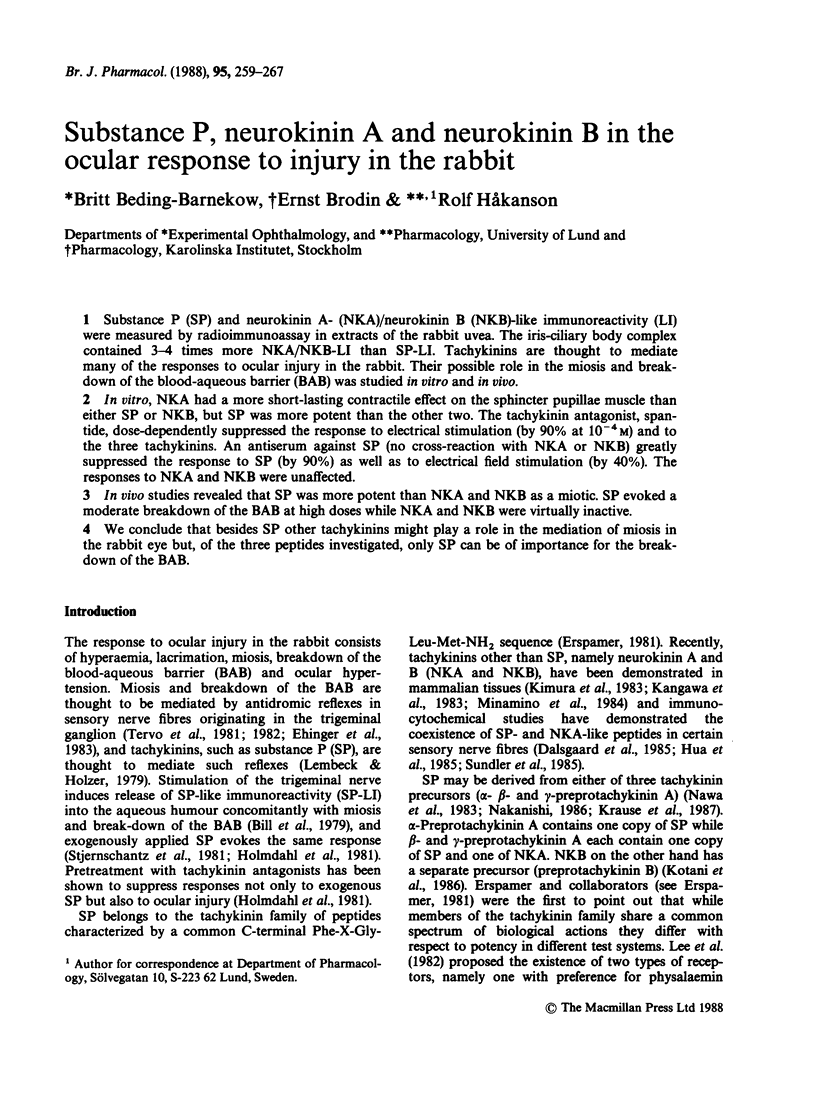


Selected References
These references are in PubMed. This may not be the complete list of references from this article.
- ANJOU C. I., KRAKAU C. E. Aqueous flare and protein content in the anterior chamber of normal rabbits' eyes. Acta Ophthalmol (Copenh) 1961;39:95–101. doi: 10.1111/j.1755-3768.1961.tb00244.x. [DOI] [PubMed] [Google Scholar]
- Bill A., Stjernschantz J., Mandahl A., Brodin E., Nilsson G. Substance P: release on trigeminal nerve stimulation, effects in the eye. Acta Physiol Scand. 1979 Jul;106(3):371–373. doi: 10.1111/j.1748-1716.1979.tb06412.x. [DOI] [PubMed] [Google Scholar]
- Brodin E., Lindefors N., Dalsgaard C. J., Theodorsson-Norheim E., Rosell S. Tachykinin multiplicity in rat central nervous system as studied using antisera raised against substance P and neurokinin A. Regul Pept. 1986 Feb;13(3-4):253–272. doi: 10.1016/0167-0115(86)90044-3. [DOI] [PubMed] [Google Scholar]
- Buck S. H., Burcher E., Shults C. W., Lovenberg W., O'Donohue T. L. Novel pharmacology of substance K-binding sites: a third type of tachykinin receptor. Science. 1984 Nov 23;226(4677):987–989. doi: 10.1126/science.6095447. [DOI] [PubMed] [Google Scholar]
- DYSTER-AAS K., KRAKAU C. E. AQUEOUS FLOW DETERMINATION IN THE RABBIT BY MEANS OF A MINIMAL EYE TRAUMA. Invest Ophthalmol. 1964 Apr;3:127–134. [PubMed] [Google Scholar]
- Dalsgaard C. J., Haegerstrand A., Theodorsson-Norheim E., Brodin E., Hökfelt T. Neurokinin A-like immunoreactivity in rat primary sensory neurons; coexistence with substance P. Histochemistry. 1985;83(1):37–39. doi: 10.1007/BF00495297. [DOI] [PubMed] [Google Scholar]
- Dion S., Drapeau G., Rhaleb N. E., D'Orléans-Juste P., Regoli D. Receptors for substance P and neurokinins. Correlation between binding and biological activities. Eur J Pharmacol. 1987 Jun 12;138(1):125–128. doi: 10.1016/0014-2999(87)90347-5. [DOI] [PubMed] [Google Scholar]
- Ehinger B., Sundler F., Tervo K., Tervo T., Tornqvist K. Substance P fibres in the anterior segment of the rabbit eye. Acta Physiol Scand. 1983 Jul;118(3):215–218. doi: 10.1111/j.1748-1716.1983.tb07265.x. [DOI] [PubMed] [Google Scholar]
- Folkers K., Håkanson R., Hörig J., Xu J. C., Leander S. Biological evaluation of substance P antagonists. Br J Pharmacol. 1984 Oct;83(2):449–456. doi: 10.1111/j.1476-5381.1984.tb16506.x. [DOI] [PMC free article] [PubMed] [Google Scholar]
- Holmdahl G., Håkanson R., Leander S., Rosell S., Folkers K., Sundler F. A substance P antagonist, [D-Pro2, D-Trp7,9]SP, inhibits inflammatory responses in the rabbit eye. Science. 1981 Nov 27;214(4524):1029–1031. doi: 10.1126/science.6171036. [DOI] [PubMed] [Google Scholar]
- Hua X. Y., Theodorsson-Norheim E., Brodin E., Lundberg J. M., Hökfelt T. Multiple tachykinins (neurokinin A, neuropeptide K and substance P) in capsaicin-sensitive sensory neurons in the guinea-pig. Regul Pept. 1985 Dec;13(1):1–19. doi: 10.1016/0167-0115(85)90082-5. [DOI] [PubMed] [Google Scholar]
- Kangawa K., Minamino N., Fukuda A., Matsuo H. Neuromedin K: a novel mammalian tachykinin identified in porcine spinal cord. Biochem Biophys Res Commun. 1983 Jul 29;114(2):533–540. doi: 10.1016/0006-291x(83)90813-6. [DOI] [PubMed] [Google Scholar]
- Kotani H., Hoshimaru M., Nawa H., Nakanishi S. Structure and gene organization of bovine neuromedin K precursor. Proc Natl Acad Sci U S A. 1986 Sep;83(18):7074–7078. doi: 10.1073/pnas.83.18.7074. [DOI] [PMC free article] [PubMed] [Google Scholar]
- Krakau C. E., Ohman R. The inhibiting effect of indomethacin on the disruption of the blood-aqueous barrier in the rabbit eye. Invest Ophthalmol. 1975 Apr;14(4):306–312. [PubMed] [Google Scholar]
- Krause J. E., Chirgwin J. M., Carter M. S., Xu Z. S., Hershey A. D. Three rat preprotachykinin mRNAs encode the neuropeptides substance P and neurokinin A. Proc Natl Acad Sci U S A. 1987 Feb;84(3):881–885. doi: 10.1073/pnas.84.3.881. [DOI] [PMC free article] [PubMed] [Google Scholar]
- Lee C. M., Iversen L. L., Hanley M. R., Sandberg B. E. The possible existence of multiple receptors for substance P. Naunyn Schmiedebergs Arch Pharmacol. 1982 Mar;318(4):281–287. doi: 10.1007/BF00501166. [DOI] [PubMed] [Google Scholar]
- Lembeck F., Holzer P. Substance P as neurogenic mediator of antidromic vasodilation and neurogenic plasma extravasation. Naunyn Schmiedebergs Arch Pharmacol. 1979 Dec;310(2):175–183. doi: 10.1007/BF00500282. [DOI] [PubMed] [Google Scholar]
- Minamino N., Kangawa K., Fukuda A., Matsuo H. Neuromedin L: a novel mammalian tachykinin identified in porcine spinal cord. Neuropeptides. 1984 Mar;4(2):157–166. doi: 10.1016/0143-4179(84)90126-4. [DOI] [PubMed] [Google Scholar]
- Nawa H., Hirose T., Takashima H., Inayama S., Nakanishi S. Nucleotide sequences of cloned cDNAs for two types of bovine brain substance P precursor. Nature. 1983 Nov 3;306(5938):32–36. doi: 10.1038/306032a0. [DOI] [PubMed] [Google Scholar]
- Stjernschantz J., Sears M., Stjernschantz L. Intraocular effects of substance P in the rabbit. Invest Ophthalmol Vis Sci. 1981 Jan;20(1):53–60. [PubMed] [Google Scholar]
- Taniguchi T., Fujiwara M., Masuo Y., Kanazawa I. Levels of neurokinin A, neurokinin B and substance P in rabbit iris sphincter muscle. Jpn J Pharmacol. 1986 Dec;42(4):590–593. doi: 10.1254/jjp.42.590. [DOI] [PubMed] [Google Scholar]
- Tervo K., Tervo T., Eränkö L., Eränkö O., Cuello A. C. Immunoreactivity for substance P in the Gasserian ganglion, ophthalmic nerve and anterior segment of the rabbit eye. Histochem J. 1981 May;13(3):435–443. doi: 10.1007/BF01005059. [DOI] [PubMed] [Google Scholar]
- Tervo T., Tervo K., Eränkö L. Ocular neuropeptides. Med Biol. 1982 Apr;60(2):53–60. [PubMed] [Google Scholar]
- Ueda N., Muramatsu I., Taniguchi T., Nakanishi S., Fujiwara M. Effects of neurokinin A, substance P and electrical stimulation on the rabbit iris sphincter muscle. J Pharmacol Exp Ther. 1986 Nov;239(2):494–499. [PubMed] [Google Scholar]