



Abstract
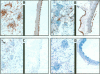
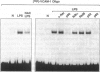
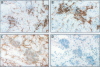
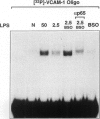
Inducible vascular cell adhesion molecule-1 (VCAM-1) in glomerular mesangial cells (GMC) exposed to lipopolysaccharide (LPS) in vitro involves the activation of nuclear factor-kappa B (NF-kappa B) and its interaction with the proximal VCAM-1 promoter. We used a murine model to assess the effect of the antioxidant, N-acetyl cysteine on GMC activation in vivo. Single intraperitoneal administration of N-acetyl cysteine completely suppressed LPS-induced VCAM-1 expression on the GMC surface. When an oligonucleotide spanning the NF-kappa B binding region of the VCAM-1 promoter was incubated with extracts from the renal cortex of LPS-treated animals, a single nucleoprotein complex formed. This complex was composed of p50 and p65, but not p52, c-Rel, or RelB, and its formation was dramatically inhibited by pretreatment with N-acetyl cysteine, D,L-Buthionine-[S,R]-sulfoximide, a compound that depletes glutathione, augmented VCAM-1 expression inducible with a suboptimal amount of LPS to levels comparable with using 50 micrograms of LPS alone, D,L-Buthionine-[S,R]-sulfoximide also potentiated the p50-p65 binding activity induced with a suboptimal amount of LPS. These data provide a redox-sensitive, transcriptional link between NF-kappa B and VCAM-1 in GMC in vivo and implicate oxidative stress as an important regulatory signal in the pathogenesis of glomerular mesangial cell disorders.
Full text
PDF


Images in this article
Selected References
These references are in PubMed. This may not be the complete list of references from this article.
- Anderson M. T., Staal F. J., Gitler C., Herzenberg L. A., Herzenberg L. A. Separation of oxidant-initiated and redox-regulated steps in the NF-kappa B signal transduction pathway. Proc Natl Acad Sci U S A. 1994 Nov 22;91(24):11527–11531. doi: 10.1073/pnas.91.24.11527. [DOI] [PMC free article] [PubMed] [Google Scholar]
- Aruoma O. I., Halliwell B., Hoey B. M., Butler J. The antioxidant action of N-acetylcysteine: its reaction with hydrogen peroxide, hydroxyl radical, superoxide, and hypochlorous acid. Free Radic Biol Med. 1989;6(6):593–597. doi: 10.1016/0891-5849(89)90066-x. [DOI] [PubMed] [Google Scholar]
- Collins T., Read M. A., Neish A. S., Whitley M. Z., Thanos D., Maniatis T. Transcriptional regulation of endothelial cell adhesion molecules: NF-kappa B and cytokine-inducible enhancers. FASEB J. 1995 Jul;9(10):899–909. [PubMed] [Google Scholar]
- Drew R., Miners J. O. The effects of buthionine sulphoximine (BSO) on glutathione depletion and xenobiotic biotransformation. Biochem Pharmacol. 1984 Oct 1;33(19):2989–2994. doi: 10.1016/0006-2952(84)90598-7. [DOI] [PubMed] [Google Scholar]
- Fries J. W., Williams A. J., Atkins R. C., Newman W., Lipscomb M. F., Collins T. Expression of VCAM-1 and E-selectin in an in vivo model of endothelial activation. Am J Pathol. 1993 Sep;143(3):725–737. [PMC free article] [PubMed] [Google Scholar]
- Khachigian L. M., Collins T., Fries J. W. Nuclear factor-kappa B mediates induction of vascular cell adhesion molecule-1 in glomerular mesangial cells. Biochem Biophys Res Commun. 1995 Jan 17;206(2):462–467. doi: 10.1006/bbrc.1995.1065. [DOI] [PubMed] [Google Scholar]
- Marui N., Offermann M. K., Swerlick R., Kunsch C., Rosen C. A., Ahmad M., Alexander R. W., Medford R. M. Vascular cell adhesion molecule-1 (VCAM-1) gene transcription and expression are regulated through an antioxidant-sensitive mechanism in human vascular endothelial cells. J Clin Invest. 1993 Oct;92(4):1866–1874. doi: 10.1172/JCI116778. [DOI] [PMC free article] [PubMed] [Google Scholar]
- Molitor J. A., Walker W. H., Doerre S., Ballard D. W., Greene W. C. NF-kappa B: a family of inducible and differentially expressed enhancer-binding proteins in human T cells. Proc Natl Acad Sci U S A. 1990 Dec;87(24):10028–10032. doi: 10.1073/pnas.87.24.10028. [DOI] [PMC free article] [PubMed] [Google Scholar]
- Morgan L. R., Holdiness M. R., Gillen L. E. N-acetylcysteine: its bioavailability and interaction with ifosfamide metabolites. Semin Oncol. 1983 Mar;10(1 Suppl 1):56–61. [PubMed] [Google Scholar]
- Müller J. M., Ziegler-Heitbrock H. W., Baeuerle P. A. Nuclear factor kappa B, a mediator of lipopolysaccharide effects. Immunobiology. 1993 Apr;187(3-5):233–256. doi: 10.1016/S0171-2985(11)80342-6. [DOI] [PubMed] [Google Scholar]
- Pendyala L., Creaven P. J. Pharmacokinetic and pharmacodynamic studies of N-acetylcysteine, a potential chemopreventive agent during a phase I trial. Cancer Epidemiol Biomarkers Prev. 1995 Apr-May;4(3):245–251. [PubMed] [Google Scholar]
- Prescott L. F., Park J., Ballantyne A., Adriaenssens P., Proudfoot A. T. Treatment of paracetamol (acetaminophen) poisoning with N-acetylcysteine. Lancet. 1977 Aug 27;2(8035):432–434. doi: 10.1016/s0140-6736(77)90612-2. [DOI] [PubMed] [Google Scholar]
- Schieven G. L., Kirihara J. M., Myers D. E., Ledbetter J. A., Uckun F. M. Reactive oxygen intermediates activate NF-kappa B in a tyrosine kinase-dependent mechanism and in combination with vanadate activate the p56lck and p59fyn tyrosine kinases in human lymphocytes. Blood. 1993 Aug 15;82(4):1212–1220. [PubMed] [Google Scholar]
- Schreck R., Meier B., Männel D. N., Dröge W., Baeuerle P. A. Dithiocarbamates as potent inhibitors of nuclear factor kappa B activation in intact cells. J Exp Med. 1992 May 1;175(5):1181–1194. doi: 10.1084/jem.175.5.1181. [DOI] [PMC free article] [PubMed] [Google Scholar]
- Schreck R., Rieber P., Baeuerle P. A. Reactive oxygen intermediates as apparently widely used messengers in the activation of the NF-kappa B transcription factor and HIV-1. EMBO J. 1991 Aug;10(8):2247–2258. doi: 10.1002/j.1460-2075.1991.tb07761.x. [DOI] [PMC free article] [PubMed] [Google Scholar]
- Schulze-Osthoff K., Beyaert R., Vandevoorde V., Haegeman G., Fiers W. Depletion of the mitochondrial electron transport abrogates the cytotoxic and gene-inductive effects of TNF. EMBO J. 1993 Aug;12(8):3095–3104. doi: 10.1002/j.1460-2075.1993.tb05978.x. [DOI] [PMC free article] [PubMed] [Google Scholar]
- Shah S. V. Role of reactive oxygen metabolites in experimental glomerular disease. Kidney Int. 1989 May;35(5):1093–1106. doi: 10.1038/ki.1989.96. [DOI] [PubMed] [Google Scholar]
- Shan Z., Tan D., Satriano J., Silbiger S., Schlondorff D. Intracellular glutathione influences collagen generation by mesangial cells. Kidney Int. 1994 Aug;46(2):388–395. doi: 10.1038/ki.1994.286. [DOI] [PubMed] [Google Scholar]
- Tetsuka T., Srivastava S. K., Morrison A. R. Tyrosine kinase inhibitors, genistein and herbimycin A, do not block interleukin-1 beta-induced activation of NF-kappa B in rat mesangial cells. Biochem Biophys Res Commun. 1996 Jan 26;218(3):808–812. doi: 10.1006/bbrc.1996.0144. [DOI] [PubMed] [Google Scholar]
- Wuthrich R. P. Vascular cell adhesion molecule-1 (VCAM-1) expression in murine lupus nephritis. Kidney Int. 1992 Oct;42(4):903–914. doi: 10.1038/ki.1992.367. [DOI] [PubMed] [Google Scholar]