



Abstract
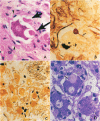
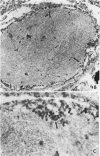
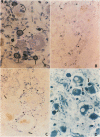
Autonomic dysfunction is an increasingly recognized problem in aging animals and man. The pathologic changes that produce autonomic dysfunction in human aging are largely unknown; however, in experimental animal models specific pathologic changes have been found in selected sympathetic ganglia. To address whether similar neuropathologic changes occur in aging humans, the authors have examined paravertebral and prevertebral sympathetic ganglia from a series of 56 adult autopsied nondiabetic patients. They found significant, specific, age-related neuropathologic lesions in the prevertebral sympathetic superior mesenteric ganglia of autopsied patients. Markedly swollen dystrophic preterminal axons compressed or displaced the perikarya of principal sympathetic neurons. Ultrastructurally, these swollen presynaptic axons contained abundant disoriented neurofilaments surrounded by peripherally marginated dense core vesicles. Immunohistochemical studies demonstrated that dystrophic axons contained tyrosine hydroxylase and neuropeptide tyrosine (NPY)-like immunoreactivity but not other neuropeptides (VIP, substance P, gastrin-releasing peptide [GRP]/bombesin, met-enkephalin). Similar to the animal models of aging, lesions were much more frequent in the prevertebral superior mesenteric ganglia than in the paravertebral superior cervical ganglia. These studies demonstrate anatomic, peptidergic, and pathologic specificity in the aging human nervous system similar in many respects to that which the authors have described in experimental animal models. Neuroaxonal dystrophy in the sympathetic nervous system may underlie poorly understood alterations in clinical autonomic nervous system function that develop with age.
Full text
PDF


Images in this article

Selected References
These references are in PubMed. This may not be the complete list of references from this article.
- Baker D. M., Santer R. M. A quantitative study of the effects of age on the noradrenergic innervation of Auerbach's plexus in the rat. Mech Ageing Dev. 1988 Feb;42(2):147–158. doi: 10.1016/0047-6374(88)90070-x. [DOI] [PubMed] [Google Scholar]
- Barnes R. F., Raskind M., Gumbrecht G., Halter J. B. The effects of age on the plasma catecholamine response to mental stress in man. J Clin Endocrinol Metab. 1982 Jan;54(1):64–69. doi: 10.1210/jcem-54-1-64. [DOI] [PubMed] [Google Scholar]
- Blakemore W. F., Cavanagh J. B. "Neuroaxonal dystrophy" occurring in an experimental "dying back" process in the rat. Brain. 1969;92(4):789–804. doi: 10.1093/brain/92.4.789. [DOI] [PubMed] [Google Scholar]
- Collins K. J., Dore C., Exton-Smith A. N., Fox R. H., MacDonald I. C., Woodward P. M. Accidental hypothermia and impaired temperature homoeostasis in the elderly. Br Med J. 1977 Feb 5;1(6057):353–356. doi: 10.1136/bmj.1.6057.353. [DOI] [PMC free article] [PubMed] [Google Scholar]
- Duchen L. W., Anjorin A., Watkins P. J., Mackay J. D. Pathology of autonomic neuropathy in diabetes mellitus. Ann Intern Med. 1980 Feb;92(2 Pt 2):301–303. doi: 10.7326/0003-4819-92-2-301. [DOI] [PubMed] [Google Scholar]
- Fiorica V. Plasma norepinephrine levels of elderly men on a controlled sodium intake diet. J Am Geriatr Soc. 1984 Aug;32(8):576–580. doi: 10.1111/j.1532-5415.1984.tb06135.x. [DOI] [PubMed] [Google Scholar]
- Geboes K., Bossaert H. Gastrointestinal disorders in old age. Age Ageing. 1977 Nov;6(4):197–200. doi: 10.1093/ageing/6.4.197. [DOI] [PubMed] [Google Scholar]
- Helén P. Fine-structural and degenerative features in adult and aged human sympathetic ganglion cells. Mech Ageing Dev. 1983 Oct;23(2):161–175. doi: 10.1016/0047-6374(83)90065-9. [DOI] [PubMed] [Google Scholar]
- Helén P., Zeitlin R., Hervonen A. Mitochondrial accumulations in nerve fibres of human sympathetic ganglia. Cell Tissue Res. 1980;207(3):491–498. doi: 10.1007/BF00224622. [DOI] [PubMed] [Google Scholar]
- Herman M. M., Huttenlocher P. R., Bensch K. G. Electron microscopic observations in infantile neuroaxonal dystrophy. Report of a cortical biopsy and review of the recent literature. Arch Neurol. 1969 Jan;20(1):19–34. doi: 10.1001/archneur.1969.00480070029004. [DOI] [PubMed] [Google Scholar]
- Johnson E. M., Jr, O'Brien F., Werbitt R. Modification and characterization of the permanent sympathectomy produced by the administration of guanethidine to newborn rats. Eur J Pharmacol. 1976 May;37(1):45–54. doi: 10.1016/0014-2999(76)90006-6. [DOI] [PubMed] [Google Scholar]
- Kreulen D. L. Integration in autonomic ganglia. Physiologist. 1984 Feb;27(1):49–55. [PubMed] [Google Scholar]
- Kuntz A. Histological variations in autonomic ganglia and ganglion cells associated with age and disease. Am J Pathol. 1938 Nov;14(6):783–796.3. [PMC free article] [PubMed] [Google Scholar]
- LAMPERT P., BLUMBERG J. M., PENTSCHEW A. AN ELECTRON MICROSCOPIC STUDY OF DYSTROPHIC AXONS IN THE GRACILE AND CUNEATE NUCLEI OF VITAMIN E-DEFICIENT RATS. J Neuropathol Exp Neurol. 1964 Jan;23:60–77. doi: 10.1097/00005072-196401000-00005. [DOI] [PubMed] [Google Scholar]
- Linares O. A., Halter J. B. Sympathochromaffin system activity in the elderly. J Am Geriatr Soc. 1987 May;35(5):448–453. doi: 10.1111/j.1532-5415.1987.tb04667.x. [DOI] [PubMed] [Google Scholar]
- Llewellyn-Smith I. J. Neuropeptides and the microcircuitry of the enteric nervous system. Experientia. 1987 Jul 15;43(7):813–821. doi: 10.1007/BF01945359. [DOI] [PubMed] [Google Scholar]
- Lundberg J. M., Terenius L., Hökfelt T., Goldstein M. High levels of neuropeptide Y in peripheral noradrenergic neurons in various mammals including man. Neurosci Lett. 1983 Dec 2;42(2):167–172. doi: 10.1016/0304-3940(83)90401-9. [DOI] [PubMed] [Google Scholar]
- Marley P., Livett B. G. Neuropeptides in the autonomic nervous system. CRC Crit Rev Clin Neurobiol. 1985;1(3):201–283. [PubMed] [Google Scholar]
- Palmer G. J., Ziegler M. G., Lake C. R. Response of norepinephrine and blood pressure to stress increases with age. J Gerontol. 1978 Jul;33(4):482–487. doi: 10.1093/geronj/33.4.482. [DOI] [PubMed] [Google Scholar]
- Partanen M., Waller S. B., London E. D., Hervonen A. Indices of neurotransmitter synthesis and release in aging sympathetic nervous system. Neurobiol Aging. 1985 Fall;6(3):227–232. doi: 10.1016/0197-4580(85)90054-5. [DOI] [PubMed] [Google Scholar]
- Pfeifer M. A., Weinberg C. R., Cook D., Best J. D., Reenan A., Halter J. B. Differential changes of autonomic nervous system function with age in man. Am J Med. 1983 Aug;75(2):249–258. doi: 10.1016/0002-9343(83)91201-9. [DOI] [PubMed] [Google Scholar]
- Reaven G. M., Reaven E. P. Age, glucose intolerance, and non-insulin-dependent diabetes mellitus. J Am Geriatr Soc. 1985 Apr;33(4):286–290. doi: 10.1111/j.1532-5415.1985.tb07118.x. [DOI] [PubMed] [Google Scholar]
- Reis D. J., Ross R. A., Joh T. H. Changes in the activity and amounts of enzymes synthesizing catecholamines and acetylcholine in brain, adrenal medulla, and sympathetic ganglia of aged rat and mouse. Brain Res. 1977 Nov 18;136(3):465–474. doi: 10.1016/0006-8993(77)90071-3. [DOI] [PubMed] [Google Scholar]
- Roots B. I. Neurofilament accumulation induced in synapses by leupeptin. Science. 1983 Sep 2;221(4614):971–972. doi: 10.1126/science.6192501. [DOI] [PubMed] [Google Scholar]
- Rowe J. W., Troen B. R. Sympathetic nervous system and aging in man. Endocr Rev. 1980 Spring;1(2):167–179. doi: 10.1210/edrv-1-2-167. [DOI] [PubMed] [Google Scholar]
- Sahenk Z., Mendell J. R. Axoplasmic transport in zinc pyridinethione neuropathy: evidence for an abnormality in distal turn-around. Brain Res. 1980 Mar 31;186(2):343–353. doi: 10.1016/0006-8993(80)90980-4. [DOI] [PubMed] [Google Scholar]
- Sahenk Z., Mendell J. R. Ultrastructural study of zinc pyridinethione-induced peripheral neuropathy. J Neuropathol Exp Neurol. 1979 Sep;38(5):532–550. doi: 10.1097/00005072-197909000-00007. [DOI] [PubMed] [Google Scholar]
- Sandbank U., Lerman P., Geifman M. Infantile neuroaxonal dystrophy: cortical axonic and presynaptic changes. Acta Neuropathol. 1970;16(4):342–352. doi: 10.1007/BF00686897. [DOI] [PubMed] [Google Scholar]
- Santer R. M. Fluorescence histochemical evidence for decreased noradrenaline synthesis in sympathetic neurones of aged rats. Neurosci Lett. 1979 Dec;15(2-3):177–180. doi: 10.1016/0304-3940(79)96109-3. [DOI] [PubMed] [Google Scholar]
- Santer R. M., Partanen M., Hervonen A. Glyoxylic acid fluorescence and ultrastructural studies of neurones in the coeliac-superior mesenteric ganglion of the aged rat. Cell Tissue Res. 1980;211(3):475–485. doi: 10.1007/BF00234401. [DOI] [PubMed] [Google Scholar]
- Schmidt R. E., McAtee S. J., Plurad D. A., Parvin C. A., Cogswell B. E., Roth K. A. Differential susceptibility of prevertebral and paravertebral sympathetic ganglia to experimental injury. Brain Res. 1988 Sep 20;460(2):214–226. doi: 10.1016/0006-8993(88)90366-6. [DOI] [PubMed] [Google Scholar]
- Schmidt R. E., Plurad D. A., Plurad S. B., Cogswell B. E., Diani A. R., Roth K. A. Ultrastructural and immunohistochemical characterization of autonomic neuropathy in genetically diabetic Chinese hamsters. Lab Invest. 1989 Jul;61(1):77–92. [PubMed] [Google Scholar]
- Schmidt R. E., Plurad D. A., Roth K. A. Effects of chronic experimental streptozotocin-induced diabetes on the noradrenergic and peptidergic innervation of the rat alimentary tract. Brain Res. 1988 Aug 23;458(2):353–360. doi: 10.1016/0006-8993(88)90478-7. [DOI] [PubMed] [Google Scholar]
- Schmidt R. E., Plurad S. B., Modert C. W. Neuroaxonal dystrophy in the autonomic ganglia of aged rats. J Neuropathol Exp Neurol. 1983 Jul;42(4):376–390. doi: 10.1097/00005072-198307000-00002. [DOI] [PubMed] [Google Scholar]
- Schmidt R. E., Plurad S. B., Olack B. J., Scharp D. W. The effect of pancreatic islet transplantation and insulin therapy on experimental diabetic autonomic neuropathy. Diabetes. 1983 Jun;32(6):532–540. doi: 10.2337/diab.32.6.532. [DOI] [PubMed] [Google Scholar]
- Schmidt R. E., Plurad S. B. Ultrastructural and biochemical characterization of autonomic neuropathy in rats with chronic streptozotocin diabetes. J Neuropathol Exp Neurol. 1986 Sep;45(5):525–544. doi: 10.1097/00005072-198609000-00004. [DOI] [PubMed] [Google Scholar]
- Sejnowski T. J. Peptidergic synaptic transmission in sympathetic ganglia. Fed Proc. 1982 Nov;41(13):2923–2928. [PubMed] [Google Scholar]
- Sotelo C., Palay S. L. Altered axons and axon terminals in the lateral vestibular nucleus of the rat. Possible example of axonal remodeling. Lab Invest. 1971 Dec;25(6):653–671. [PubMed] [Google Scholar]
- Szurszewski J. H. Physiology of mammalian prevertebral ganglia. Annu Rev Physiol. 1981;43:53–68. doi: 10.1146/annurev.ph.43.030181.000413. [DOI] [PubMed] [Google Scholar]
- Varga F. Transit time changes with age in the gastrointestinal tract of the rat. Digestion. 1976;14(4):319–324. doi: 10.1159/000197947. [DOI] [PubMed] [Google Scholar]
- Yagihashi S., Sima A. A. Diabetic autonomic neuropathy. The distribution of structural changes in sympathetic nerves of the BB rat. Am J Pathol. 1985 Oct;121(1):138–147. [PMC free article] [PubMed] [Google Scholar]
- Young J. B., Rowe J. W., Pallotta J. A., Sparrow D., Landsberg L. Enhanced plasma norepinephrine response to upright posture and oral glucose administration in elderly human subjects. Metabolism. 1980 Jun;29(6):532–539. doi: 10.1016/0026-0495(80)90078-5. [DOI] [PubMed] [Google Scholar]
- Zaimis E., Berk L., Callingham B. A. Morphological, biochemical and functional changes in the sympathetic nervous system of rats treated with nerve growth factor-antiserum. Nature. 1965 Jun 19;206(990):1220–1222. doi: 10.1038/2061220a0. [DOI] [PubMed] [Google Scholar]
- Ziegler M. G., Lake C. R., Kopin I. J. Plasma noradrenaline increases with age. Nature. 1976 May 27;261(5558):333–335. doi: 10.1038/261333a0. [DOI] [PubMed] [Google Scholar]