



Abstract
A number of 1'-substituted 9-anilinoacridines were evaluated for their activities against promastigote and amastigote forms of Leishmania major and for their toxicities to human Jurkat leukemia cells. Several compounds possessing 1'-NH-alkyl substituents produced more than 80% growth inhibition of macrophage-infected L. major amastigotes at or below a concentration of 1 microM. 1'-Hexylamino-9-anilinoacridine (compound 14) was the least toxic compound to human Jurkat cells, while it retained strong antileishmanial activity. There was a general trend for the more lipophilic compounds to show the greatest antileishmanial activity, whereas 3,6-di-NH2 substitution of the acridine nucleus reduced or eliminated activity. Some structure-activity relationships of the various compounds are discussed.
Full text
PDF


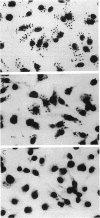
Images in this article
Selected References
These references are in PubMed. This may not be the complete list of references from this article.
- Arlin Z. A. Current status of amsacrine (AMSA) combination chemotherapy programs in acute leukemia. Cancer Treat Rep. 1983 Nov;67(11):967–970. [PubMed] [Google Scholar]
- Ashford R. W., Desjeux P., Deraadt P. Estimation of population at risk of infection and number of cases of Leishmaniasis. Parasitol Today. 1992 Mar;8(3):104–105. doi: 10.1016/0169-4758(92)90249-2. [DOI] [PubMed] [Google Scholar]
- Baguley B. C., Holdaway K. M., Fray L. M. Design of DNA intercalators to overcome topoisomerase II-mediated multidrug resistance. J Natl Cancer Inst. 1990 Mar 7;82(5):398–402. doi: 10.1093/jnci/82.5.398. [DOI] [PubMed] [Google Scholar]
- Behin R., Mauel J., Sordat B. Leishmania tropica: pathogenicity and in vitro macrophage function in strains of inbred mice. Exp Parasitol. 1979 Aug;48(1):81–91. doi: 10.1016/0014-4894(79)90057-2. [DOI] [PubMed] [Google Scholar]
- Berens R. L., Marr J. J. An easily prepared defined medium for cultivation of Leishmania donovani promastigotes. J Parasitol. 1978 Feb;64(1):160–160. [PubMed] [Google Scholar]
- Chakraborty A. K., Majumder H. K. Mode of action of pentavalent antimonials: specific inhibition of type I DNA topoisomerase of Leishmania donovani. Biochem Biophys Res Commun. 1988 Apr 29;152(2):605–611. doi: 10.1016/s0006-291x(88)80081-0. [DOI] [PubMed] [Google Scholar]
- Croft S. L., Hogg J. Limited activity of bacterial DNA topoisomerase II inhibitors against Leishmania donovani and Trypanosoma cruzi amastigotes in vitro. Trans R Soc Trop Med Hyg. 1988;82(6):856–856. doi: 10.1016/0035-9203(88)90017-x. [DOI] [PubMed] [Google Scholar]
- Douc-Rasy S., Riou J. F., Ahomadegbe J. C., Riou G. ATP-independent DNA topoisomerase II as potential drug target in trypanosomes. Biol Cell. 1988;64(2):145–156. doi: 10.1016/0248-4900(88)90074-3. [DOI] [PubMed] [Google Scholar]
- Figgitt D., Denny W., Chavalitshewinkoon P., Wilairat P., Ralph R. In vitro study of anticancer acridines as potential antitrypanosomal and antimalarial agents. Antimicrob Agents Chemother. 1992 Aug;36(8):1644–1647. doi: 10.1128/aac.36.8.1644. [DOI] [PMC free article] [PubMed] [Google Scholar]
- Finlay G. J., Baguley B. C., Snow K., Judd W. Multiple patterns of resistance of human leukemia cell sublines to amsacrine analogues. J Natl Cancer Inst. 1990 Apr 18;82(8):662–667. doi: 10.1093/jnci/82.8.662. [DOI] [PubMed] [Google Scholar]
- Harvey V. J., Hardy J. R., Smith S., Grove W., Baguley B. C. Phase II study of the amsacrine analogue CI-921 (NSC 343499) in non-small cell lung cancer. Eur J Cancer. 1991;27(12):1617–1620. doi: 10.1016/0277-5379(91)90427-f. [DOI] [PubMed] [Google Scholar]
- Jehn U., Heinemann V. New drugs in the treatment of acute and chronic leukemia with some emphasis on m-AMSA. Anticancer Res. 1991 Mar-Apr;11(2):705–711. [PubMed] [Google Scholar]
- Liu L. F. DNA topoisomerase poisons as antitumor drugs. Annu Rev Biochem. 1989;58:351–375. doi: 10.1146/annurev.bi.58.070189.002031. [DOI] [PubMed] [Google Scholar]
- Mauel J. Intracellular parasite killing induced by electron carriers. I. Effect of electron carriers on intracellular Leishmania spp. in macrophages from different genetic backgrounds. Mol Biochem Parasitol. 1984 Sep;13(1):83–96. doi: 10.1016/0166-6851(84)90103-8. [DOI] [PubMed] [Google Scholar]
- Meerpohl H. G., Lohmann-Matthes M. L., Fischer H. Studies on the activation of mouse bone marrow-derived macrophages by the macrophage cytotoxicity factor (MCF). Eur J Immunol. 1976 Mar;6(3):213–217. doi: 10.1002/eji.1830060313. [DOI] [PubMed] [Google Scholar]
- Miller L. P., Pyesmany A. F., Wolff L. J., Rogers P. C., Siegel S. E., Wells R. J., Buckley J. D., Hammond G. D. Successful reinduction therapy with amsacrine and cyclocytidine in acute nonlymphoblastic leukemia in children. A report from the Childrens Cancer Study Group. Cancer. 1991 May 1;67(9):2235–2240. doi: 10.1002/1097-0142(19910501)67:9<2235::aid-cncr2820670904>3.0.co;2-2. [DOI] [PubMed] [Google Scholar]
- Rewcastle G. W., Baguley B. C., Atwell G. J., Denny W. A. Potential antitumor agents. 52. Carbamate analogues of amsacrine with in vivo activity against multidrug-resistant P388 leukemia. J Med Chem. 1987 Sep;30(9):1576–1581. doi: 10.1021/jm00392a009. [DOI] [PubMed] [Google Scholar]
- Werbovetz K. A., Lehnert E. K., Macdonald T. L., Pearson R. D. Cytotoxicity of acridine compounds for Leishmania promastigotes in vitro. Antimicrob Agents Chemother. 1992 Feb;36(2):495–497. doi: 10.1128/aac.36.2.495. [DOI] [PMC free article] [PubMed] [Google Scholar]