



Abstract
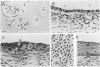
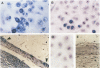
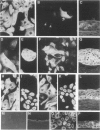
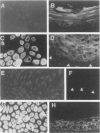
We have previously shown that cultured normal human endocervical cells (HENs) form epithelium resembling squamous metaplasia in vivo. To analyze the cellular origin of squamous metaplasia, the cytokeratin and mucin expression and morphological features of HENs in monolayer cultures and in implants beneath the skin of nude mice were examined. Primary HENs had two distinct morphological phenotypes in vitro pleomorphic epithelial cells and keratinocytelike cells. Using a panel of monoclonal antibodies for various cytokeratins (CKs), we observed that the pleomorphic cells, which were the primary outgrowths, expressed CK7 and CK18 and produced mucin, suggesting their origin to be the mucosecretory columnar cells (CCs) of the endocervix. Keratinocytelike cells were observed in proximity of the CC-like cells after a few days of HEN culture. Interestingly, these cells were homogeneously negative for CK7 expression, as for native reserve cells (RCs), and homogeneously positive for CK13 expression with the antibody that is specific for RCs. During early passages, the culture consisted mostly of the RC-like keratinocytelike cells, and in the late passages, the CC-like cells were predominant. HEN implants in nude mice morphologically formed epithelia similar to immature squamous metaplasia and showed variable CK18 expression. Moreover, they showed homogeneous CK13 expression throughout all layers and expressed mucin and CK7 in the suprabasal cells. The possibility that the HEN culture was originally a mixed population of CCs and RCs, that we failed to detect, cannot be eliminated. Our results support the more likely view that the endocervical simple epithelia, which form squamous metaplasia, are bipotential cells and undergo differentiation readily and reversibly to give rise to CC-like and RC-like cells in culture.
Full text
PDF


Images in this article
Selected References
These references are in PubMed. This may not be the complete list of references from this article.
- Barrandon Y., Li V., Green H. New techniques for the grafting of cultured human epidermal cells onto athymic animals. J Invest Dermatol. 1988 Oct;91(4):315–318. doi: 10.1111/1523-1747.ep12475646. [DOI] [PubMed] [Google Scholar]
- Czernobilsky B., Moll R., Franke W. W., Dallenbach-Hellweg G., Hohlweg-Majert P. Intermediate filaments of normal and neoplastic tissues of the female genital tract with emphasis on problems of differential tumor diagnosis. Pathol Res Pract. 1984 Sep;179(1):31–37. doi: 10.1016/S0344-0338(84)80058-8. [DOI] [PubMed] [Google Scholar]
- FLUHMANN C. F. Comparative studies of squamous metaplasia of the cervix uteri and endometrium. Am J Obstet Gynecol. 1954 Dec;68(6):1447–1463. doi: 10.1016/0002-9378(54)90296-3. [DOI] [PubMed] [Google Scholar]
- Gigi-Leitner O., Geiger B., Levy R., Czernobilsky B. Cytokeratin expression in squamous metaplasia of the human uterine cervix. Differentiation. 1986;31(3):191–205. doi: 10.1111/j.1432-0436.1986.tb00400.x. [DOI] [PubMed] [Google Scholar]
- Hiersche H. D., Nagl W. Regeneration of secretory epithelium in the human endocervix. Arch Gynecol. 1980;229(2):83–90. doi: 10.1007/BF02109947. [DOI] [PubMed] [Google Scholar]
- Ivanyi D., Groeneveld E., Van Doornewaard G., Mooi W. J., Hageman P. C. Keratin subtypes in carcinomas of the uterine cervix: implications for histogenesis and differential diagnosis. Cancer Res. 1990 Aug 15;50(16):5143–5152. [PubMed] [Google Scholar]
- Levy R., Czernobilsky B., Geiger B. Subtyping of epithelial cells of normal and metaplastic human uterine cervix, using polypeptide-specific cytokeratin antibodies. Differentiation. 1988 Dec;39(3):185–196. doi: 10.1111/j.1432-0436.1988.tb00093.x. [DOI] [PubMed] [Google Scholar]
- Lugo M., Putong P. B. Metaplasia. An overview. Arch Pathol Lab Med. 1984 Mar;108(3):185–189. [PubMed] [Google Scholar]
- Moll R., Franke W. W., Schiller D. L., Geiger B., Krepler R. The catalog of human cytokeratins: patterns of expression in normal epithelia, tumors and cultured cells. Cell. 1982 Nov;31(1):11–24. doi: 10.1016/0092-8674(82)90400-7. [DOI] [PubMed] [Google Scholar]
- Schürch W., McDowell E. M., Trump B. F. Long-term organ culture of human uterine endocervix. Cancer Res. 1978 Nov;38(11 Pt 1):3723–3733. [PubMed] [Google Scholar]
- Smedts F., Ramaekers F., Robben H., Pruszczynski M., van Muijen G., Lane B., Leigh I., Vooijs P. Changing patterns of keratin expression during progression of cervical intraepithelial neoplasia. Am J Pathol. 1990 Mar;136(3):657–668. [PMC free article] [PubMed] [Google Scholar]
- Smedts F., Ramaekers F., Troyanovsky S., Pruszczynski M., Robben H., Lane B., Leigh I., Plantema F., Vooijs P. Basal-cell keratins in cervical reserve cells and a comparison to their expression in cervical intraepithelial neoplasia. Am J Pathol. 1992 Mar;140(3):601–612. [PMC free article] [PubMed] [Google Scholar]
- Stegner H. E. Precursors of cervical cancer: ultrastructural morphology. Curr Top Pathol. 1981;70:171–193. doi: 10.1007/978-3-642-68185-1_7. [DOI] [PubMed] [Google Scholar]
- Sun Q., Tsutsumi K., Kelleher M. B., Pater A., Pater M. M. Squamous metaplasia of normal and carcinoma in situ of HPV 16-immortalized human endocervical cells. Cancer Res. 1992 Aug 1;52(15):4254–4260. [PubMed] [Google Scholar]
- Tsutsumi K., Belaguli N., Qi S., Michalak T. I., Gulliver W. P., Pater A., Pater M. M. Human papillomavirus 16 DNA immortalizes two types of normal human epithelial cells of the uterine cervix. Am J Pathol. 1992 Feb;140(2):255–261. [PMC free article] [PubMed] [Google Scholar]
- Turyk M. E., Golub T. R., Wood N. B., Hawkins J. L., Wilbanks G. D. Growth and characterization of epithelial cells from normal human uterine ectocervix and endocervix. In Vitro Cell Dev Biol. 1989 Jun;25(6):544–556. doi: 10.1007/BF02623567. [DOI] [PubMed] [Google Scholar]
- Weikel W., Wagner R., Moll R. Characterization of subcolumnar reserve cells and other epithelia of human uterine cervix. Demonstration of diverse cytokeratin polypeptides in reserve cells. Virchows Arch B Cell Pathol Incl Mol Pathol. 1987;54(2):98–110. doi: 10.1007/BF02899201. [DOI] [PubMed] [Google Scholar]
- Woodworth C. D., Bowden P. E., Doniger J., Pirisi L., Barnes W., Lancaster W. D., DiPaolo J. A. Characterization of normal human exocervical epithelial cells immortalized in vitro by papillomavirus types 16 and 18 DNA. Cancer Res. 1988 Aug 15;48(16):4620–4628. [PubMed] [Google Scholar]
- Woodworth C. D., Waggoner S., Barnes W., Stoler M. H., DiPaolo J. A. Human cervical and foreskin epithelial cells immortalized by human papillomavirus DNAs exhibit dysplastic differentiation in vivo. Cancer Res. 1990 Jun 15;50(12):3709–3715. [PubMed] [Google Scholar]
- zur Hausen H. Human papillomaviruses in the pathogenesis of anogenital cancer. Virology. 1991 Sep;184(1):9–13. doi: 10.1016/0042-6822(91)90816-t. [DOI] [PubMed] [Google Scholar]