



Abstract
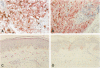
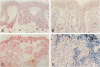
Basic fibroblast growth factor (bFGF) is an angiogenic and mitogenic polypeptide produced by diverse cell types including cell lines derived from malignant melanomas but not from normal melanocytes. However, there is no consensus concerning in vivo expression of bFGF in melanocytic lesions due in part to the small numbers of cases studied to date. To evaluate further the possible differential expression of bFGF in melanocytic lesions, we examined 110 formalin-fixed, paraffin-embedded metastatic and primary invasive melanomas, melanomas in situ, nevi with architectural disorder and cytological atypia, and ordinary benign melanocyte nevi by nucleic acid in situ hybridization. All metastatic and primary invasive melanomas studied expressed bFGF mRNA, whereas melanomas in situ and benign melanocyte nevi were negative. Melanomas in situ with features of tumor regression and a majority of nevi with architectural disorder and cytological atypia also contained bFGF mrNA. The results suggest that in vivo bFGF expression is not requisite for malignant transformation per se, but appears to correlate more with invasion or fibroblastic reactions adjacent to the melanocyte lesions.
Full text
PDF


Images in this article
Selected References
These references are in PubMed. This may not be the complete list of references from this article.
- Albino A. P., Davis B. M., Nanus D. M. Induction of growth factor RNA expression in human malignant melanoma: markers of transformation. Cancer Res. 1991 Sep 15;51(18):4815–4820. [PubMed] [Google Scholar]
- Baird A., Esch F., Mormède P., Ueno N., Ling N., Böhlen P., Ying S. Y., Wehrenberg W. B., Guillemin R. Molecular characterization of fibroblast growth factor: distribution and biological activities in various tissues. Recent Prog Horm Res. 1986;42:143–205. doi: 10.1016/b978-0-12-571142-5.50008-2. [DOI] [PubMed] [Google Scholar]
- Becker D., Meier C. B., Herlyn M. Proliferation of human malignant melanomas is inhibited by antisense oligodeoxynucleotides targeted against basic fibroblast growth factor. EMBO J. 1989 Dec 1;8(12):3685–3691. doi: 10.1002/j.1460-2075.1989.tb08543.x. [DOI] [PMC free article] [PubMed] [Google Scholar]
- Bishop J. M. The molecular genetics of cancer. Science. 1987 Jan 16;235(4786):305–311. doi: 10.1126/science.3541204. [DOI] [PubMed] [Google Scholar]
- Bucana C. D., Radinsky R., Dong Z., Sanchez R., Brigati D. J., Fidler I. J. A rapid colorimetric in situ mRNA hybridization technique using hyperbiotinylated oligonucleotide probes for analysis of mdr1 in mouse colon carcinoma cells. J Histochem Cytochem. 1993 Apr;41(4):499–506. doi: 10.1177/41.4.8095509. [DOI] [PubMed] [Google Scholar]
- Burgess W. H., Maciag T. The heparin-binding (fibroblast) growth factor family of proteins. Annu Rev Biochem. 1989;58:575–606. doi: 10.1146/annurev.bi.58.070189.003043. [DOI] [PubMed] [Google Scholar]
- Cook A. F., Vuocolo E., Brakel C. L. Synthesis and hybridization of a series of biotinylated oligonucleotides. Nucleic Acids Res. 1988 May 11;16(9):4077–4095. doi: 10.1093/nar/16.9.4077. [DOI] [PMC free article] [PubMed] [Google Scholar]
- Dotto G. P., Moellmann G., Ghosh S., Edwards M., Halaban R. Transformation of murine melanocytes by basic fibroblast growth factor cDNA and oncogenes and selective suppression of the transformed phenotype in a reconstituted cutaneous environment. J Cell Biol. 1989 Dec;109(6 Pt 1):3115–3128. doi: 10.1083/jcb.109.6.3115. [DOI] [PMC free article] [PubMed] [Google Scholar]
- Fleming M. G., Howe S. F., Candel A. G. Immunohistochemical localization of cytokines in nevi. Am J Dermatopathol. 1992 Dec;14(6):496–503. doi: 10.1097/00000372-199212000-00002. [DOI] [PubMed] [Google Scholar]
- Folkman J., Klagsbrun M. Angiogenic factors. Science. 1987 Jan 23;235(4787):442–447. doi: 10.1126/science.2432664. [DOI] [PubMed] [Google Scholar]
- Gospodarowicz D., Ferrara N., Schweigerer L., Neufeld G. Structural characterization and biological functions of fibroblast growth factor. Endocr Rev. 1987 May;8(2):95–114. doi: 10.1210/edrv-8-2-95. [DOI] [PubMed] [Google Scholar]
- Goustin A. S., Leof E. B., Shipley G. D., Moses H. L. Growth factors and cancer. Cancer Res. 1986 Mar;46(3):1015–1029. [PubMed] [Google Scholar]
- Gruber S. B., Barnhill R. L., Stenn K. S., Roush G. C. Nevomelanocytic proliferations in association with cutaneous malignant melanoma: a multivariate analysis. J Am Acad Dermatol. 1989 Oct;21(4 Pt 1):773–780. doi: 10.1016/s0190-9622(89)70253-x. [DOI] [PubMed] [Google Scholar]
- Halaban R., Ghosh S., Baird A. bFGF is the putative natural growth factor for human melanocytes. In Vitro Cell Dev Biol. 1987 Jan;23(1):47–52. doi: 10.1007/BF02623492. [DOI] [PubMed] [Google Scholar]
- Halaban R., Kwon B. S., Ghosh S., Delli Bovi P., Baird A. bFGF as an autocrine growth factor for human melanomas. Oncogene Res. 1988 Sep;3(2):177–186. [PubMed] [Google Scholar]
- Halaban R., Langdon R., Birchall N., Cuono C., Baird A., Scott G., Moellmann G., McGuire J. Basic fibroblast growth factor from human keratinocytes is a natural mitogen for melanocytes. J Cell Biol. 1988 Oct;107(4):1611–1619. doi: 10.1083/jcb.107.4.1611. [DOI] [PMC free article] [PubMed] [Google Scholar]
- Iezzoni J. C., Kang J. H., Montone K. T., Reed J. A., Brigati D. J. Colorimetric detection of herpes simplex virus by DNA in situ sandwich hybridization: a rapid, formamide-free, random oligomer-enhanced method. Nucleic Acids Res. 1992 Mar 11;20(5):1149–1150. doi: 10.1093/nar/20.5.1149. [DOI] [PMC free article] [PubMed] [Google Scholar]
- Kikkawa U., Kishimoto A., Nishizuka Y. The protein kinase C family: heterogeneity and its implications. Annu Rev Biochem. 1989;58:31–44. doi: 10.1146/annurev.bi.58.070189.000335. [DOI] [PubMed] [Google Scholar]
- NIH Consensus conference. Diagnosis and treatment of early melanoma. JAMA. 1992 Sep 9;268(10):1314–1319. doi: 10.1001/jama.1992.03490100112037. [DOI] [PubMed] [Google Scholar]
- Prats H., Kaghad M., Prats A. C., Klagsbrun M., Lélias J. M., Liauzun P., Chalon P., Tauber J. P., Amalric F., Smith J. A. High molecular mass forms of basic fibroblast growth factor are initiated by alternative CUG codons. Proc Natl Acad Sci U S A. 1989 Mar;86(6):1836–1840. doi: 10.1073/pnas.86.6.1836. [DOI] [PMC free article] [PubMed] [Google Scholar]
- Radinsky R., Bucana C. D., Ellis L. M., Sanchez R., Cleary K. R., Brigati D. J., Fidler I. J. A rapid colorimetric in situ messenger RNA hybridization technique for analysis of epidermal growth factor receptor in paraffin-embedded surgical specimens of human colon carcinomas. Cancer Res. 1993 Mar 1;53(5):937–943. [PubMed] [Google Scholar]
- Reed J. A., Manahan L. J., Park C. S., Brigati D. J. Complete one-hour immunocytochemistry based on capillary action. Biotechniques. 1992 Sep;13(3):434–443. [PubMed] [Google Scholar]
- Rodeck U., Melber K., Kath R., Menssen H. D., Varello M., Atkinson B., Herlyn M. Constitutive expression of multiple growth factor genes by melanoma cells but not normal melanocytes. J Invest Dermatol. 1991 Jul;97(1):20–26. doi: 10.1111/1523-1747.ep12477822. [DOI] [PubMed] [Google Scholar]
- Rogelj S., Weinberg R. A., Fanning P., Klagsbrun M. Basic fibroblast growth factor fused to a signal peptide transforms cells. Nature. 1988 Jan 14;331(6152):173–175. doi: 10.1038/331173a0. [DOI] [PubMed] [Google Scholar]
- Schulze-Osthoff K., Risau W., Vollmer E., Sorg C. In situ detection of basic fibroblast growth factor by highly specific antibodies. Am J Pathol. 1990 Jul;137(1):85–92. [PMC free article] [PubMed] [Google Scholar]
- Scott G., Stoler M., Sarkar S., Halaban R. Localization of basic fibroblast growth factor mRNA in melanocytic lesions by in situ hybridization. J Invest Dermatol. 1991 Mar;96(3):318–322. doi: 10.1111/1523-1747.ep12465203. [DOI] [PubMed] [Google Scholar]
- Slamon D. J., deKernion J. B., Verma I. M., Cline M. J. Expression of cellular oncogenes in human malignancies. Science. 1984 Apr 20;224(4646):256–262. doi: 10.1126/science.6538699. [DOI] [PubMed] [Google Scholar]
- Story M. T. Cultured human foreskin fibroblasts produce a factor that stimulates their growth with properties similar to basic fibroblast growth factor. In Vitro Cell Dev Biol. 1989 May;25(5):402–408. doi: 10.1007/BF02624624. [DOI] [PubMed] [Google Scholar]
- Thomas K. A. Fibroblast growth factors. FASEB J. 1987 Dec;1(6):434–440. doi: 10.1096/fasebj.1.6.3315806. [DOI] [PubMed] [Google Scholar]
- Weinberg R. A. Oncogenes, antioncogenes, and the molecular bases of multistep carcinogenesis. Cancer Res. 1989 Jul 15;49(14):3713–3721. [PubMed] [Google Scholar]