



Abstract
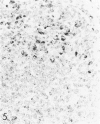
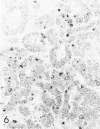
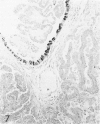
The localization of surfactant apoprotein (SAP) and the Clara cell antigen(s) (CCA) was studied in naturally occurring and experimentally induced pulmonary hyperplasias and neoplasms by avidin-biotin peroxidase complex (ABC) immunocytochemistry. Lungs of B6C3F1 and A strain mice with naturally occurring lesions, B6C3F1 mice given injections of N-nitrosodiethylamine (DEN), BALB/c nu/nu or nu/+ mice exposed transplacentally on Day 16 of gestation to ethylnitrosourea (ENU), or BALB/c nu/+ mice exposed to ENU at 8-12 weeks of age were preserved in formalin or Bouin's fixative. After ABC immunocytochemistry, SAP was found in the cytoplasm of normal alveolar Type II cells; in the majority of cells in focal alveolar and solid hyperplasias originating in peribronchiolar or peripheral locations; and in solid, tubular, papillary, and mixed adenomas and carcinomas. The larger mixed-pattern neoplasms and small or large tubular neoplasms usually had the least number of cells with SAP. The majority of large papillary adenomas and carcinomas in BALB/c mice exposed to ENU and in untreated A strain mice contained SAP in the nuclei of many neoplastic cells but only in the cytoplasm of a few neoplastic cells. CCA was found in normal Clara cells of bronchi and bronchioles but not in any hyperplastic or neoplastic lesion of any mouse studied. This study provided immunocytochemical evidence that the vast majority of naturally occurring and experimentally induced pulmonary neoplasms of mice are alveolar Type II cell adenomas and carcinomas.
Full text
PDF

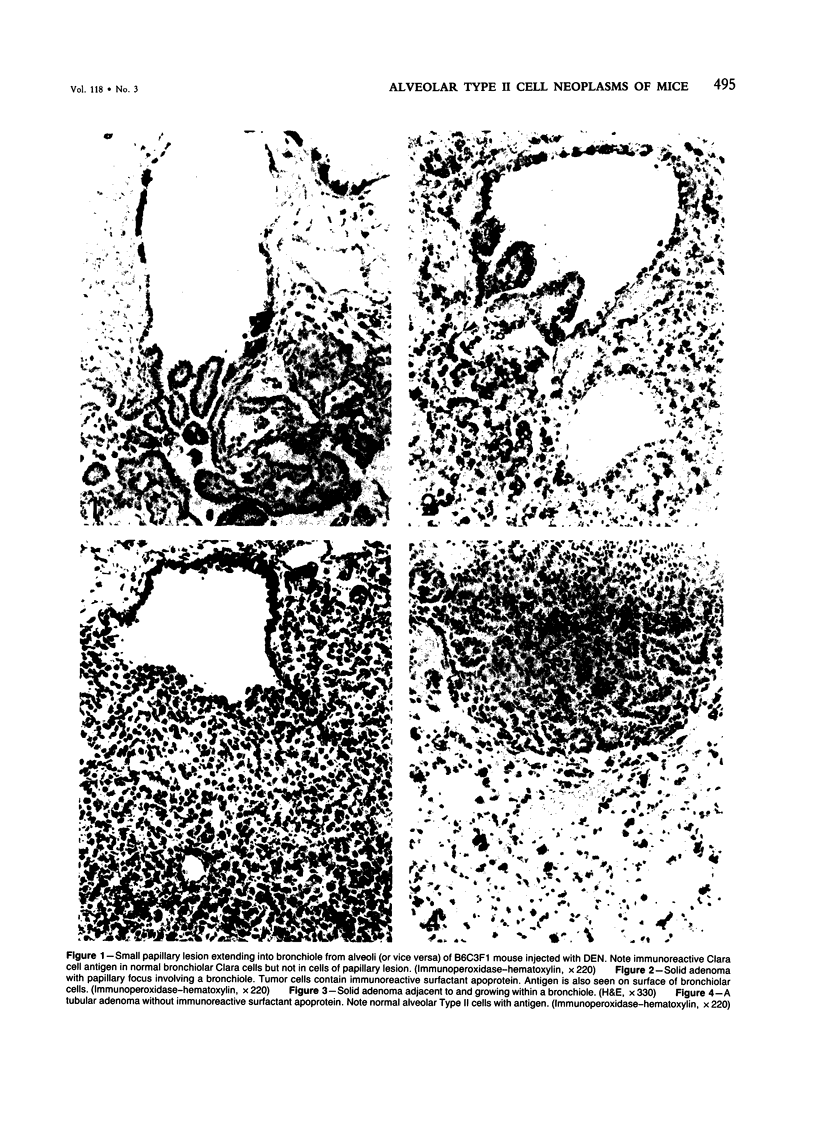


Images in this article

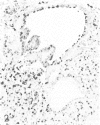
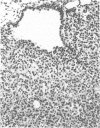
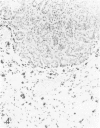

Selected References
These references are in PubMed. This may not be the complete list of references from this article.
- Anderson L. M., Last-Barney K., Budinger J. M. Sensitivity to carcinogenesis in nude mice: skin tumors caused by transplacental exposure to ethylnitrosourea. Science. 1982 Nov 12;218(4573):682–684. doi: 10.1126/science.7134965. [DOI] [PubMed] [Google Scholar]
- Brooks R. E. Pulmonary adenoma of strain A mice: an electron microscopic study. J Natl Cancer Inst. 1968 Sep;41(3):719–742. [PubMed] [Google Scholar]
- Choudhury C., Kauffman S. L., Seravalli E., Durkin H. Lymphocytic infiltration of bronchioloalveolar adenomas in mice. Cancer Lett. 1983 Oct;20(3):299–304. doi: 10.1016/0304-3835(83)90028-9. [DOI] [PubMed] [Google Scholar]
- Dairaku M., Sueishi K., Tanaka K., Horie A. Immunohistological analysis of surfactant-apoprotein in the bronchiolo-alveolar carcinoma. Virchows Arch A Pathol Anat Histopathol. 1983;400(3):223–234. doi: 10.1007/BF00612184. [DOI] [PubMed] [Google Scholar]
- Grady H. G., Stewart H. L. Histogenesis of induced pulmonary tumors in strain a mice. Am J Pathol. 1940 Jul;16(4):417–432.5. [PMC free article] [PubMed] [Google Scholar]
- Hsu S. M., Raine L., Fanger H. Use of avidin-biotin-peroxidase complex (ABC) in immunoperoxidase techniques: a comparison between ABC and unlabeled antibody (PAP) procedures. J Histochem Cytochem. 1981 Apr;29(4):577–580. doi: 10.1177/29.4.6166661. [DOI] [PubMed] [Google Scholar]
- Katyal S. L., Singh G. An immunologic study of the apoproteins of rat lung surfactant. Lab Invest. 1979 May;40(5):562–567. [PubMed] [Google Scholar]
- Kauffman S. L., Alexander L., Sass L. Histologic and ultrastructural features of the clara cell adenoma of the mouse lung. Lab Invest. 1979 Jun;40(6):708–716. [PubMed] [Google Scholar]
- Kauffman S. L. Histogenesis of the papillary Clara cell adenoma. Am J Pathol. 1981 May;103(2):174–180. [PMC free article] [PubMed] [Google Scholar]
- MORI K. FURTHER STUDIES ON THE HISTOGENESIS OF PULMONARY TUMORS IN MICE INDUCED BY 4-NITROQUINOLINE 1-OXIDE. Gan. 1964 Aug;55:315–323. [PubMed] [Google Scholar]
- MORI K., HIRAFUKU I. HISTOGENESIS OF LUNG CARCINOMA IN MICE INDUCED BY 4-NITROQUINOLINE 1-OXIDE: CARCINOMA ARISING FROM AREAS OF ADENOMA. Gan. 1964 Jun;55:205–210. [PubMed] [Google Scholar]
- Maksvytis H. J., Vaccaro C., Brody J. S. Isolation and characterization of the lipid-containing interstitial cell from the developing rat lung. Lab Invest. 1981 Sep;45(3):248–259. [PubMed] [Google Scholar]
- Meyrick B., Reid L. The alveolar brush cell in rat lung--a third pneumonocyte. J Ultrastruct Res. 1968 Apr;23(1):71–80. doi: 10.1016/s0022-5320(68)80032-2. [DOI] [PubMed] [Google Scholar]
- Parsa I., Kauffman S. L. Malignant Clara cell line derived from ethylnitrosourea-induced murine lung adenomas. Cancer Lett. 1983 Apr;18(3):311–316. doi: 10.1016/0304-3835(83)90241-0. [DOI] [PubMed] [Google Scholar]
- Rijhsinghani K. S., Krakower C., Abrahams C., Swerdlow M., Rao K. V., Ghose T. A light and electron microscopic study of liver and lung tumors induced by a single low dose of diethylnitrosamine (DEN) in C57BLXC3H F1 mice. Cancer Detect Prev. 1981;4(1-4):85–97. [PubMed] [Google Scholar]
- SVOBODA D. J. Ultrastructure of pulmonary adenomas in mice. Cancer Res. 1962 Nov;22:1197–1201. [PubMed] [Google Scholar]
- Sato T., Kauffman S. L. A scanning electron microscopic study of the Type II and Clara cell adenoma of the mouse lung. Lab Invest. 1980 Jul;43(1):28–36. [PubMed] [Google Scholar]
- Shimkin M. B., Stoner G. D. Lung tumors in mice: application to carcinogenesis bioassay. Adv Cancer Res. 1975;21:1–58. doi: 10.1016/s0065-230x(08)60970-7. [DOI] [PubMed] [Google Scholar]
- Singh G., Katyal S. L. An immunologic study of the secretory products of rat Clara cells. J Histochem Cytochem. 1984 Jan;32(1):49–54. doi: 10.1177/32.1.6418790. [DOI] [PubMed] [Google Scholar]
- Singh G., Katyal S. L., Ordonez N. G., Dail D. H., Negishi Y., Weedn V. W., Marcus P. B., Weldon-Linne C. M., Axiotis C. A., Alvarez-Fernandez E. Type II pneumocytes in pulmonary tumors. Implications for histogenesis. Arch Pathol Lab Med. 1984 Jan;108(1):44–48. [PubMed] [Google Scholar]
- Singh G., Katyal S. L. Surfactant apoprotein in nonmalignant pulmonary disorders. Am J Pathol. 1980 Oct;101(1):51–61. [PMC free article] [PubMed] [Google Scholar]
- Singh G., Katyal S. L., Torikata C. Carcinoma of type II pneumocytes: immunodiagnosis of a subtype of "bronchioloalveolar carcinomas". Am J Pathol. 1981 Feb;102(2):195–208. [PMC free article] [PubMed] [Google Scholar]
- Stewart H. L., Dunn T. B., Snell K. C., Deringer M. K. Tumours of the respiratory tract. IARC Sci Publ. 1979;23:251–287. [PubMed] [Google Scholar]
- Suzuki Y. Neoplastic effect of vinyl chloride in mouse lung--lower doses and short-term exposure. Environ Res. 1983 Oct;32(1):91–103. doi: 10.1016/0013-9351(83)90195-0. [DOI] [PubMed] [Google Scholar]
- Ward J. M., Argilan F., Reynolds C. W. Immunoperoxidase localization of large granular lymphocytes in normal tissues and lesions of athymic nude rats. J Immunol. 1983 Jul;131(1):132–139. [PubMed] [Google Scholar]
- Ward J. M. Background data and variations in tumor rates of control rats and mice. Prog Exp Tumor Res. 1983;26:241–258. doi: 10.1159/000407263. [DOI] [PubMed] [Google Scholar]
- Ward J. M., Goodman D. G., Squire R. A., Chu K. C., Linhart M. S. Neoplastic and nonneoplastic lesions in aging (C57BL/6N x C3H/HeN)F1 (B6C3F1) mice. J Natl Cancer Inst. 1979 Sep;63(3):849–854. doi: 10.1093/jnci/63.3.849. [DOI] [PubMed] [Google Scholar]
- Ward J. M., Rice J. M., Creasia D., Lynch P., Riggs C. Dissimilar patterns of promotion by di(2-ethylhexyl)phthalate and phenobarbital of hepatocellular neoplasia initiated by diethylnitrosamine in B6C3F1 mice. Carcinogenesis. 1983 Aug;4(8):1021–1029. doi: 10.1093/carcin/4.8.1021. [DOI] [PubMed] [Google Scholar]
- Witschi H., Haschek W. M. Cells of origin of lung tumors in mice. J Natl Cancer Inst. 1983 Jun;70(6):991–992. [PubMed] [Google Scholar]