



Abstract
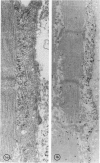
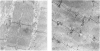
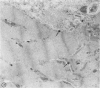
Cytochemical and biochemical characteristics of the surface membrane components of avian dystrophic muscle were examined. A Mg2+- or Ca2+-activated ("basic") adenosine triphosphate (ATPase) was localized cytochemically in fixed, intact dystrophic muscle slices in a medium containing Mg2+ or Ca2+, adenosine triphosphate (ATP), and 1 microM free Pb2+ to capture enzymatically released phosphate ions. Electron-dense staining precipitates were found to be associated with the plasmalemma and its tortuous invaginations, and the transverse components of the T-system membrane and its associated proliferated networks. Enzymatic analysis of microsomal fractions isolated from 7-day-old and 90-day-old normal and dystrophic muscle showed a complex behavior. Specific activity of "basic" ATPase decreased with maturity in normal and dystrophic animals. The specific activities of the surface membrane associated enzymes, leucyl beta-naphthylamidase, adenylate cyclase, and guanylate cyclase, remained at various elevated levels in the mature dystrophic animals, in contrast to the normal muscle, which showed decreases in the specific activity of all three enzymes with maturation. The persistent high levels in some but not all enzyme activities in 90-day-old dystrophic muscle indicates a complicated developmental pattern in the dystrophic chicken muscle.
Full text
PDF


Images in this article
Selected References
These references are in PubMed. This may not be the complete list of references from this article.
- Baskin R. J. Ultrastructure and calcium transport in microsomes from developing muscle. J Ultrastruct Res. 1974 Dec;49(3):348–371. doi: 10.1016/s0022-5320(74)90050-1. [DOI] [PubMed] [Google Scholar]
- Cantley L. C., Jr, Cantley L. G., Josephson L. A characterization of vanadate interactions with the (Na,K)-ATPase. Mechanistic and regulatory implications. J Biol Chem. 1978 Oct 25;253(20):7361–7368. [PubMed] [Google Scholar]
- Cosmos E., Butler J., Allard E. P., Mazliah J. Factors that influence the phenotypic expression of genetically normal and dystrophic muscles. Ann N Y Acad Sci. 1979;317:571–593. doi: 10.1111/j.1749-6632.1979.tb56578.x. [DOI] [PubMed] [Google Scholar]
- Costello B. R., Shafiq S. A. Freeze-fracture study of muscle plasmalemma in normal and dystrophic chickens. Muscle Nerve. 1979 May-Jun;2(3):191–201. doi: 10.1002/mus.880020307. [DOI] [PubMed] [Google Scholar]
- Crowe L. M., Baskin R. J. Stereologic analysis of dystrophic chicken muscle. Am J Pathol. 1979 May;95(2):295–315. [PMC free article] [PubMed] [Google Scholar]
- Evans W. H. A biochemical dissection of the functional polarity of the plasma membrane of the hepatocyte. Biochim Biophys Acta. 1980 May 27;604(1):27–64. doi: 10.1016/0005-2736(80)90584-2. [DOI] [PubMed] [Google Scholar]
- Firth J. A. Cytochemical approaches to the localization of specific adenosine triphosphatases. Histochem J. 1978 May;10(3):253–269. doi: 10.1007/BF01007558. [DOI] [PubMed] [Google Scholar]
- Firth J. A. Reliability and specificity of membrane adenosine triphosphatase localizations. J Histochem Cytochem. 1980 Jan;28(1):69–71. doi: 10.1177/28.1.6243323. [DOI] [PubMed] [Google Scholar]
- Flaherty J. O., Barrett E. J., Bradley D. P., Headon D. R. Association of basal ATPase activity and cholesterol with a distinct group of rabbit skeletal muscle microsomal particles. Biochim Biophys Acta. 1975 Aug 20;401(2):177–183. doi: 10.1016/0005-2736(75)90302-8. [DOI] [PubMed] [Google Scholar]
- GOLDBARG J. A., RUTENBURG A. M. The colorimetric determination of leucine aminopeptidase in urine and serum of normal subjects and patients with cancer and other diseases. Cancer. 1958 Mar-Apr;11(2):283–291. doi: 10.1002/1097-0142(195803/04)11:2<283::aid-cncr2820110209>3.0.co;2-8. [DOI] [PubMed] [Google Scholar]
- Gillis J. M., Page S. G. Localization of ATPase activity in striated muscle and probable sources of artifact. J Cell Sci. 1967 Mar;2(1):113–118. doi: 10.1242/jcs.2.1.113. [DOI] [PubMed] [Google Scholar]
- Heilmann C., Brdiczka D., Nickel E., Pette D. ATPase activities, Ca2+ transport and phosphoprotein formation in sarcoplasmic reticulum subfractions of fast and slow rabbit muscles. Eur J Biochem. 1977 Dec 1;81(2):211–222. doi: 10.1111/j.1432-1033.1977.tb11943.x. [DOI] [PubMed] [Google Scholar]
- Horváth B. Z., Levin D. H. Adenyl cyclase in the pectoral muscle of normal chickens and chickens with hereditary muscular dystrophy. Enzyme. 1972;13(5-6):311–319. doi: 10.1159/000459679. [DOI] [PubMed] [Google Scholar]
- Ishikawa H. Formation of elaborate networks of T-system tubules in cultured skeletal muscle with special reference to the T-system formation. J Cell Biol. 1968 Jul;38(1):51–66. doi: 10.1083/jcb.38.1.51. [DOI] [PMC free article] [PubMed] [Google Scholar]
- Kimura H., Murad F. Subcellular localization of guanylate cyclase. Life Sci. 1975 Sep 15;17(6):837–843. doi: 10.1016/0024-3205(75)90433-6. [DOI] [PubMed] [Google Scholar]
- Kimura H., Murad F. Two forms of guanylate cyclase in mammalian tissues and possible mechanisms for their regulation. Metabolism. 1975 Mar;24(3):439–445. doi: 10.1016/0026-0495(75)90123-7. [DOI] [PubMed] [Google Scholar]
- LOWRY O. H., ROSEBROUGH N. J., FARR A. L., RANDALL R. J. Protein measurement with the Folin phenol reagent. J Biol Chem. 1951 Nov;193(1):265–275. [PubMed] [Google Scholar]
- Levine S. N., Steiner A. L., Earp H. S., Meissner G. Particulate guanylate cyclase of skeletal muscle: effects of Ca2+ and other divalent cations on enzyme activity. Biochim Biophys Acta. 1979 Jan 12;566(1):171–182. doi: 10.1016/0005-2744(79)90259-6. [DOI] [PubMed] [Google Scholar]
- Malouf N. N., Meissner G. Cytochemical localization of a "basic" ATPase to canine myocardial surface membrane. J Histochem Cytochem. 1980 Dec;28(12):1286–1294. doi: 10.1177/28.12.6453153. [DOI] [PubMed] [Google Scholar]
- Malouf N. N., Meissner G. Localization of a Mg2+- or Ca2+-activated ("basic") ATPase in skeletal muscle. Exp Cell Res. 1979 Sep;122(2):233–250. doi: 10.1016/0014-4827(79)90301-x. [DOI] [PubMed] [Google Scholar]
- Malouf N. N., Sommer J. R. Chicken dystrophy. The geometry of the transverse tubules. Am J Pathol. 1976 Aug;84(2):299–316. [PMC free article] [PubMed] [Google Scholar]
- Martonosi A. Membrane transport during development in animals. Biochim Biophys Acta. 1975 Oct 31;415(3):311–333. doi: 10.1016/0304-4157(75)90012-x. [DOI] [PubMed] [Google Scholar]
- Michell R. H., Hawthorne J. N. The site of diphosphoinositide synthesis in rat liver. Biochem Biophys Res Commun. 1965 Nov 22;21(4):333–338. doi: 10.1016/0006-291x(65)90198-1. [DOI] [PubMed] [Google Scholar]
- Owens K. Biochemical studies of dystrophy in the young chicken: lysosomal and sarcolemmal enzymes. Ann N Y Acad Sci. 1979;317:247–262. doi: 10.1111/j.1749-6632.1979.tb56533.x. [DOI] [PubMed] [Google Scholar]
- Parsons M. E., Pennington R. J. Separation of rat muscle aminopeptidases. Biochem J. 1976 May 1;155(2):375–381. doi: 10.1042/bj1550375. [DOI] [PMC free article] [PubMed] [Google Scholar]
- Petell J. K., Lebherz H. G. Regulation of fructose diphosphate aldolase concentrations in skeletal muscles of normal and dystrophic chickens. J Biol Chem. 1979 Aug 10;254(15):7411–7417. [PubMed] [Google Scholar]
- Rodan G. A., Rodan S. B., Raible D. G., Cutler L. S., Wacholtz M., Sha'afi R. I. Adenylate cyclase in muscular dystrophy. Ann N Y Acad Sci. 1979;317:670–691. doi: 10.1111/j.1749-6632.1979.tb56587.x. [DOI] [PubMed] [Google Scholar]
- Rodan S. B., Hintz R. L., Sha'afi R. I., Rodan G. A. The activity of membrane bound enzymes in muscular dystrophic chicks. Nature. 1974 Dec 13;252(5484):589–591. doi: 10.1038/252589a0. [DOI] [PubMed] [Google Scholar]
- Scales D., Sabbadini R., Inesi G. The involvement of sarcotubular membranes in genetic muscular dystrophy. Biochim Biophys Acta. 1977 Mar 17;465(3):535–549. doi: 10.1016/0005-2736(77)90271-1. [DOI] [PubMed] [Google Scholar]
- Schimmel S. D., Kent C., Bischoff R., Vagelos P. R. Plasma membranes from cultured muscle cells: isolation procedure and separation of putative plasma-membrane marker enzymes. Proc Natl Acad Sci U S A. 1973 Nov;70(11):3195–3199. doi: 10.1073/pnas.70.11.3195. [DOI] [PMC free article] [PubMed] [Google Scholar]
- Schulze W., Portius H. J., Scheller F., Wollenberger A. Uber Grundlagen der Anwendungsmöglichkeiten des Komplexbildners Tiron beim histochemischen Nachweis der NaK-ATPase-Aktivität. Acta Histochem. 1973;47(2):376–379. [PubMed] [Google Scholar]
- Steiner A. L., Parker C. W., Kipnis D. M. Radioimmunoassay for cyclic nucleotides. I. Preparation of antibodies and iodinated cyclic nucleotides. J Biol Chem. 1972 Feb 25;247(4):1106–1113. [PubMed] [Google Scholar]
- Tada M., Yamamoto T., Tonomura Y. Molecular mechanism of active calcium transport by sarcoplasmic reticulum. Physiol Rev. 1978 Jan;58(1):1–79. doi: 10.1152/physrev.1978.58.1.1. [DOI] [PubMed] [Google Scholar]
- WACHSTEIN M., MEISEL E. Histochemistry of hepatic phosphatases of a physiologic pH; with special reference to the demonstration of bile canaliculi. Am J Clin Pathol. 1957 Jan;27(1):13–23. doi: 10.1093/ajcp/27.1.13. [DOI] [PubMed] [Google Scholar]
- Wakayama Y., Schotland D. L., Bonilla E. Transplantation of human skeletal muscle to nude mice: a sequential morphologic study. Neurology. 1980 Jul;30(7 Pt 1):740–748. doi: 10.1212/wnl.30.7.740. [DOI] [PubMed] [Google Scholar]
- Wilson B. W., Randall W. R., Patterson G. T., Entrikin R. K. Major physiologic and histochemical characteristics of inherited dystrophy of the chicken. Ann N Y Acad Sci. 1979;317:224–246. doi: 10.1111/j.1749-6632.1979.tb56531.x. [DOI] [PubMed] [Google Scholar]
- YAP J. L., MacLennan D. H. Characterization of the adenosinetriphosphatase and calsequestrin isolated from sarcoplasmic reticulum of normal and dystrophic chickens. Can J Biochem. 1976 Jul;54(7):670–673. doi: 10.1139/o76-097. [DOI] [PubMed] [Google Scholar]