



Chapkin R.S., Arrington J.L., Apanasovich T.V., Carroll, R.J. & McMurray, D.N. Dietary n-3 PUFA affect TcR-mediated activation of purified murine T cells and accessory cell function in co-cultures. Clin Exp Immunol 2002; 130:12–18.
In Fig 1 and Fig 4, the diagonal hatching in the columns was erroneously omitted during printing and these appeared as open columns. The corrected figures are shown below.
Fig. 1.
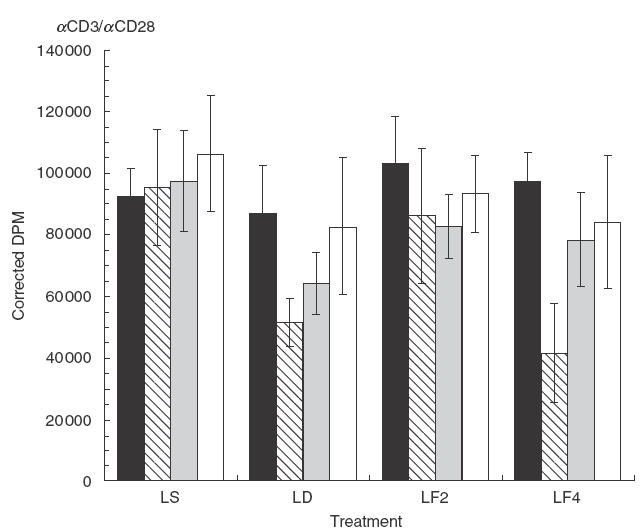
The in vitro proliferative response to αCD3/αCD28 of co-cultures of purified T lymphocytes (L) and purified accessory cells (M) isolated from mice fed diets containing different levels of n-3 PUFA for two weeks; lymphocytes from each diet source (LS, LD, LF2, LF4) were co-cultured with accessory cells from each diet source (▪ (M)S,  (M)D,
(M)D,  (M)F2, □ (M)F4) in a 4 × 4 factorial design; S, Safflower oil diet; F2, 2% Fish oil diet; F4, 4% Fish oil diet; D, DHA-enriched diet; Mean ± SEM (n = 3–5 mice).
Fig. 4.
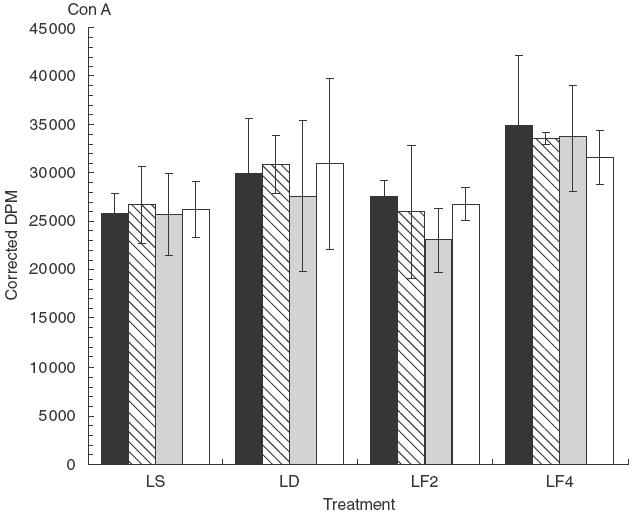
The in vitro proliferative response to ConA of co-cultures of purified T lymphocytes (L) and purified accessory cells (M) isolated from mice fed diets containing different levels of n-3 PUFA for two weeks; lymphocytes from each diet source (LS, LD, LF2, LF4) were co-cultured with accessory cells from each diet source (▪ (M)S,  (M)D, (M)F2, □ (M)F4) in a 4 × 4 factorial design; S, Safflower oil diet; F2, 2% Fish oil diet; F4, 4% Fish oil diet; D, DHA-enriched diet; Mean ± SEM (n = 3–5 mice); no statistically significant dietary effects were detected.