



Abstract
Concerns are mounting about the risks of genetic discrimination resulting from the release of predictive and presymptomatic genetic test results to employers, insurers, and others. The ability to keep this information confidential is questionable, particularly in view of the expansion of electronic medical databases. One solution is to afford individuals access to anonymous genetic counseling and testing. Probands would be identified only by a code that would not reveal personal information, and test results would be stored, retrieved, and released solely on the basis of this code. The experience with anonymous HIV testing, while not completely analogous, suggests that such an approach would be both practical and effective.
Full text
PDF


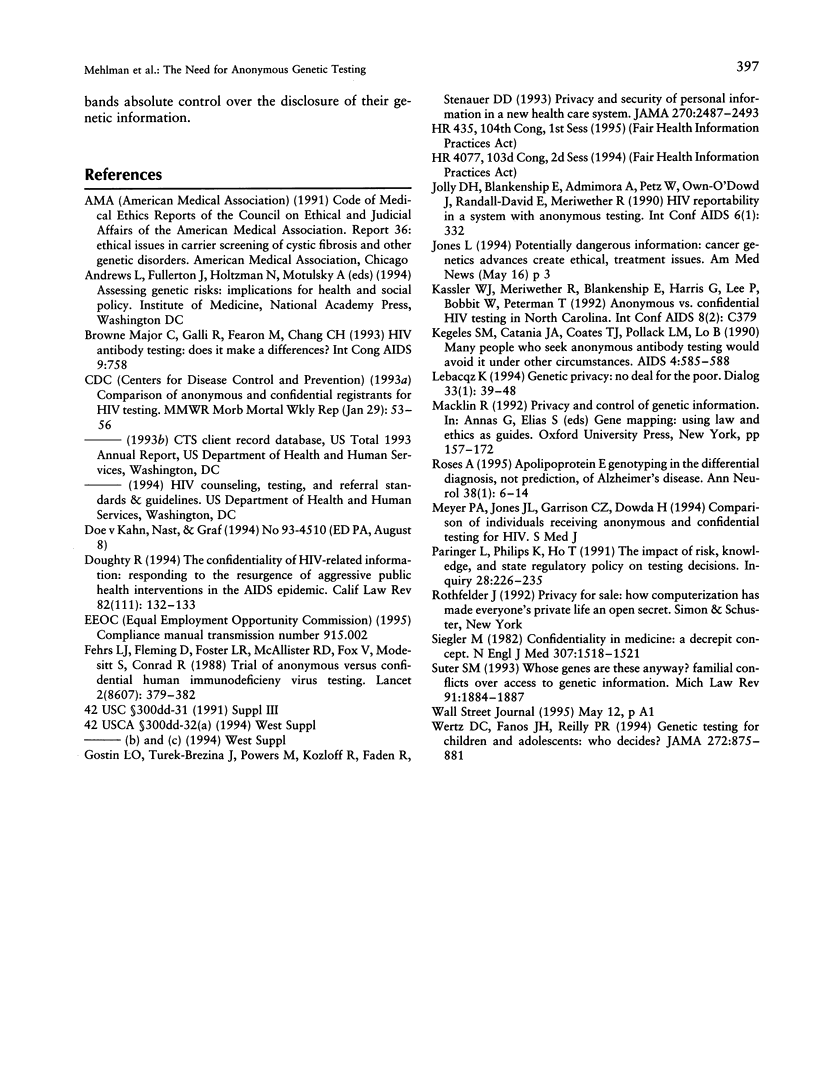
Selected References
These references are in PubMed. This may not be the complete list of references from this article.
- Fehrs L. J., Fleming D., Foster L. R., McAlister R. O., Fox V., Modesitt S., Conrad R. Trial of anonymous versus confidential human immunodeficiency virus testing. Lancet. 1988 Aug 13;2(8607):379–382. doi: 10.1016/s0140-6736(88)92846-2. [DOI] [PubMed] [Google Scholar]
- Gostin L. O., Turek-Brezina J., Powers M., Kozloff R., Faden R., Steinauer D. D. Privacy and security of personal information in a new health care system. JAMA. 1993 Nov 24;270(20):2487–2493. [PubMed] [Google Scholar]
- Kegeles S. M., Catania J. A., Coates T. J., Pollack L. M., Lo B. Many people who seek anonymous HIV-antibody testing would avoid it under other circumstances. AIDS. 1990 Jun;4(6):585–588. doi: 10.1097/00002030-199006000-00016. [DOI] [PubMed] [Google Scholar]
- Roses A. D. Apolipoprotein E genotyping in the differential diagnosis, not prediction, of Alzheimer's disease. Ann Neurol. 1995 Jul;38(1):6–14. doi: 10.1002/ana.410380105. [DOI] [PubMed] [Google Scholar]
- Wertz D. C., Fanos J. H., Reilly P. R. Genetic testing for children and adolescents. Who decides? JAMA. 1994 Sep 21;272(11):875–881. [PubMed] [Google Scholar]