



Abstract
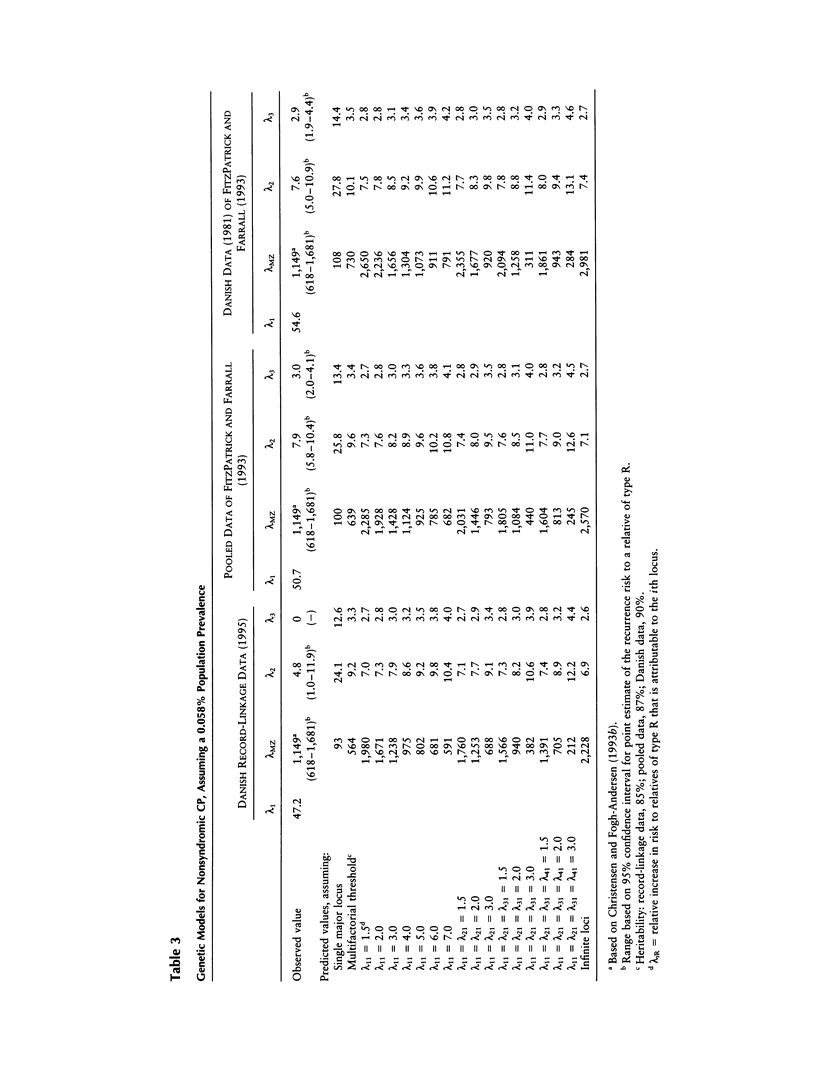
The finding of an association between genetic variation at the transforming growth-factor alpha (TGFA) locus and nonsyndromic isolated cleft palate (CP) represents a potentially important breakthrough in our understanding of this condition. The present study was undertaken to assess the feasibility of detecting linkage to putative CP-susceptibility loci, such as TGFA. To this end, the familial recurrence pattern for CP was evaluated to determine the most likely mode of inheritance for this condition. The study took advantage of the high ascertainment and uniform registration of CP in Denmark. In addition, the study utilized estimates of familial recurrence that were obtained by register linkage and, hence, were not subject to either recall bias or the potentially biasing influence of nonresponders. The recurrence risks for first-, second-, and third-degree relatives of 1,364 nonsyndromic CP probands were estimated to be 2.74% (72/2,628), 0.28% (3/1,068), and 0.00% (0/360), respectively. These estimates are close to published estimates based on questionnaire and interview data. The population prevalence for nonsyndromic CP was, however, found to be considerable higher than usually reported (0.058% [1,456/2,523,023]). Analyses of these and previously published data, using the method presented by Risch, indicated that major-locus or additive multilocus inheritance of CP is unlikely. The familial recurrence pattern was, however, consistent with CP being determined by several interacting loci. Under such a model, a single locus accounting for more than a sixfold increase in the risk to first-degree relatives of CP probands is unlikely, whereas a single locus accounting for a threefold increase provided a good fit to the data. Such a locus could be detected in a realistic sample of affected sib pairs.
Full text
PDF




Selected References
These references are in PubMed. This may not be the complete list of references from this article.
- Ardinger H. H., Buetow K. H., Bell G. I., Bardach J., VanDemark D. R., Murray J. C. Association of genetic variation of the transforming growth factor-alpha gene with cleft lip and palate. Am J Hum Genet. 1989 Sep;45(3):348–353. [PMC free article] [PubMed] [Google Scholar]
- Bixler D., Fogh-Andersen P., Conneally P. M. Incidence of cleft lip and palate in the offspring of cleft parents. Clin Genet. 1971;2(3):155–159. doi: 10.1111/j.1399-0004.1971.tb00271.x. [DOI] [PubMed] [Google Scholar]
- Bonaiti C., Briard M. L., Feingold J., Pavy B., Psaume J., Migne-Tufferaud G., Kaplan J. An epidemiological and genetic study of facial clefting in France. I. Epidemiology and frequency in relatives. J Med Genet. 1982 Feb;19(1):8–15. doi: 10.1136/jmg.19.1.8. [DOI] [PMC free article] [PubMed] [Google Scholar]
- Chenevix-Trench G., Jones K., Green A. C., Duffy D. L., Martin N. G. Cleft lip with or without cleft palate: associations with transforming growth factor alpha and retinoic acid receptor loci. Am J Hum Genet. 1992 Dec;51(6):1377–1385. [PMC free article] [PubMed] [Google Scholar]
- Christensen K., Fogh-Andersen P. Cleft lip (+/- cleft palate) in Danish twins, 1970-1990. Am J Med Genet. 1993 Nov 1;47(6):910–916. doi: 10.1002/ajmg.1320470620. [DOI] [PubMed] [Google Scholar]
- Christensen K., Holm N. V., Olsen J., Kock K., Fogh-Andersen P. Selection bias in genetic-epidemiological studies of cleft lip and palate. Am J Hum Genet. 1992 Sep;51(3):654–659. [PMC free article] [PubMed] [Google Scholar]
- Christensen K., Schmidt M. M., Vaeth M., Olsen J. Absence of an environmental effect on the recurrence of facial-cleft defects. N Engl J Med. 1995 Jul 20;333(3):161–164. doi: 10.1056/NEJM199507203330305. [DOI] [PubMed] [Google Scholar]
- Davie A. M. The 'singles' method for segregation analysis under incomplete ascertainment. Ann Hum Genet. 1979 May;42(4):507–512. doi: 10.1111/j.1469-1809.1979.tb00683.x. [DOI] [PubMed] [Google Scholar]
- Farrall M., Buetow K. H., Murray J. C. Resolving an apparent paradox concerning the role of TGFA in CL/P. Am J Hum Genet. 1993 Feb;52(2):434–437. [PMC free article] [PubMed] [Google Scholar]
- FitzPatrick D., Farrall M. An estimation of the number of susceptibility loci for isolated cleft palate. J Craniofac Genet Dev Biol. 1993 Oct-Dec;13(4):230–235. [PubMed] [Google Scholar]
- Goldberg R., Motzkin B., Marion R., Scambler P. J., Shprintzen R. J. Velo-cardio-facial syndrome: a review of 120 patients. Am J Med Genet. 1993 Feb 1;45(3):313–319. doi: 10.1002/ajmg.1320450307. [DOI] [PubMed] [Google Scholar]
- Hwang S. J., Beaty T. H., Panny S. R., Street N. A., Joseph J. M., Gordon S., McIntosh I., Francomano C. A. Association study of transforming growth factor alpha (TGF alpha) TaqI polymorphism and oral clefts: indication of gene-environment interaction in a population-based sample of infants with birth defects. Am J Epidemiol. 1995 Apr 1;141(7):629–636. doi: 10.1093/oxfordjournals.aje.a117478. [DOI] [PubMed] [Google Scholar]
- Mitchell L. E., Risch N. Mode of inheritance of nonsyndromic cleft lip with or without cleft palate: a reanalysis. Am J Hum Genet. 1992 Aug;51(2):323–332. [PMC free article] [PubMed] [Google Scholar]
- Moore G. E., Ivens A., Chambers J., Farrall M., Williamson R., Page D. C., Bjornsson A., Arnason A., Jensson O. Linkage of an X-chromosome cleft palate gene. Nature. 1987 Mar 5;326(6108):91–92. doi: 10.1038/326091a0. [DOI] [PubMed] [Google Scholar]
- Pradat P. Recurrence risk for major congenital heart defects in Sweden: a registry study. Genet Epidemiol. 1994;11(2):131–140. doi: 10.1002/gepi.1370110204. [DOI] [PubMed] [Google Scholar]
- Reich T., James J. W., Morris C. A. The use of multiple thresholds in determining the mode of transmission of semi-continuous traits. Ann Hum Genet. 1972 Nov;36(2):163–184. doi: 10.1111/j.1469-1809.1972.tb00767.x. [DOI] [PubMed] [Google Scholar]
- Risch N. Linkage strategies for genetically complex traits. I. Multilocus models. Am J Hum Genet. 1990 Feb;46(2):222–228. [PMC free article] [PubMed] [Google Scholar]
- Sander A., Murray J. C., Scherpbier-Heddema T., Buetow K. H., Weissenbach J., Zingg M., Ludwig K., Schmelzle R. Microsatellite-based fine mapping of the Van der Woude syndrome locus to an interval of 4.1 cM between D1S245 and D1S414. Am J Hum Genet. 1995 Jan;56(1):310–318. [PMC free article] [PubMed] [Google Scholar]
- Shiang R., Lidral A. C., Ardinger H. H., Buetow K. H., Romitti P. A., Munger R. G., Murray J. C. Association of transforming growth-factor alpha gene polymorphisms with nonsyndromic cleft palate only (CPO). Am J Hum Genet. 1993 Oct;53(4):836–843. [PMC free article] [PubMed] [Google Scholar]
- Shields E. D., Bixler D., Fogh-Andersen P. Cleft palate: a genetic and epidemiologic investigation. Clin Genet. 1981 Jul;20(1):13–24. doi: 10.1111/j.1399-0004.1981.tb01800.x. [DOI] [PubMed] [Google Scholar]
- WOOLF C. M., WOOLF R. M., BROADBENT T. R. A genetic study of cleft lip and palate in Utah. Am J Hum Genet. 1963 Jun;15:209–215. [PMC free article] [PubMed] [Google Scholar]