



Abstract
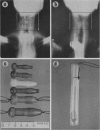
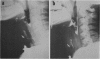
Laryngeal trauma may be obscured by associated injuries of the face and chest. An early assessment of these injuries should be made. Many cases may require observation only. In patients with severe laryngeal fractures, preservation of the airway and control of hemorrhage must first be assured. Following this, splinting by external or internal means should be carried out. Three severe laryngeal injuries were splinted with open and closed plastic moulds, with satisfactory results. It is proposed that early recognition and proper management of severe cases of this nature would shorten the treatment and achieve the best results.
Full text
PDF


Images in this article
Selected References
These references are in PubMed. This may not be the complete list of references from this article.
- BENNETT T. Laryngeal trauma. Laryngoscope. 1960 Jul;70:973–982. doi: 10.1288/00005537-196007000-00009. [DOI] [PubMed] [Google Scholar]
- HENRY G. A. Post irradiation damage to the pharynx; larynx and esophagus. Laryngoscope. 1957 Jul;67(7):709–712. doi: 10.1288/00005537-195707000-00008. [DOI] [PubMed] [Google Scholar]
- HOLINGER P. H., JOHNSTON K. C. The management of chronic laryngeal stenosis. Ann Otol Rhinol Laryngol. 1958 Jun;67(2):496–515. doi: 10.1177/000348945806700217. [DOI] [PubMed] [Google Scholar]
- NORRIS C. M. Use of acrylic materials in laryngology. Laryngoscope. 1959 Mar;69(3):306–319. doi: 10.1288/00005537-195903000-00011. [DOI] [PubMed] [Google Scholar]
- SUGGIT S. Some problems of laryngeal injuries and stenosis. J Laryngol Otol. 1960 Jan;74:22–31. doi: 10.1017/s0022215100056176. [DOI] [PubMed] [Google Scholar]