



Abstract
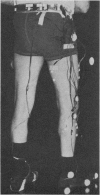
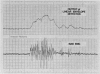
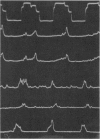
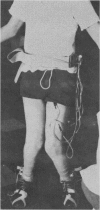
A clinical locomotion laboratory has been developed to provide quantitative information in the management of gait disorders. The biomedical engineering development of this system identified two major clinical constraints: (a) the need for instrumentation that would not alter the natural gait of the patient and (b) the need for data-processing techniques that would permit analysis and correlation of the large volume of electromyographic (EMg) and kinematic information. The net result has been a unit that incorporates a multichannel telemetry system to capture the EMG and foot-switch information and a television computer system to handle the kinematic information. Gait studies on children with hemiparesis, muscular dystrophy and cerebral palsy have yielded quantitative EMG and kinematic information on the pathomechanics of ambulation in these disorders. Because the information obtained is quantitative, an accurate measure of improvement (or lack of it) after treatment can be documented. Therefore, the locomotion laboratory may have an important role in the preoperative and postoperative evaluation of children whose abnormal gait may require surgical corrective procedures or rehabilitative treatment including the use of prostheses or orthoses.
Full text
PDF


Images in this article
Selected References
These references are in PubMed. This may not be the complete list of references from this article.
- Lamoreux L. W. Kinematic measurements in the study of human walking. Bull Prosthet Res. 1971 Spring;10(15):3–84. [PubMed] [Google Scholar]
- MURRAY M. P., DROUGHT A. B., KORY R. C. WALKING PATTERNS OF NORMAL MEN. J Bone Joint Surg Am. 1964 Mar;46:335–360. [PubMed] [Google Scholar]
- Milner M., Basmajian J. V., Quanbury A. O. Multifactorial analysis of walking by electromyography and computer. Am J Phys Med. 1971 Oct;50(5):235–258. [PubMed] [Google Scholar]
- SAUNDERS J. B., INMAN V. T., EBERHART H. D. The major determinants in normal and pathological gait. J Bone Joint Surg Am. 1953 Jul;35-A(3):543–558. [PubMed] [Google Scholar]
- Sutherland D. H., Hagy J. L. Measurement of gait movements from motion picture film. J Bone Joint Surg Am. 1972 Jun;54(4):787–797. [PubMed] [Google Scholar]
- Winter D. A., Greenlaw R. K., Hobson D. A. A microswitch shoe for use in locomotion studies. J Biomech. 1972 Sep;5(5):553–554. doi: 10.1016/0021-9290(72)90011-5. [DOI] [PubMed] [Google Scholar]
- Winter D. A., Greenlaw R. K., Hobson D. A. Television-computer analysis of kinematics of human gait. Comput Biomed Res. 1972 Oct;5(5):498–504. doi: 10.1016/0010-4809(72)90056-0. [DOI] [PubMed] [Google Scholar]