


Abstract
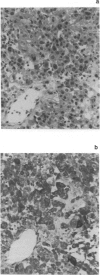
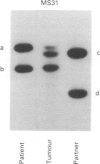
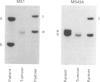
The genetic origin of two placental site trophoblastic tumours was established using a Y chromosome-specific and locus-specific minisatellite probes. A gestational origin was confirmed for both tumours. In one case the origin of the tumour was consistent with derivation from a normal female conceptus while the other was shown to arise from a homozygous complete hydatidiform mole, an abnormal conceptus more usually associated with the development of choriocarcinoma.
Full text
PDF


Images in this article
Selected References
These references are in PubMed. This may not be the complete list of references from this article.
- Armour J. A., Povey S., Jeremiah S., Jeffreys A. J. Systematic cloning of human minisatellites from ordered array charomid libraries. Genomics. 1990 Nov;8(3):501–512. doi: 10.1016/0888-7543(90)90037-u. [DOI] [PubMed] [Google Scholar]
- Chaganti R. S., Koduru P. R., Chakraborty R., Jones W. B. Genetic origin of a trophoblastic choriocarcinoma. Cancer Res. 1990 Oct 1;50(19):6330–6333. [PubMed] [Google Scholar]
- Eckstein R. P., Russell P., Friedlander M. L., Tattersall M. H., Bradfield A. Metastasizing placental site trophoblastic tumor: a case study. Hum Pathol. 1985 Jun;16(6):632–636. doi: 10.1016/s0046-8177(85)80114-3. [DOI] [PubMed] [Google Scholar]
- Fisher R. A., Lawler S. D., Povey S., Bagshawe K. D. Genetically homozygous choriocarcinoma following pregnancy with hydatidiform mole. Br J Cancer. 1988 Dec;58(6):788–792. doi: 10.1038/bjc.1988.310. [DOI] [PMC free article] [PubMed] [Google Scholar]
- Fisher R. A., Povey S., Jeffreys A. J., Martin C. A., Patel I., Lawler S. D. Frequency of heterozygous complete hydatidiform moles, estimated by locus-specific minisatellite and Y chromosome-specific probes. Hum Genet. 1989 Jun;82(3):259–263. doi: 10.1007/BF00291166. [DOI] [PubMed] [Google Scholar]
- Jacobs P. A., Wilson C. M., Sprenkle J. A., Rosenshein N. B., Migeon B. R. Mechanism of origin of complete hydatidiform moles. Nature. 1980 Aug 14;286(5774):714–716. doi: 10.1038/286714a0. [DOI] [PubMed] [Google Scholar]
- Jeffreys A. J., Royle N. J., Wilson V., Wong Z. Spontaneous mutation rates to new length alleles at tandem-repetitive hypervariable loci in human DNA. Nature. 1988 Mar 17;332(6161):278–281. doi: 10.1038/332278a0. [DOI] [PubMed] [Google Scholar]
- Kajii T., Ohama K. Androgenetic origin of hydatidiform mole. Nature. 1977 Aug 18;268(5621):633–634. doi: 10.1038/268633a0. [DOI] [PubMed] [Google Scholar]
- Kardana A., Taylor M. E., Southall P. J., Boxer G. M., Rowan A. J., Bagshawe K. D. Urinary gonadotrophin peptide--isolation and purification, and its immunohistochemical distribution in normal and neoplastic tissues. Br J Cancer. 1988 Sep;58(3):281–286. doi: 10.1038/bjc.1988.204. [DOI] [PMC free article] [PubMed] [Google Scholar]
- Kurman R. J., Young R. H., Norris H. J., Main C. S., Lawrence W. D., Scully R. E. Immunocytochemical localization of placental lactogen and chorionic gonadotropin in the normal placenta and trophoblastic tumors, with emphasis on intermediate trophoblast and the placental site trophoblastic tumor. Int J Gynecol Pathol. 1984;3(1):101–121. doi: 10.1097/00004347-198403010-00009. [DOI] [PubMed] [Google Scholar]
- Lawler S. D., Pickthall V. J., Fisher R. A., Povey S., Evans M. W., Szulman A. E. Genetic studies of complete and partial hydatidiform moles. Lancet. 1979 Sep 15;2(8142):580–580. doi: 10.1016/s0140-6736(79)91632-5. [DOI] [PubMed] [Google Scholar]
- MAKINO S., SASAKI M. S., FUKUSCHIMA T. CYTOLOGICAL STUDIES OF TUMORS. XLI. CHROMOSOMAL INSTABILITY IN HUMAN CHORIONIC LESIONS. Okajimas Folia Anat Jpn. 1965 Jan;40:439–465. doi: 10.2535/ofaj1936.40.4-6_439. [DOI] [PubMed] [Google Scholar]
- Ohama K., Kajii T., Okamoto E., Fukuda Y., Imaizumi K., Tsukahara M., Kobayashi K., Hagiwara K. Dispermic origin of XY hydatidiform moles. Nature. 1981 Aug 6;292(5823):551–552. doi: 10.1038/292551a0. [DOI] [PubMed] [Google Scholar]
- Royle N. J., Clarkson R. E., Wong Z., Jeffreys A. J. Clustering of hypervariable minisatellites in the proterminal regions of human autosomes. Genomics. 1988 Nov;3(4):352–360. doi: 10.1016/0888-7543(88)90127-9. [DOI] [PubMed] [Google Scholar]
- Sheppard D. M., Fisher R. A., Lawler S. D. Karyotypic analysis and chromosome polymorphisms in four choriocarcinoma cell lines. Cancer Genet Cytogenet. 1985 Apr 1;16(3):251–258. doi: 10.1016/0165-4608(85)90052-4. [DOI] [PubMed] [Google Scholar]
- Shibata D., Martin W. J., Arnheim N. Analysis of DNA sequences in forty-year-old paraffin-embedded thin-tissue sections: a bridge between molecular biology and classical histology. Cancer Res. 1988 Aug 15;48(16):4564–4566. [PubMed] [Google Scholar]
- Wake N., Tanaka K., Chapman V., Matsui S., Sandberg A. A. Chromosome and cellular origin of choriocarcinoma. Cancer Res. 1981 Aug;41(8):3137–3143. [PubMed] [Google Scholar]
- Wolfe J., Darling S. M., Erickson R. P., Craig I. W., Buckle V. J., Rigby P. W., Willard H. F., Goodfellow P. N. Isolation and characterization of an alphoid centromeric repeat family from the human Y chromosome. J Mol Biol. 1985 Apr 20;182(4):477–485. doi: 10.1016/0022-2836(85)90234-7. [DOI] [PubMed] [Google Scholar]
- Wong Z., Wilson V., Patel I., Povey S., Jeffreys A. J. Characterization of a panel of highly variable minisatellites cloned from human DNA. Ann Hum Genet. 1987 Oct;51(Pt 4):269–288. doi: 10.1111/j.1469-1809.1987.tb01062.x. [DOI] [PubMed] [Google Scholar]