



Abstract
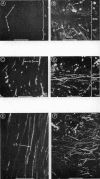
The adrenergic innervation of normal and aganglionic regions of bowel from patients with Hirschsprung's disease was investigated by a fluorescent histochemical technique. In normal bowel the adrenergic nerves end about intramural ganglion cells. In aganglionic bowel the adrenergic nerves form a dense varicose plexus in both muscularis externa and muscularis mucosae. It is suggested that the cause of megacolon in Hirschsprung's disease is due to a lack of nervous pathways controlling the intrinsic reflexes, which is probably congenital in origin.
Full text
PDF


Images in this article

Selected References
These references are in PubMed. This may not be the complete list of references from this article.
- Aldridge R. T., Campbell P. E. Ganglion cell distribution in the normal rectum and anal canal. A basis for the diagnosis of Hirschsprung's disease by anorectal biopsy. J Pediatr Surg. 1968 Aug;3(4):475–490. doi: 10.1016/0022-3468(68)90670-2. [DOI] [PubMed] [Google Scholar]
- BURNSTOCK G., CAMPBELL G., BENNETT M., HOLMAN M. E. INHIBITION OF THE SMOOTH MUSCLE ON THE TAENIA COLI. Nature. 1963 Nov 9;200:581–582. doi: 10.1038/200581a0. [DOI] [PubMed] [Google Scholar]
- Bennett A., Garrett J. R., Howard E. R. Adrenergic myenteric nerves in Hirschsprung's disease. Br Med J. 1968 Feb 24;1(5590):487–489. doi: 10.1136/bmj.1.5590.487. [DOI] [PMC free article] [PubMed] [Google Scholar]
- Burnstock G., Campbell G., Rand M. J. The inhibitory innervation of the taenia of the guinea-pig caecum. J Physiol. 1966 Feb;182(3):504–526. doi: 10.1113/jphysiol.1966.sp007834. [DOI] [PMC free article] [PubMed] [Google Scholar]
- Campbell G. The inhibitory nerve fibres in the vagal supply to the guinea-pig stomach. J Physiol. 1966 Aug;185(3):600–612. doi: 10.1113/jphysiol.1966.sp008004. [DOI] [PMC free article] [PubMed] [Google Scholar]
- Capurso L., Friedmann C. A., Parks A. G. Adrenergic fibres in the human intestine. Gut. 1968 Dec;9(6):678–682. doi: 10.1136/gut.9.6.678. [DOI] [PMC free article] [PubMed] [Google Scholar]
- Crema A., Del Tacca M., Frigo G. M., Lecchini S. Presence of a non-adrenergic inhibitory system in the human colon. Gut. 1968 Dec;9(6):633–637. doi: 10.1136/gut.9.6.633. [DOI] [PMC free article] [PubMed] [Google Scholar]
- Gannon B. J., Burnstock G., Noblett H. R., Campbell P. E. Histochemical diagnosis of Hirschsprung's disease. Lancet. 1969 Apr 26;1(7600):894–895. doi: 10.1016/s0140-6736(69)91946-1. [DOI] [PubMed] [Google Scholar]
- HAMBERGER B., MALMFORS T., SACHS C. STANDARDIZATION OF PARAFORMALDEHYDE AND OF CERTAIN PROCEDURES FOR THE HISTOCHEMICAL DEMONSTRATION OF CATECHOLAMINES. J Histochem Cytochem. 1965 Feb;13:147–147. doi: 10.1177/13.2.147. [DOI] [PubMed] [Google Scholar]
- HUKUHARA T., KOTANI S., SATO G. Comparative studies on the motility of the normal, denervated and aganglionic Thiry-loops. Jpn J Physiol. 1962 Aug 15;12:348–356. doi: 10.2170/jjphysiol.12.348. [DOI] [PubMed] [Google Scholar]
- HUKUHARA T., KOTANI S., SATO G. Effects of destruction of intramural ganglion cells on colon motility: possible genesis of congenital megacolon. Jpn J Physiol. 1961 Dec 15;11:635–640. doi: 10.2170/jjphysiol.11.635. [DOI] [PubMed] [Google Scholar]
- Hofmann S., Orestano F. Histology of the myenteric plexus in relation to rectal biopsy in congenital megacolon. J Pediatr Surg. 1967 Dec;2(6):575–577. doi: 10.1016/s0022-3468(67)80016-2. [DOI] [PubMed] [Google Scholar]
- KAMIJO K., HIATT R. B., KOELLE G. B. Congenital megacolon; a comparison of the spastic and hypertrophied segments with respect to Cholinesterase activities and sensitivities to Acetylcholine, DFP and the barium ion. Gastroenterology. 1953 Jun;24(2):173–185. [PubMed] [Google Scholar]
- LEAMING D. B., CAUNA N. A qualitative and quantitative study of the myenteric plexus of the small intestine of the cat. J Anat. 1961 Apr;95:160–169. [PMC free article] [PubMed] [Google Scholar]
- LEVIN R. J., NEWEY H., SMYTH D. H. THE EFFECTS OF ADRENALECTOMY AND FASTING ON INTESTINAL FUNCTION IN THE RAT. J Physiol. 1965 Mar;177:58–73. doi: 10.1113/jphysiol.1965.sp007575. [DOI] [PMC free article] [PubMed] [Google Scholar]
- Levi-Montalcini R., Angeletti P. U. Nerve growth factor. Physiol Rev. 1968 Jul;48(3):534–569. doi: 10.1152/physrev.1968.48.3.534. [DOI] [PubMed] [Google Scholar]
- Levi-Montalcini R., Angeletti P. U. Second symposium on catecholamines. Modification of sympathetic function. Immunosympathectomy. Pharmacol Rev. 1966 Mar;18(1):619–628. [PubMed] [Google Scholar]
- Martinson J. Vagal relaxation of the stomach. Experimental re-investigation of the concept of the transmission mechanism. Acta Physiol Scand. 1965 Aug;64(4):453–462. doi: 10.1111/j.1748-1716.1965.tb04204.x. [DOI] [PubMed] [Google Scholar]
- NORBERG K. A. ADRENERGIC INNERVATION OF THE INTESTINAL WALL STUDIED BY FLUORESCENCE MICROSCOPY. Int J Neuropharmacol. 1964 Sep;3:379–382. doi: 10.1016/0028-3908(64)90067-x. [DOI] [PubMed] [Google Scholar]
- Read J. B., Burnstock G. Comparative histochemical studies of adrenergic nerves in the enteric plexuses of vertebrate large intestine. Comp Biochem Physiol. 1968 Nov;27(2):505–517. doi: 10.1016/0010-406x(68)90247-8. [DOI] [PubMed] [Google Scholar]
- STOKER M. REGULATION OF GROWTH AND ORIENTATION IN HAMSTER CELLS TRANSFORMED BY POLYOMA VIRUS. Virology. 1964 Oct;24:165–174. doi: 10.1016/0042-6822(64)90099-6. [DOI] [PubMed] [Google Scholar]
- YNTEMA C. L., HAMMOND W. S. The origin of intrinsic ganglia of trunk viscera from vagal neural crest in the chick embryo. J Comp Neurol. 1954 Oct;101(2):515–541. doi: 10.1002/cne.901010212. [DOI] [PubMed] [Google Scholar]