



Abstract
The Equity in Prescription Insurance and Contraceptive Coverage Act, introduced in Congress in 1997 and still unpassed, seeks to redress health insurers’ failure to pay for birth control as they pay for other prescription drugs, most paradoxically Viagra.
In 1936 the International Workers Order (IWO), a fraternal society, became the first insurer to include contraception in its benefits package. A forerunner in the movement for prepaid medical care, the IWO offered its members primary care and contraceptive services for annual flat fees. Founded at a time when the legal status of contraception was in flux, the IWO’s Birth Control Center was the only such clinic to operate on an insurance system.
Recent state laws and judicial actions have revived the IWO’s groundbreaking view of contraception as a basic preventive service deserving of insurance coverage.
“TODAY WE FIND OURSELVES in the inexplicable situation where most insurance policies pay for Viagra but not for prescription contraceptives that prevent unintentional pregnancies and abortions.”1 So argued Senator Harry Reid (D, Nev) in 2005 as cosponsor of EPICC, the Equity in Prescription Insurance and Contraceptive Coverage Act, which was first introduced in 1997 and remains unpassed. Insurers have evaded covering the cost of contraception by defining it as a “lifestyle” item rather than a “medical necessity.” That claim seemed particularly specious once insurers jumped to cover the impotence drug Viagra, with nearly half of Viagra prescriptions being subsidized by insurance less than 2 months after the drug’s release on the market in 1998.2 Since then, while attempts at federal legislation went nowhere, uproar over this sexually absurd disparity spawned a patchwork of state laws and legal decisions mandating contraceptive equity. But even before Viagra tipped the scales, one forward-looking insurer recognized the virtue of contraceptive coverage and voluntarily added birth control services to its benefits package—in 1936. This is the story of the International Workers Order (IWO), a fraternal society that, at the inception of health insurance and in the infancy of the birth control movement, forged the first connection between the two.
INSURANCE AND IDEALS
The IWO bears the distinction of being perhaps the only organization in history that gave members the opportunity to be fitted for a diaphragm and play in a mandolin orchestra. Fraternal societies were a fixture of American immigrant life in the late 19th and early 20th centuries, serving as an economic safety net and a social oasis that both nourished ethnic identity and eased the road to assimilation. The IWO supported its members with an infrastructure of “sport, culture, insurance, [and] health.” It also had a loftier aim that informed everything from its medical to musical offerings: “to be an integral part of the proletarian class-front against capitalism.”3
The IWO was founded in 1930 by Communists who split off from the Workmen’s Circle, a Jewish Socialist fraternal society begun in 1892. From an initial group of 5000, IWO membership swelled to more than 97000 in 1935 and to 166000 in 1940.4 It grew by door-to-door recruiting and by absorbing other ethnic fraternal orders (putting the “international” in IWO, which was based solely in the United States). The 1930s were “the heyday of American Communism”; the Depression had exposed capitalism’s shortcomings on a grand scale, and repression of left-wing groups and anti-Soviet sentiment was in a lull.5 Technically, the IWO was a Communist “front,” a word that acquired sinister connotations in the McCarthy era but in this case simply means an organization composed of a Communist leadership and a largely non-Communist membership. Indeed, the IWO leaders were key players in the Communist Party—General Secretary Max Bedacht had been acting secretary; General Counsel Joseph Brodsky was the attorney—but most IWO members were members for the social programs.
Those programs came peppered with rhetoric. The IWO promoted “the mobilization of the workers for the proletarian sports movement”6; in other words, members could play on organization-sponsored basketball or softball teams. “Aware of the fact that culture is a powerful weapon in the hands of the bourgeoisie to enslave the working masses,”3 the order vowed to give its members “a culture which will make their brains clearer, their will stronger, their ranks more united.”6 That is, members could also join the mandolin orchestra, the folk dance troupes, or the annual dramatic competition (whose first-prize entry in 1940, sadly lost to posterity, bore the public health title “The People Is Your Patient, Doctor”). The order was divided along ethnic lines into “sections,” which sponsored cultural programs to preserve and transmit heritage. The Jewish Section, for example, ran afternoon schools featuring a primer that taught the proper construction of Yiddish sentences such as “The Public School teacher does not tell the children why there are social classes in the world.”7 At Camp Kinderland, the Jewish Section’s summer camp, activities included swimming, dance, and “organiz[ing] the 36 bungalows into 36 little Soviet republics.”7
As important as sport and culture were to the IWO’s ethos, insurance was always the order’s core function. Selling insurance was a traditional fraternal role that the IWO inherited from the Workmen’s Circle (a role the Workmen’s Circle still fulfills through the Internet). The actuarial is political: the IWO was the only insurer of its day that did not charge Black policyholders higher rates than it did Whites. As pictured in the cartoon on the right from the IWO newspaper, those policies were pay dirt for individuals in need, yielding cash benefits in time of accidents, death, illness, or tuberculosis.
Cash payments were the prevalent form of health insurance, designed to compensate for wages lost during illness or, in the case of tuberculosis, finance care in a sanatorium. But the IWO was also on the forefront of a new experiment in insurance: prepaid medical care. In 1932, the influential Committee on the Costs of Medical Care recommended group prepayment plans, such as existed in most of Europe, as the solution to increasingly unaffordable health care. The problem, the committee argued, was not that the amount spent on health care was too high—the nation’s $3 656 000 000 bill for medical care in 1929 was virtually a bargain compared with the $5 807 000 000 spent on tobacco, toiletries, and recreation—but that the burden was unevenly distributed.8 Prepayment plans distributed costs over groups and over time, easing financial stress not only for patients but also for hospitals and physicians, who could count on a steady income rather than hope that patients, in the thick of the Depression, would pay their bills for services already rendered. In different language, the IWO articulated the same need for pooled resources: insurance enabled workers to “solve their mutual problems collectively.”9
The IWO’s system of prepaid medical care was so popular that it began 3 months before the IWO itself was officially chartered. The Workmen’s Circle offered prepaid medical care, and the service filled such a need that members who were considering shifting allegiances to the IWO were willing to let their life insurance or sick benefits lapse, but not their medical plan. The only way to lure members from the Workmen’s Circle was to get the health plan up and running.10 That story attests to a thirst for health care that the IWO fully appreciated. An article in its newspaper New Order stated, “The plight of the sailors who saw ‘water, water everywhere but not a drop to drink’ is today duplicated by the experience of the millions of Americans who daily hear of the march of progress in medical science and find that for themselves there is not even rudimentary medical care.”11 The IWO’s medical department aimed to correct that discrepancy. For 35 cents a month per family or 25 cents a month per individual ($4.36 and $3.11, respectively, in 2007 dollars), members in New York City had unlimited access to the district physicians contracted by the IWO to provide care in their office or on house calls. Fixed periodic payments were a novel approach to health care financing, but they were a familiar concept to Depression-era consumers, who were used to upgrading to otherwise unattainable luxuries on the installment plan. The “metered ice plan,” for example, allowed buyers to make daily payments on a refrigerator just as they once made daily payments to an ice man.12 What worked for fridges worked for medicine; by 1938, 14000 members had enrolled in the IWO’s health plan.13
The system of a fraternal society contracting with a doctor, known as “lodge practice,” began in the 1890s. It was the urban counterpart to the other oldest form of prepaid medical plans, “contract practice,” in which remotely located railroad, lumber, and mining companies—motivated by workmen’s compensation laws enacted in the early 1910s—contracted with a physician to provide care for their employees. Lodge and contract practice worked on a capitation basis: the IWO, for example, paid its physicians $3 per year—around $45 in 2007 dollars—for each family in their district. The American Medical Association loathed these prepayment plans, rejecting capitation as “a bet between the member and the doctor as to whether the member will be sick during the year.”14 Nevertheless, prepayment was the wave of the future, a future foretold in New Plans of Medical Service, a follow-up volume to the Committee on the Costs of Medical Care’s 1932 report. In this survey of health plans with experimental payment models, the IWO’s listing had august company: Ross-Loos Medical Group, a prepaid private group practice for employees of the Los Angeles Department of Water and Power, considered the prototypical HMO; Baylor University Hospital, where Dallas, Tex, schoolteachers prepaying a set annual fee for inpatient care heralded the start of Blue Cross; and King County Medical Service Bureau, a prepaid plan coordinated by the county medical society in Seattle, Wash, that referred patients to participating doctors for outpatient care and set the stage for Blue Shield.15
In addition to prepaid generalist care by the district physicians, the IWO’s medical department provided members with specialty care at a reduced rate, discounted medications at some 90 pharmacies that had contracted with the order, and a central dental clinic, where care was available at half the price of a private practice. Living up to the Committee on the Costs of Medical Care’s decree that public health is an essential component of any satisfactory medical program, the IWO initiated 2 mass screening programs: in 1937, coincident with the surgeon general’s campaign to eradicate syphilis, the order offered free Wassermann tests. The order began an annual chest x-ray survey in 1939, screening more than 24 000 members for tuberculosis in the next 10 years with the low-cost photographic paper technology showcased at the 1939 World’s Fair. Members diagnosed with the “proletarian pest” could use their IWO tuberculosis benefits to pay for care at a sanatorium contracted by the order in Liberty, NY.16 The comprehensiveness of the medical department is reflected in the comments of the artist Rockwell Kent, who was elected president of the IWO in 1944. When asked why he joined the IWO, Kent replied, “I heard that it was not only an insurance order interested in paying premiums after the death of people, but it was possibly the only so-called insurance organization in America that was primarily interested in keeping people alive.”17
THE MOST MODERN METHODS
It was this basic commitment to health that prompted the IWO to add the Birth Control Center to its medical department in November 1936. Like the dental clinic, it was located at the IWO’s headquarters at 80 Fifth Ave, New York City. An article in Fraternal Outlook (New Order was renamed Fraternal Outlook in 1939) discussing the history of the center compared it to the IWO’s tuberculosis campaign: “Constantly on the alert, the Order soon realized that the members required other preventive services which it could offer.”18 That is, unlike insurers in the 21st century, the IWO recognized that birth control was not a lifestyle item but an essential component of preventive care. In the center’s first 3 years, 1200 women took advantage of the IWO’s forward thinking. The response (in a 1937 letter to the editor of New Order) was positive:
I have been attending the Center since March of this year and have received really valuable help. I don’t think that a better Center for women on birth control is to be found anywhere else in New York or even in the United States. I’m very satisfied with the careful and concrete instructions given to me by an efficient doctor and nurse.
Fraternally yours,
Case No. 5819
What other motivations, besides a precocious grasp of preventive health care, lay behind the Birth Control Center? Notably, intrinsic feminism on the order’s part was not among them. Except for Louise Thompson, a prominent Communist Party member and Harlem Renaissance literary figure who served as vice president of the IWO in the 1940s, women were absent from the order’s leadership. Nor did the order have radical aspirations for its female members: a typical entry in the “For the Ladies” column of the IWO newspaper included tips on how to salvage separated mayonnaise.20 One motive the order did cite for its birth control service is one it shares with Senator Reid in his efforts to enact EPICC: concern about “the great cost that American mothers pay in money and in health for abortions.”21 The illegal status of abortion made it a life-threatening procedure. In 1935 the medical inspector for New York City’s Health Department reported being summoned to 5 cases of septic abortion each week, and twice that many that appeared to be septic abortion although the women denied it—not surprisingly, since the inspector’s protocol was to admit such patients to the hospital and then call the police.22 In its focus on reducing abortion, the IWO anticipated the strategy of EPICC’s sponsors, who argued that improving access to contraception should be the “common ground” on which both sides of the abortion debate could agree.23
The IWO’s Birth Control Center functioned on a prepayment system separate from the “primary care” plan. An annual fee of $4 (about $60 in 2007 dollars) entitled members to a general examination, a gynecological examination, the prescribed contraceptive supplies, and a year’s worth of unlimited follow-up visits. (Non-IWO members could also enroll for $5, or $4 if they belonged to a union.) This arrangement was highly unorthodox. The IWO’s center was the only birth control clinic operating on an insurance system and the only one that was economically self-sufficient. The center was affiliated with the American Birth Control League (ABCL, renamed the Birth Control Federation of America in 1939), which set standards for both the operation of its clinics and the devices to be dispensed. As of January 1938, the ABCL oversaw 374 birth control clinics. Eighty-five of them were supported partly or wholly by public funds; the rest relied on patient fees and, primarily, philanthropy.24
Birth control had become the cause du jour among the socialite set. A 1935 article in the popular press, “Birth Control Goes Suave,” described a banquet for the National Committee on Federal Legislation for Birth Control, a lobbying group founded by Margaret Sanger: “Limousines drew to the door in a prosperous relay, debouching a confident and well-bred crowd. . . . [S]ociety-page cameras clicked.”25 Although this well-bred crowd’s generosity underwrote the birth control movement, the IWO had no use for it. As the order stated in its manifesto, “Charity is certainly no solution for the worker’s problems.” Short of a socialist state, “the only other way out is insurance,” a formalized system of “all for one and one for all.”26
The IWO opened its Birth Control Center at an auspicious time: those limousines signified the upgraded status of contraception in public, legal, and medical opinion. Sixteen months after the founding of the IWO’s center, Ladies Home Journal published the results of its nationwide survey, “What Do the Women of America Think About Birth Control?” In it, 79% of respondents declared themselves in favor of birth control.27 In the courts, 1936 brought what Sanger called the “greatest legal VICTORY in the Birth Control Movement,” when a decision handed down by the 2nd circuit court of appeals established the lawfulness of birth control under medical supervision.28 This case began as a deliberate challenge to the Comstock Act of 1873, reaffirmed in the Tariff Act of 1930, which defined contraceptives and information about them as obscene and prohibited the transport of either through the mail. Sanger arranged for a Japanese colleague to mail pessaries (diaphragms or cervical caps) to Hannah Stone, medical director of the Birth Control Clinical Research Bureau, which Sanger founded in 1923 as the country’s first legal birth control clinic. Customs officials seized the pessaries. In the government’s appeal of the ensuing case, United States v. One Package of Pessaries, the court ruled that the Comstock Act had not been designed “to prevent the importation, sale or carriage by mail of things which might intelligently be employed by conscientious and competent physicians for the purpose of saving life or promoting the well-being of their patients.”29
Reassured by this case, physicians for the first time recognized birth control as a legitimate part of medicine. In 1937, the American Medical Association officially endorsed contraception, stating that “the intelligent, voluntary spacing of pregnancies may be desirable for the health and general well being of mothers and children.” The American Medical Association also called for instruction on birth control in medical schools and reiterated the courts’ position that birth control clinics must function under medical control.30
Although judges and doctors framed contraception in a medical model, it had not always been that way. In the 1910s, Sanger and other activists, distributing pamphlets that explained how to use over-the-counter cervical caps, envisioned birth control as a grass-roots, laywomen’s movement. The medicalization of birth control was a political compromise brokered by Sanger to gain respectability and physicians’ support for the movement.31 What was lost was the focus on women’s right to control their bodies, replaced instead by a focus on control as a generic social goal, depicted in a 1939 poster by the Birth Control Federation of America shown on the next page. That shift reached its full expression in 1942, when the Birth Control Federation of America changed its name to Planned Parenthood Federation of America and the notion of power inherent in “birth control ” was lost in the asexual term “family planning.” (As Sanger’s niece quipped, “Family planning for what, for summer vacations?”32) So if the IWO was not subscribing to feminism, neither, at that point, was the birth control movement. The IWO willingly adopted the medical model laid out by the courts, the American Medical Association, and the movement itself.
The director of the IWO’s center was Cheri Appel. One of 5 women in the class of 1927 at New York University Medical School, Appel worked at Sanger’s Birth Control Clinical Research Bureau before starting the IWO center. In 1934, she traveled with Sanger to the Soviet Union to teach contraception methods. Whereas the IWO revered the USSR and the children at Camp Kinderland organized their bunks after Soviet republics, Appel had seen for herself that reality fell short of the IWO’s dreams. She later recalled, “To read the New York Communist press back then, one would have concluded that birth control was alive and well in every Soviet clinic”; in fact, the only available method of family planning was abortion.33 Although she may have rolled her eyes at the IWO’s pro-Soviet rhetoric, Appel took on the medical responsibility of the center, which was chiefly to find something wrong or potentially wrong with every patient.
In a 1918 trial in which Sanger unsuccessfully appealed her arrest for opening a birth control clinic in Brooklyn, Judge Frederick Crane had ruled that New York physicians (but not nurses like Sanger) could legally dispense contraceptive advice and devices for the cure or prevention of disease. Although that restriction rather missed the point of contraception (as Fortune magazine noted wryly, “It is as if the automobile could be sold only for the prevention of cruelty to animals”), clinics learned to live with it.34 Appel cautioned readers of the IWO newspaper, “it is only on the basis of abnormal findings” that the center could prescribe birth control.35 Luckily, abnormality was ubiquitous.
The American Birth Control League had worked out an extensive menu of accepted indications for contraception. These included medical indications, such as any condition that would warrant therapeutic abortion (which was legal) to protect the health of the mother; anatomical abnormalities, such as uterine prolapse; a history of obstetric complications like toxemia; and general systemic disease like hypertension or tuberculosis. In addition, child spacing was framed as a medical need: the health risks associated with multiparity—including a tripled maternal mortality rate for women with 8 or more pregnancies—justified the use of contraception. Finally, there was a category of social indications, and after divulging her “sociological history” at the IWO center, almost anyone could fit into this one if she had fallen short on all the others. This category included factors such as income, housing conditions, and the employment status of the husband and wife (the Crane ruling specifically restricted contraception to married couples). Although considerations of child spacing and social factors presupposed a generous interpretation of “disease prevention,” they were granted tacit approval in the One Package appeal, when the judges did not refute testimony that cited these indications.36
Once a patient was deemed medically and legally eligible, the IWO center was ready to supply her with “the most modern methods of birth control.”37 What those methods were is not spelled out in any of the IWO literature, but the center’s parent organization, the American Birth Control League, kept records galore; documenting who was using what and how well was central to the league’s mission of conducting the first rigorous evaluation of contraception. If the ABCL data accurately reflect the activities of the IWO center, then nearly every IWO member went home with a diaphragm. In the ABCL’s 1937 survey of more than 29000 patients in 170 of its clinics, 92% were prescribed a diaphragm and spermicidal jelly. Diaphragms made of rubber or latex were “the mainstay” of the clinic repertoire until the advent of the birth control pill in 1960.38
Invented in their modern form in 1882 by the German gynecologist Wilhelm Mensinga, diaphragms were the primary method used in the birth control clinics of Holland, which Sanger visited in 1915. There she was sold not only on the device but on the medical model of contraception; unlike the over-the-counter “womb veils” that had been available to American women since the mid-1800s, the Mensinga diaphragm required fitting by a physician. Indeed, although 92% of women in the ABCL survey were given one, prescription diaphragms made up less than 1% of the contraceptive trade. The vast majority of women continued to depend on a booming over-the-counter contraceptive industry, which in 1938 produced 636 known brands of douches, suppositories, powders, jellies, and one-size-fits-all diaphragms all marketed under the euphemism “feminine hygiene.”39 Cheap and accessible, these products’ downside was an utter lack of quality control. Although clearly over-the-counter methods had some efficacy—evident in the nation’s decline in fertility since 1880—many were useless or, in the case of the most popular method, the Lysol douche, harmful.40 Compared with the Birth Control Clinical Research Bureau’s documented failure rates of 28% for over-the-counter diaphragms and 71% for douches, the physician-fitted diaphragm and jelly, with a failure rate of 6.7% when used conscientiously, afforded an enormous degree of protection from pregnancy.41
Although diaphragms predominated in ABCL clinics, they were not the only option. The second most popular method in the 1937 survey, recommended to 4% of patients, was condoms and jelly. Hardly modern, condoms were first described in writing by the 16th century anatomist Fallopius (of the tubes), who noted their use for syphilis prevention; they were first used for birth control in the 18th century—most famously by Casanova, who bought them by the dozen—and became inexpensive and widely used after Goodyear (of the tires) discovered how to vulcanize rubber in the 1840s.42 But an innovation in condoms came in 1937, when, as part of the government’s efforts to eradicate venereal disease, they were brought under the regulatory powers of the US Food and Drug Administration. Despite this solution to condoms’ previous erratic quality, the ABCL generally shunned them, preferring methods that did not depend on male responsibility: “Because the woman is more likely than the man faithfully to carry out the method of control, the means may better be in her hands.”43
To keep women in control of birth control, the ABCL sparingly tried some alternatives to diaphragms: the sponge was available (long before they were immortalized by Seinfeld) as a disk cut from a real sea sponge, to be moistened with water and sprinkled with spermicide; the rubber cervical cap was effective but suffered from an undeserved reputation of being difficult to learn to use; and contraceptive jelly alone was not yet proven to “invalidate” sperm but was still prescribed occasionally. Intrauterine devices (IUDs), popular in Europe and Japan, were not used at all in the ABCL clinics. Made of silver, IUDs required cervical dilatation and anesthesia for insertion, an obstacle eventually overcome by the invention of malleable plastic in the 1950s.44
A DREAM DEFERRED
The IWO’s Birth Control Center sets an inspiring example of contraceptive equity, but it was intended merely as a stopgap; the medical department, the order insisted, was “a temporary emergency measure in the place of socialized medicine.”45 Noting that many people could not afford even the low-cost insurance issued by the order, the IWO campaigned for a program of national health insurance. The idea was not novel; since the Progressive Era, when reformers declared health insurance “the next step in social progress,” universal access to health care remained an elusive goal.46 Although glaringly absent from the safety net package of the Social Security Act, national health insurance resurfaced on the public agenda in the late 1930s as a growing coalition, including organized labor, insisted on the right to health care.
Some 200 participants attended the 1938 National Health Conference, where President Roosevelt’s Technical Committee on Medical Care presented its proposals for expanded public health programs, increased hospital construction, funding for care for the indigent, and maybe a federally financed, state-run “program of medical care . . . to serve the entire population.” IWO Vice President John Middleton was a delegate to the conference, and he invited the government to draw on the experience and expertise of fraternal societies to devise such a program.47 The committee’s proposals made it to the Senate as the Wagner bill in 1939, but a conservative victory in the 1938 elections, coupled with Roosevelt’s reluctance to upset a medical lobby vociferously opposed to government involvement in health care, ensured the bill’s defeat. National health insurance again appeared tantalizingly within reach in 1943, when the Wagner-Murray-Dingell bill calling for universal, comprehensive coverage was introduced in the Senate. The IWO made passage of the bill its top priority and began a robust petition effort. The future looked bright: In 1944, Roosevelt called on Congress to draft an “economic bill of rights,” encompassing the right to health care. Truman kept that priority alive, proposing an insurance plan that dropped the 1939 Wagner bill’s separate provisions for the indigent in favor of a single system for everyone. But again universal health coverage became a dream deferred. The cold war furnished Republicans and the American Medical Association with a new tactic that effectively extinguished the movement for national health insurance: linking it to Communism.48
Soon the IWO fell victim to the same ideology that had toppled national health insurance. In 1947 Attorney General Tom Clark issued a list of subversive organizations, and the IWO was on it. Less than 2 weeks later, New York’s superintendent of insurance ordered an investigation of the order. The resulting report in 1950 concluded that the IWO, although undeniably financially sound as an insurer, was “a recruiting and propaganda unit for the Communist Party” that “may well become a threat to America’s peace,” and recommended the order’s liquidation.49 Devoted mandolin players and diaphragm users were stunned to learn that the benevolent organization that had sponsored their social life, health care, and insurance was subversive and began leaving the order in droves. Immigrant members were denied citizenship, and members working in companies with government contracts lost their jobs.50
In 1951, the IWO went to court to contest the superintendent’s ruling. That the IWO trial was part of something much larger was unmistakable: in the federal court adjacent to the New York County Supreme Court where the IWO case was being heard, the Rosenbergs were on trial for spying for the Soviet Union. Although Julius Rosenberg refused to say whether he was a member of the Communist Party, the prosecutor was nearly as satisfied by his admission of membership in the IWO, with whom he held a life insurance policy.51 The judge in the IWO trial ruled in favor of the Insurance Department, a decision upheld in 2 appeals and declined a hearing by the Supreme Court. In December 1953, the IWO was liquidated.
LEGISLATING EQUITY
When the IWO’s Birth Control Center closed its doors in 1951, insurance coverage for contraception waned. It would require Viagra to restore its potency, at least in the private sector. Medicaid was the first insurer to embrace contraceptive coverage, motivated largely by economic logic that preventing unintended childbearing would lessen the need for public assistance. In 1972, Congress amended Medicaid legislation to require every state to cover contraceptive services and supplies, with no patient co-payments, even if it does not cover other prescription drugs. Medicaid family planning programs have proven so cost-effective that, since 1993, 26 states have expanded eligibility to include women with incomes too high to qualify for general Medicaid and postpartum women about to lose the Medicaid coverage they gained during pregnancy, when eligibility requirements are less stringent.52
Although private sector insurers also have a financial incentive to cover contraception—pills are cheaper than pregnancies—their adoption of the practice has been slow and dependent on relentless legal prodding. A 1993 survey of employment-based indemnity plans found that virtually all of them covered prescription drugs in general, but half did not pay for any prescription contraceptives.53 If passed, EPICC would require insurers to cover prescription contraceptive drugs, devices, and services to the same extent that they cover other prescription drugs and outpatient services. Meanwhile, as EPICC stagnates in Congress, the spectacular coverage rates for Viagra have induced states to enact their own so-called pill bills. Beginning with Maryland in 1998, 26 states as of July 2007 have laws requiring all private sector insurers that cover prescription drugs to cover the full range of FDA-approved contraceptives. Seven more states have partial mandates limited to HMOs or insurers of individuals and small businesses.54
In addition to the state laws, which are for insurers, 3 judicial actions, which are for employers, have fueled the push for contraceptive equity. In 2000, the Equal Employment Opportunity Commission ruled that failure to include birth control in an otherwise comprehensive insurance plan violates the Pregnancy Discrimination Act, the 1975 amendment to Title VII of the Civil Rights Act of 1964 that prohibits employers from discriminating against women “on the basis of pregnancy, childbirth, or related medical conditions.”55 In the 2001 case Erickson v. Bartell Drug Company, a US district court decided in favor of pharmacist Jennifer Erickson’s claim that her employer had violated Title VII by excluding contraception from its insurance plan and ordered Bartell to cover contraceptives to the same extent that it covered other prescription drugs. In a similar class action suit against Union Pacific Railroad in 2005, the court ruled that not covering birth control constitutes sex discrimination under Title VII because it “treats medical care women need to prevent pregnancy less favorably than it treats medical care needed to prevent other medical conditions that are no greater threat to employees’ health than is pregnancy.”56 The 8th Circuit appellate court reversed the decision in 2007, ruling that the Pregnancy Discrimination Act did not apply: “contraception is not ‘related to’ pregnancy” because “contraception prevents pregnancy from even occurring.” Moreover, because Union Pacific’s health plan did not cover vasectomies or condoms, failure to cover birth control methods used by women did not constitute sex discrimination. Despite the decision in its favor, Union Pacific planned to continue covering prescription contraceptives in its employee health plans, as ordered in 2005.57
The Equal Employment Opportunity Commission ruling and ensuing lawsuits, the state “pill bills,” and Congress’s 1998 vote to include contraception in the Federal Employees Health Benefits Program yielded a hefty increase in insurance coverage of birth control. A 2002 survey of 205 health insurers found that 86% covered the 5 leading prescription birth control methods, compared with 28% in 1993.58 Yet reproductive rights advocates maintain that federal legislation like EPICC is still necessary because the legal decisions and state laws leave too many loopholes: lawsuits apply only to the company sued, Title VII does not cover businesses with fewer than 15 employees, and the 8th Circuit’s recent decision sets a precedent for rejecting the Equal Employment Opportunity Commission’s ruling. Many states still have no laws mandating contraceptive equity, and of states that do have them, 15 include “conscience clauses” that exempt religious employers from complying. Moreover, about half of workers with health insurance benefits are enrolled in plans that their employer purchased through an insurance company; the other half have employers who self-insure. The state laws only apply to insurance company plans, whereas self-insured plans are regulated by the federal Employee Retirement Income Security Act.59 EPICC would close those gaps, securing contraceptive equity for women with private sector health insurance. It would not help the 20% of reproductive-aged American women who are uninsured. As the IWO would have been the first to point out, only a system of universal health coverage has the possibility of attaining contraceptive equity.
Figure 1.
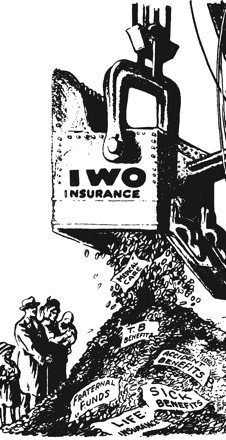
Reaping the benefits (political cartoon).
Source. Fraternal Outlook, 1947, reprinted by permission of the New York Public Library.
Figure 2.
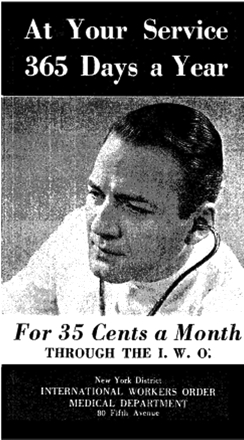
Flier for International Workers Order insurance.
Source. International Workers Order Records, Kheel Center, Cornell University.
Figure 3.

Birth Control Federation of America poster linking contraception to other control technologies.
Source. Planned Parenthood Federation of America Records, Sophia Smith Collection, Smith College.
Acknowledgments
The Barbara Bates Center for the Study of the History of Nursing at the University of Pennsylvania, Philadelphia, funded research for this article.
The author thanks Ruth Sidel, Donna Diers, and Duff Gillespie for their helpful comments.
Peer Reviewed
REFERENCES
- 1.A Bill to Require Equitable Coverage of Prescription Contraceptive Drugs and Devices, and Contraceptive Services Under Health Plans, S 1214, 109th Congress, 1st session, Congressional Record 151 (June 9, 2005): S6316. Available at: http://frwebgate.access.gpo.gov/cgi-bin/getpage.cgi?position=all&page=S6316&dbname=2005_record. Accessed July 12, 2006. [Google Scholar]
- 2.Jennifer N. White, “The Contraception Misconception: Why Prescription Contraceptives Should be Covered by Employer Insurance Plans,” Hofstra Law Review 31, no. 1 (2004): 271–302. [PubMed] [Google Scholar]
- 3.Almanakh: baytrog fun Idn tsu dem oyfboy fun Amerike; tsen yoriker yubiley fun Internatsyonaln Arbeter Ordn [Almanac: Jews’ Contribution to the Building of America; 10 Year Jubilee of the International Workers Order.] (New York: International Workers Order, 1940), 421; “Class Struggle in Fraternal Organizations,” 1930, p. 16, International Workers Order Records, Tamiment Library, New York University.
- 4.International Workers Order, Inc. General Data, 1930 to 1938, box 2, International Workers Order Records, 1927–1956. 5276, Kheel Center for Labor-Management Documentation and Archives, Cornell University Library; “Promoting Security,” 1940, p. 3, in box 48, Kheel Center for Labor-Management Documentation and Archives, Cornell University Library.
- 5.Klehr Harvey, The Heyday of American Communism (New York: Basic Books, 1984).
- 6.“The International Workers Order and What It Stands For, 1931, p. 15, International Workers Order Records, Tamiment Library, New York University; “Class Struggle,” 18–19.
- 7.Paul C. Mishler, Raising Reds: The Young Pioneers, Radical Summer Camps, and Communist Political Culture in the United States (New York: Columbia University Press, 1999), 77; Melech Epstein, The Jews and Communism (New York: Trade Union Sponsoring Committee, 1959), 260.
- 8.Committee on the Costs of Medical Care, Medical Care for the American People (Chicago: University of Chicago Press, 1932), 13.
- 9.“The International Workers Order,” 7.
- 10.Shaffer N., “The New York Medical Department,” in Five Years of International Workers Order 1930–1935 (New York: International Workers Order, 1935), 109–12, in box 48, Kheel Center for Labor-Management Documentation and Archives, Cornell University Library.
- 11.Ginsberg Sol, “Cooperating for Health,” New Order, February 1938, 9.
- 12.Robert S. Lynd and Alice C. Hanson, “The People as Consumers,” in Recent Social Trends in the United States: Report of the President’s Research Committee on Social Trends (New York: Whittlesey House, 1934), 864.
- 13.Ginsberg, “Cooperating for Health,” 9; see also Thomas J.E. Walker, Pluralistic Fraternity: The History of the International Worker’s Order (New York: Garland Publishing, 1991), 18–19.
- 14.JAMA 49 (1907), quoted in Jerome L. Schwartz, “Early History of Prepaid Medical Care Plans,” Bulletin of the History of Medicine 39, no. 5 (1965): 461; Paul Starr, The Social Transformation of American Medicine (New York: Basic Books, 1982), 200–209. [PubMed]
- 15.New Plans of Medical Service (Chicago: Julius Rosenwald Fund, 1936) and rev. ed. (New York: Bureau of Cooperative Medicine, 1940); Schwartz, “Early History,” 475.
- 16.“New York, Detroit and Philadelphia Join in Anti-Syphilis War,” New Order, December 1937, 11; “X-Ray for Members,” Fraternal Outlook, December 1939, 2, 27; “Chest X-Ray Survey,” Fraternal Outlook, February 1949, 15; Peter Shipka, “Our Order and Its Benefits,” in Five Years of International Workers Order 30–34.
- 17.Arthur J. Sabin, Red Scare in Court: New York versus the International Workers Order (Philadelphia: University of Pennsylvania Press, 1993), 249–250.
- 18.Appel Cheri, “Planning Your Family,” Fraternal Outlook, May 1940, 29.
- 19.Ibid, 30; Letter to the editor, New Order, October 1937, 21.
- 20.“For the Ladies,” Fraternal Outlook, January 1940, 9.
- 21.Greene Dave, “Der Meditzinisher Department in Nyu York [The Medical Department in New York],” in Almanakh [Almanac], 460.
- 22.Kahn I. W., “The Problem of Criminal Abortion in the City of New York,” Medical Record 142, no. 8 (1935): 9, 11, 13, and no. 9 (1935): 406. [Google Scholar]
- 23.Harry Reid and Hillary Rodham Clinton, “Abortion Debate Shuns Prevention,” Albany Times Union, April 18, 2006, http://www.timesunion.com/AspStories/storyprint.asp?StoryID=472621 (accessed July 12, 2006).
- 24.Appel, “Planning Your Family”; Annual Report of the American Birth Control League for the Year 1937, p. 24, box 4, Planned Parenthood Federation of America Records, 1918–1974 (PPFA I), Sophia Smith Collection, Smith College.
- 25.Gretta Palmer, “Birth Control Goes Suave,” Today, July 20, 1935, 14–15, quoted in Linda Gordon, Woman’s Body, Woman’s Right, 2nd ed (New York: Penguin Books, 1990), 323.
- 26.“The International Workers Order,” 7.
- 27.Henry F. Pringle, “What Do the Women of America Think About Birth Control?” Ladies’ Home Journal, March 1938, 14–15, 94–95, 97.
- 28.Sanger Margaret, form letter to supporters, December 14, 1936, quoted in Ellen Chesler, Woman of Valor: Margaret Sanger and the Birth Control Movement in America (New York: Simon and Schuster, 1992), 373.
- 29.US v. One Package, 86 F.2d 737 (1936), quoted in Chesler, Woman of Valor, 373.
- 30.“The Report of the Committee on Contraception of the American Medical Association,” Journal of Contraception 2, no. 6–7 (1937): 123. [Google Scholar]
- 31.Tone Andrea, Devices and Desires: A History of Contraceptives in America (New York: Hill and Wang, 2001), 119–149.
- 32.Chesler, Woman of Valor, 393.
- 33.Appel Cheri, letter to the editor, New York Times, February 13, 1990, A24.
- 34.“The Accident of Birth,” Fortune, February 1938, 85.
- 35.Appel, “Planning Your Family,” 30.
- 36.Ibid; Eric M. Matsner, Medical Indications for Contraceptive Advice, 1938, box 10, Planned Parenthood Federation of America Records, 1918–1974 (PPFA I), Sophia Smith Collection, Smith College; Hannah M. Stone, “Multiparity as an Indication for Contraception,” Human Fertility 5, no. 5 (1940): 144; Morris L. Ernst and Harriet F. Pilpel, “A Medical Bill of Rights,” Journal of Contraception 2, no. 2 (1937): 35–37. [Google Scholar]
- 37.Greene, “Meditzinisher Department [Medical Department],” 460.
- 38.American Birth Control League for the Year 1937, pp. 29–30; Hannah M. Stone, “The Vaginal Diaphragm,” Journal of Contraception 3, no. 6–7 (1938): 123. [Google Scholar]
- 39.“Accident of Birth,” 84–85.
- 40.Tone, Devices and Desires, 68, 170.
- 41.Marie E. Kopp, Birth Control in Practice (New York: Robert M. McBride & Co, 1934), 134, 211.
- 42.Norman E. Himes, Medical History of Contraception (1936; repr, New York: Schocken Books, 1970), 186–206.
- 43.Robert L. Dickinson and Woodbridge E. Morris, Techniques of Conception Control (Baltimore, Md: Williams and Wilkins Co, 1941), 7.
- 44.Hannah M. Stone, “Occlusive Methods of Contraception,” Journal of Contraception 2, no. 5 (1937): 102–105; Dickinson and Morris, Techniques of Conception Control, 23; Tone, Devices and Desires, 264. [Google Scholar]
- 45.“The Main Task Before the IWO,” in Five Years of International Workers Order, 59.
- 46.Rubinow I. M., The Quest for Security (New York: Henry Holt & Company, 1934), 208; Alan Derickson, Health Security for All: Dreams of Universal Health Care in America (Baltimore: Johns Hopkins University Press, 2005), 72–100.
- 47.A National Health Program: Report of the Technical Committee on Medical Care 1938 (Washington, DC: GPO, 1939), 3; John E. Middleton, “A New Deal for Health,” New Order, August 1938, 10.
- 48.Starr, Social Transformation, 277–287.
- 49.“Report on Examination of the International Workers Order, Inc, by the Insurance Department of the State of New York,” 1950, pp. 143–144, in box 24, Kheel Center for Labor-Management Documentation and Archives, Cornell University Library.
- 50.The Order, 1950, p. 134, box 23, Kheel Center for Labor-Management Documentation and Archives, Cornell University Library.
- 51.Sabin, Red Scare in Court, 212–215.
- 52.Gold Rachel Benson, Cory L. Richards, Usha R. Ranji, and Alina Salganicoff, “Medicaid: A Critical Source of Support for Family Planning in the United States,” Guttmacher Institute Issues in Brief, April 2005, http://www.guttmacher.org/pubs/medicaid-IB-Gold.pdf (accessed July 12, 2006); Guttmacher Institute, “State Policies in Brief: State Medicaid Family Planning Eligibility Expansions,” July 2007, http://www.guttmacher.org/statecenter/spibs/spib_SMFPE.pdf (accessed July 18, 2007).
- 53.Uneven and Unequal: Insurance Coverage and Reproductive Heath Services (New York: Guttmacher Institute, 1994), cited in Adam Sonfield et al., “US Insurance Coverage of Contraceptives and the Impact of Contraceptive Coverage Mandates, 2002,” Perspectives on Sexual and Reproductive Health 36, no. 2 (2004): 72–73. [DOI] [PubMed]
- 54.Dailard Cynthia, “Contraceptive Coverage: A 10-Year Retrospective,” Guttmacher Report on Public Policy 7, no. 2 (2004), http://www.guttmacher.org/pubs/tgr/07/2/gr070206.html (accessed July 17, 2006); “State Policies in Brief: Insurance Coverage of Contraceptives,” July 2007, http://www.guttmacher.org/statecenter/spibs/spib_ICC.pdf (accessed July 18, 2007).
- 55.U.S. Equal Employment Opportunity Commission, “Decision on Coverage of Contraception,” http://www.eeoc.gov/policy/docs/decision-contraception.html (accessed July 15, 2007).
- 56.In re Union Pac. R.R. Employment Practices Litig., 378 F. Supp. 2d 1139, 1149 (D. Neb. 2005), quoted in National Women’s Law Center, “Coverage of Contraceptives in Health Insurance: The Facts You Should Know,” http://www.nwlc.org/pdf/022406_ContraceptiveCoverageBackgrounder.pdf (accessed December 29, 2006).
- 57.Brandi Standridge v. Union Pacific Railroad Company, 479 F.3d 936 (8th Cir. 2007), http://www.ca8.uscourts.gov/opndir/07/03/061706P.pdf; Tamar Lewin, “Court Says Health Coverage May Bar Birth-Control Pills,” New York Times, March 17, 2007, A11.
- 58.Sonfield et al., “US Insurance Coverage,” 72–79.
- 59.National Women’s Law Center, “Coverage of Contraceptives”; Sonfield et al., “US Insurance Coverage.”