



Figure 1.
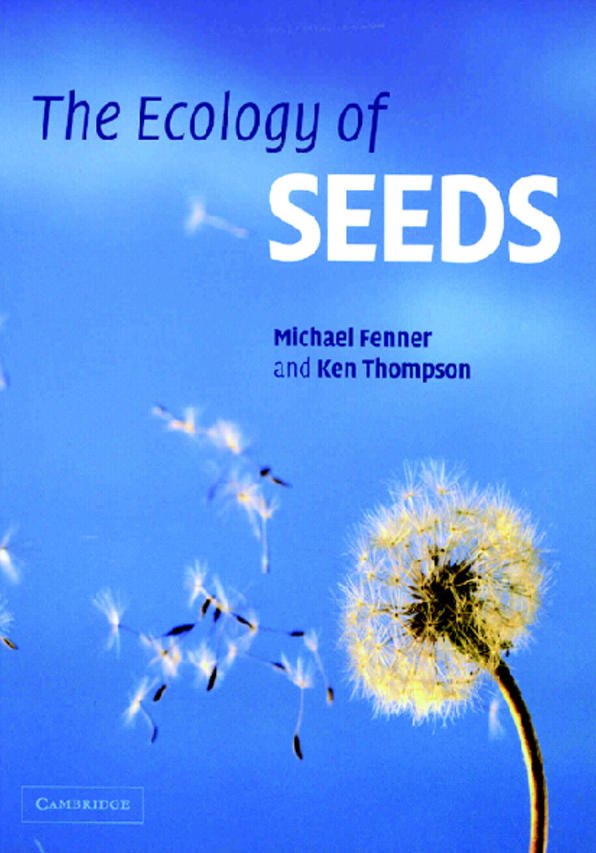
This volume is a timely update and considerable expansion of the small book Seed Ecology, published by the first author twenty years ago, and long out of print.
Is it useful to separate a particular branch of study such as ‘seed ecology’ from the wider field of plant ecology? Aren't seeds just a particular packaged form of the sporophyte, at a certain stage in its life cycle? While some may ask those questions, a major strength of this book is the care that the authors take throughout to set their review in the context of current ecological thinking and debate. They achieve this is by the (chrono)logical progression of their chapters, and also by the provision of boxed discussions of a number of ‘hot’ topics and questions at appropriate points in the text.
The first chapter sets the scene by considering general questions of life histories, reproductive strategies and allocation. The issue of sexual versus asexual reproduction in plants leads to all the topics around resource allocation and the costs of seed production, giving special emphasis to the question of seed size and its variation, and a useful boxed discussion of ‘trade-off’. Perhaps surprisingly, the authors haven't included the classic review on seed size and shape by Harper et al. (1970). However, they do remind readers of the often large variation in seed crops between years in many species, a feature often forgotten or ignored, but long known and measured (mast fruiting), especially by foresters (e.g. Schwappach, 1895).
Chapter 2 discusses hazards during seeds' development, including poor pollination, resource limitation and pre-dispersal predation. The boxed discussion features low seed set in sparse populations (the Allee effect), an understanding of which has important consequences for potential extinction and conservation efforts to counteract it.
The authors point out in Chapter 3 that probably few things in seed ecology have changed more in recent years than our understanding of the fascinating topic of seed dispersal. For example, for both wind- and animal-dispersed seeds there has been an underestimate of the importance of the ‘tails’ of distributions of dispersal distance; and the numbers of seeds achieving such extreme dispersal distances are mostly underestimated because of methodological problems. The boxed essay highlights how little we know about why the fleshy fruits of some plants, presumed to attract animal dispersers, are nevertheless poisonous.
Chapter 4 covers a particular specialism of the second author: soil seed banks, their composition, dynamics and ecological significance; with a brief mention of aerial seed banks (serotiny). The now well-known classification of seed bank types is described; along with caveats on methodology, and a boxed consideration of seed persistence as a plant trait—the conclusion being that it is mainly a species trait, but one that can be modified by environmental conditions.
Chapters 5 and 6 respectively consider seed dormancy and seed germination. One link between Chapters 4 and 5 is that seed dormancy and persistence in soil are not necessarily related, perhaps counter-intuitively. Dormancy is one, though not the only means by which germination is delayed following shedding, so that it takes place at the right time and in the right place. The authors give a clear and commonsense account of the various attempts to describe and classify seed dormancy, which from time to time have descended into semantics; and this will be especially valuable for the novice. Does light break dormancy, or is it merely an environmental cue for germination? The authors favour the latter, but give fair exposure to the former view. Topics overlap between these two chapters; and, for example, some of the apparent confusion around the role of temperature is explained by the fact that exposure to particular temperature regimes can act both to remove dormancy and provide an environmental cue for germination (radicle growth). Seed germination in response to smoke has been of special interest in the last few years, and this is covered in the boxed essay in Chapter 6.
Post-dispersal hazards such as predation, loss to pathogens, fatal germination at depth and loss of viability due to ageing are all covered in Chapter 7. To round off and return to the broad ecological and evolutionary context of the first, the final two chapters cover the related topics of seedling establishment (Chapter 8) and ‘gaps, regeneration and diversity’ (Chapter 9), making the link to adult plants and their distribution and abundance—the stuff of plant ecology. A thoughtful and useful boxed essay in Chapter 9 considers whether seed traits are linked to the abundance of species; and concludes that they are not in any consistent way, having shown in Chapter 1 that seed traits and adult plant traits are not strongly associated, with the latter perhaps mostly determining species range.
Overall, the authors have been very successful in achieving their aim ‘to synthesise the current information available on the ecological aspects of seed biology’. While their review of the current literature is a broadly representative overview, rather than comprehensive, this volume cites well over three times as many papers as its predecessor; pointing to the substantial increase in interest and activity in the subject over the last twenty years. For depth of coverage it cannot compete with the relatively recent collection of reviews by individual specialists edited by the first author (Fenner, 2000). Nevertheless, its coverage of the very recent literature has to give it some advantage. As an introduction to seed ecology, complementary to that earlier volume, it is excellent. The consistency of style, compared with multi-author compilations, will help it appeal to a broad range of readers; from schoolteachers and keen pupils seeking low-cost but relevant ecological projects, to ecologists and botanists requiring an accessible, rapid introduction to the subject. The style is clear and rigorous and at the same time engaging—a good read! The reviewer's copy was a soft-back version, well produced and attractive for its reasonable price, putting it in easy range of most students.
LITERATURE CITED
- Fenner M. (ed) 2000. Seeds: the ecology of regeneration in plant communities. Wallingford, UK: CABI Publishing.
- Harper JL, Lovell PH, Moore KG. 1970. The shapes and sizes of seeds. Annual Review of Ecology and Systematics 1: 327–356. [Google Scholar]
- Schwappach A. 1895. Die Samenproduktion der wichtigsten Waldholzarten in Preussen. Preussische Zeitschrift für Forst- und Jagdwesen 27: 147–174. [Google Scholar]