



Abstract
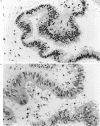
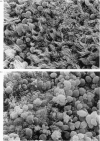
Mobiluncus curtisii and M. mulieris are anaerobic curved rods commonly isolated, together with other bacteria, from the vagina of women with bacterial vaginosis (BV). We have shown that of 11 strains of M. curtisii and four strains of M. mulieris examined, each produced a cytotoxin after growth in three types of liquid media. The toxin present in supernatant fluids after centrifugation of Mobiluncus cultures was active against Vero cells and four other cell lines tested, producing a marked cytopathic effect with destruction within 72 hours. The supernatant fluids could be diluted no more than 8 to 16-fold before toxic activity was lost. In bovine oviduct organ cultures, the supernatant fluids from cultures of eight M. curtisii and two M. mulieris strains that were tested caused loss of ciliary vigour which was usually complete after 60 hours. In addition, there was raggedness of the epithelial cell border with detachment of cells seen histologically and loss of cilia together with bloating and loss of ciliated cells observed by scanning electron microscopy. The toxin was extracellular, relatively thermostable (surviving heating to 56 degrees C for 30 min but not boiling for 20 min) and was inactivated under extremes of pH (pH 9 and pH 3). The existence of the toxin means that the Mobiluncus spp could have an active role in the development of BV.
Full text
PDF


Images in this article

Selected References
These references are in PubMed. This may not be the complete list of references from this article.
- Fontaine E. A., Clark J. B., Abeck D., Taylor-Robinson D. The effect of a toxin from Bacteroides ureolyticus on the mucosal epithelium of human and bovine oviducts. Br J Exp Pathol. 1988 Oct;69(5):631–638. [PMC free article] [PubMed] [Google Scholar]
- Hjelm E., Hallen A., Forsum U., Wallin J. Anaerobic curved rods in vaginitis. Lancet. 1981 Dec 12;2(8259):1353–1354. doi: 10.1016/s0140-6736(81)91380-5. [DOI] [PubMed] [Google Scholar]
- McGee Z. A., Johnson A. P., Taylor-Robinson D. Human fallopian tubes in organ culture: preparation, maintenance, and quantitation of damage by pathogenic microorganisms. Infect Immun. 1976 Feb;13(2):608–618. doi: 10.1128/iai.13.2.608-618.1976. [DOI] [PMC free article] [PubMed] [Google Scholar]
- Phillips I., Taylor E. Anaerobic curved rods in vaginitis. Lancet. 1982 Jan 23;1(8265):221–221. doi: 10.1016/s0140-6736(82)90780-2. [DOI] [PubMed] [Google Scholar]
- Sprott M. S., Ingham H. R., Pattman R. S., Eisenstadt R. L., Short G. R., Narang H. K., Sisson P. R., Selkon J. B. Characteristics of motile curved rods in vaginal secretions. J Med Microbiol. 1983 May;16(2):175–182. doi: 10.1099/00222615-16-2-175. [DOI] [PubMed] [Google Scholar]
- Vetere A., Borriello S. P., Fontaine E., Reed P. J., Taylor-Robinson D. Characterisation of anaerobic curved rods (Mobiluncus spp.) isolated from the urogenital tract. J Med Microbiol. 1987 May;23(3):279–288. doi: 10.1099/00222615-23-3-279. [DOI] [PubMed] [Google Scholar]