



Abstract
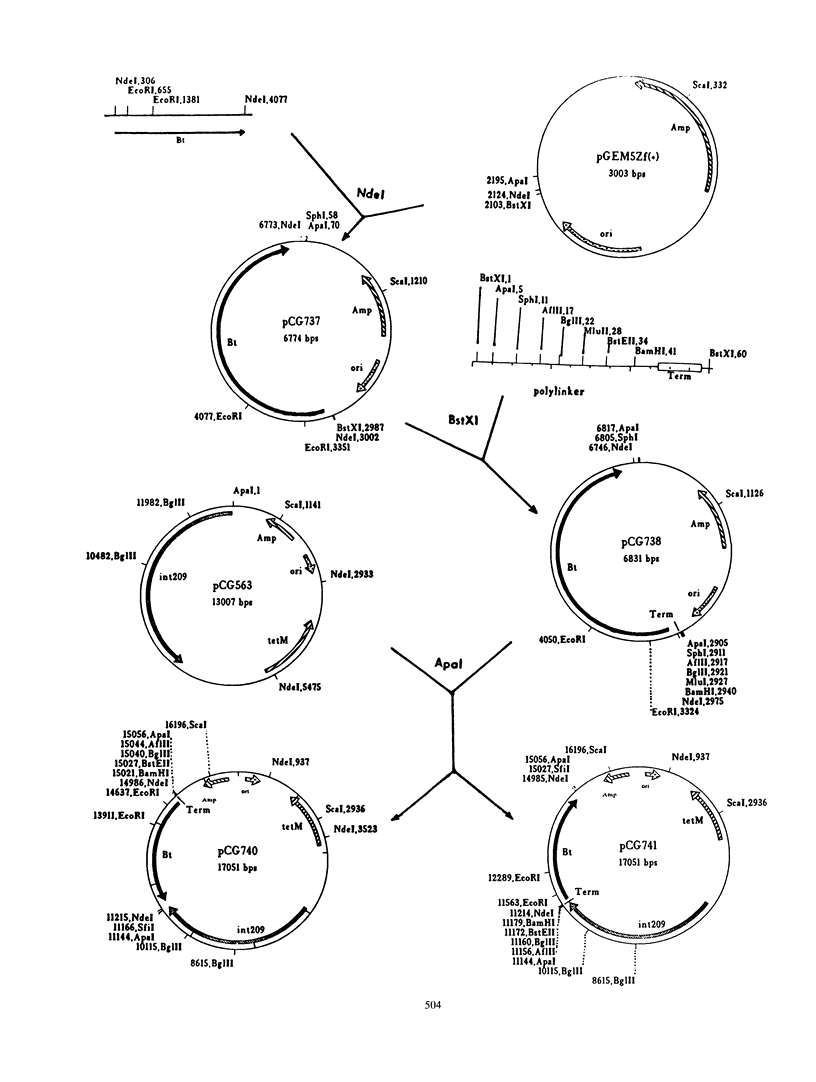
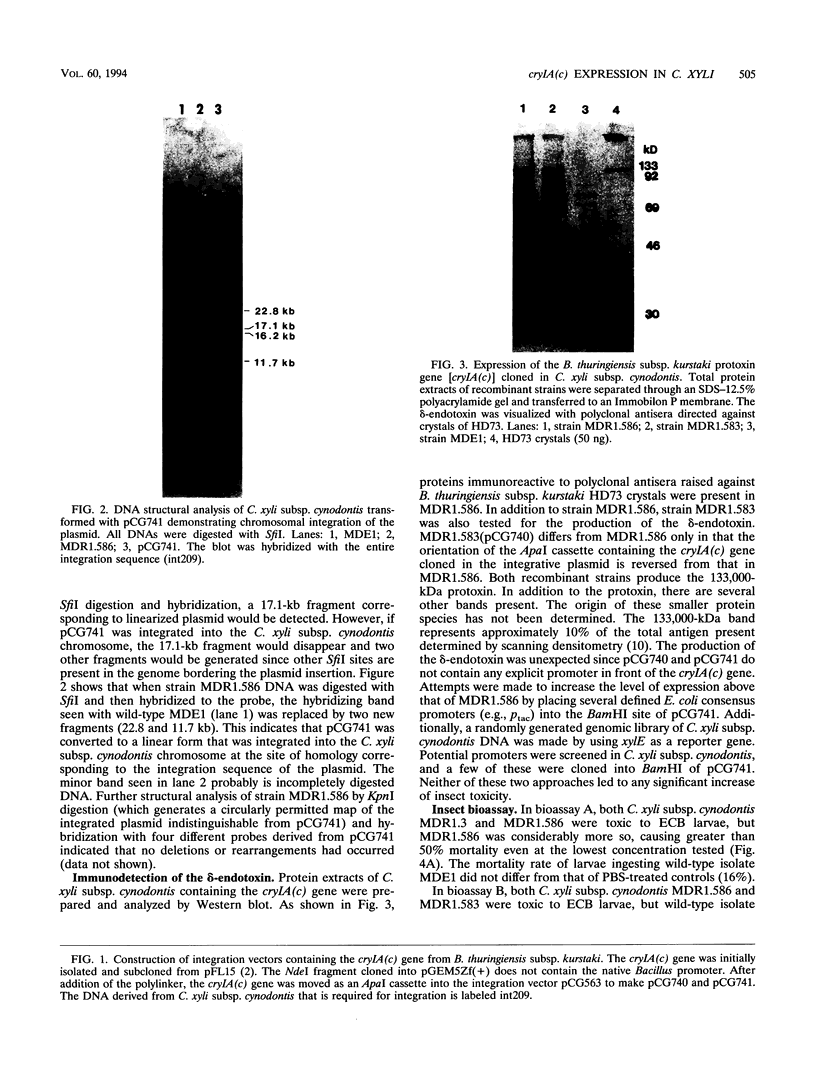
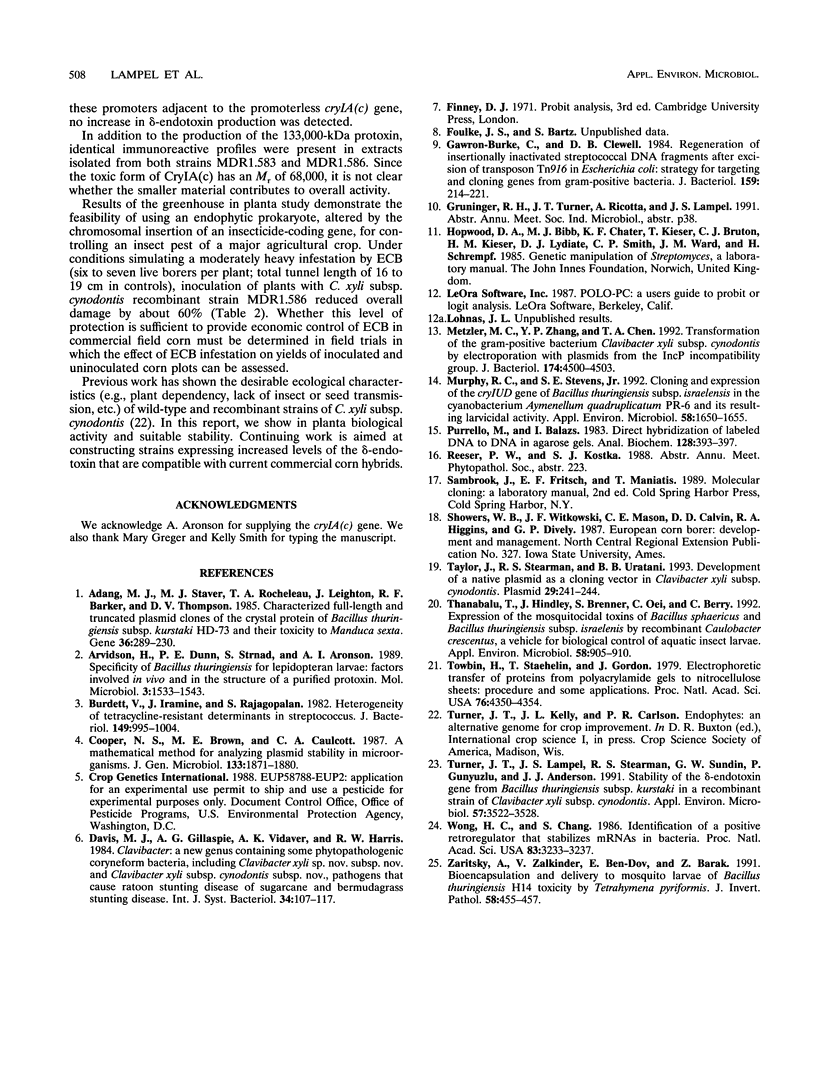
A bacterial endophyte was engineered for insecticidal activity against the European corn borer. The cryIA(c) gene from Bacillus thuringiensis subsp. kurstaki was introduced into the chromosome of Clavibacter xyli subsp. cynodontis by using an integrative plasmid vector. The integration vectors pCG740 and pCG741 included the replicon pGEM5Zf(+), which is maintained in Escherichia coli but not in C. xyli subsp. cynodontis; tetM as a marker for selection in C. xyli subsp. cynodontis; and a chromosomal fragment of C. xyli subsp. cynodontis to allow for homologous recombination between the vector and the bacterial chromosome. Insertion of vector DNA into the chromosome was demonstrated by DNA hybridization. Recombinant strains MDR1.583 and MDR1.586 containing the cryIA(c) gene were shown to produce the 133,000-kDa protoxin and several smaller immunoreactive proteins. Both strains were equally toxic to insect larvae in bioassays. Significant insecticidal activity was demonstrated in planta. The cryIA(c) gene and the tetM gene introduced into strain MDR1.586 were shown to be deleted from some cells, thereby giving rise to a noninsecticidal segregant population. In DNA hybridization experiments and insect bioassays, these segregants were indistinguishable from the wild-type strain. Overall, these results demonstrate the plausibility of genetically engineered bacterial endophytes for insect control.
Full text
PDF


Images in this article


Selected References
These references are in PubMed. This may not be the complete list of references from this article.
- Adang M. J., Staver M. J., Rocheleau T. A., Leighton J., Barker R. F., Thompson D. V. Characterized full-length and truncated plasmid clones of the crystal protein of Bacillus thuringiensis subsp. kurstaki HD-73 and their toxicity to Manduca sexta. Gene. 1985;36(3):289–300. doi: 10.1016/0378-1119(85)90184-2. [DOI] [PubMed] [Google Scholar]
- Arvidson H., Dunn P. E., Strnad S., Aronson A. I. Specificity of Bacillus thuringiensis for lepidopteran larvae: factors involved in vivo and in the structure of a purified protoxin. Mol Microbiol. 1989 Nov;3(11):1533–1543. doi: 10.1111/j.1365-2958.1989.tb00139.x. [DOI] [PubMed] [Google Scholar]
- Burdett V., Inamine J., Rajagopalan S. Heterogeneity of tetracycline resistance determinants in Streptococcus. J Bacteriol. 1982 Mar;149(3):995–1004. doi: 10.1128/jb.149.3.995-1004.1982. [DOI] [PMC free article] [PubMed] [Google Scholar]
- Cooper N. S., Brown M. E., Caulcott C. A. A mathematical method for analysing plasmid stability in micro-organisms. J Gen Microbiol. 1987 Jul;133(7):1871–1880. doi: 10.1099/00221287-133-7-1871. [DOI] [PubMed] [Google Scholar]
- Gawron-Burke C., Clewell D. B. Regeneration of insertionally inactivated streptococcal DNA fragments after excision of transposon Tn916 in Escherichia coli: strategy for targeting and cloning of genes from gram-positive bacteria. J Bacteriol. 1984 Jul;159(1):214–221. doi: 10.1128/jb.159.1.214-221.1984. [DOI] [PMC free article] [PubMed] [Google Scholar]
- Metzler M. C., Zhang Y. P., Chen T. A. Transformation of the gram-positive bacterium Clavibacter xyli subsp. cynodontis by electroporation with plasmids from the IncP incompatibility group. J Bacteriol. 1992 Jul;174(13):4500–4503. doi: 10.1128/jb.174.13.4500-4503.1992. [DOI] [PMC free article] [PubMed] [Google Scholar]
- Murphy R. C., Stevens S. E., Jr Cloning and expression of the cryIVD gene of Bacillus thuringiensis subsp. israelensis in the cyanobacterium Agmenellum quadruplicatum PR-6 and its resulting larvicidal activity. Appl Environ Microbiol. 1992 May;58(5):1650–1655. doi: 10.1128/aem.58.5.1650-1655.1992. [DOI] [PMC free article] [PubMed] [Google Scholar]
- Purrello M., Balazs I. Direct hybridization of labeled DNA to DNA in agarose gels. Anal Biochem. 1983 Feb 1;128(2):393–397. doi: 10.1016/0003-2697(83)90391-3. [DOI] [PubMed] [Google Scholar]
- Taylor J., Stearman R. S., Uratani B. B. Development of a native plasmid as a cloning vector in Clavibacter xyli subsp. cynodontis. Plasmid. 1993 May;29(3):241–244. doi: 10.1006/plas.1993.1027. [DOI] [PubMed] [Google Scholar]
- Thanabalu T., Hindley J., Brenner S., Oei C., Berry C. Expression of the mosquitocidal toxins of Bacillus sphaericus and Bacillus thuringiensis subsp. israelensis by recombinant Caulobacter crescentus, a vehicle for biological control of aquatic insect larvae. Appl Environ Microbiol. 1992 Mar;58(3):905–910. doi: 10.1128/aem.58.3.905-910.1992. [DOI] [PMC free article] [PubMed] [Google Scholar]
- Towbin H., Staehelin T., Gordon J. Electrophoretic transfer of proteins from polyacrylamide gels to nitrocellulose sheets: procedure and some applications. Proc Natl Acad Sci U S A. 1979 Sep;76(9):4350–4354. doi: 10.1073/pnas.76.9.4350. [DOI] [PMC free article] [PubMed] [Google Scholar]
- Turner J. T., Lampel J. S., Stearman R. S., Sundin G. W., Gunyuzlu P., Anderson J. J. Stability of the delta-endotoxin gene from Bacillus thuringiensis subsp. kurstaki in a recombinant strain of Clavibacter xyli subsp. cynodontis. Appl Environ Microbiol. 1991 Dec;57(12):3522–3528. doi: 10.1128/aem.57.12.3522-3528.1991. [DOI] [PMC free article] [PubMed] [Google Scholar]
- Wong H. C., Chang S. Identification of a positive retroregulator that stabilizes mRNAs in bacteria. Proc Natl Acad Sci U S A. 1986 May;83(10):3233–3237. doi: 10.1073/pnas.83.10.3233. [DOI] [PMC free article] [PubMed] [Google Scholar]
- Zaritsky A., Zalkinder V., Ben-Dov E., Barak Z. Bioencapsulation and delivery to mosquito larvae of Bacillus thuringiensis H14 toxicity by Tetrahymena pyriformis. J Invertebr Pathol. 1991 Nov;58(3):455–457. doi: 10.1016/0022-2011(91)90195-v. [DOI] [PubMed] [Google Scholar]