



Abstract
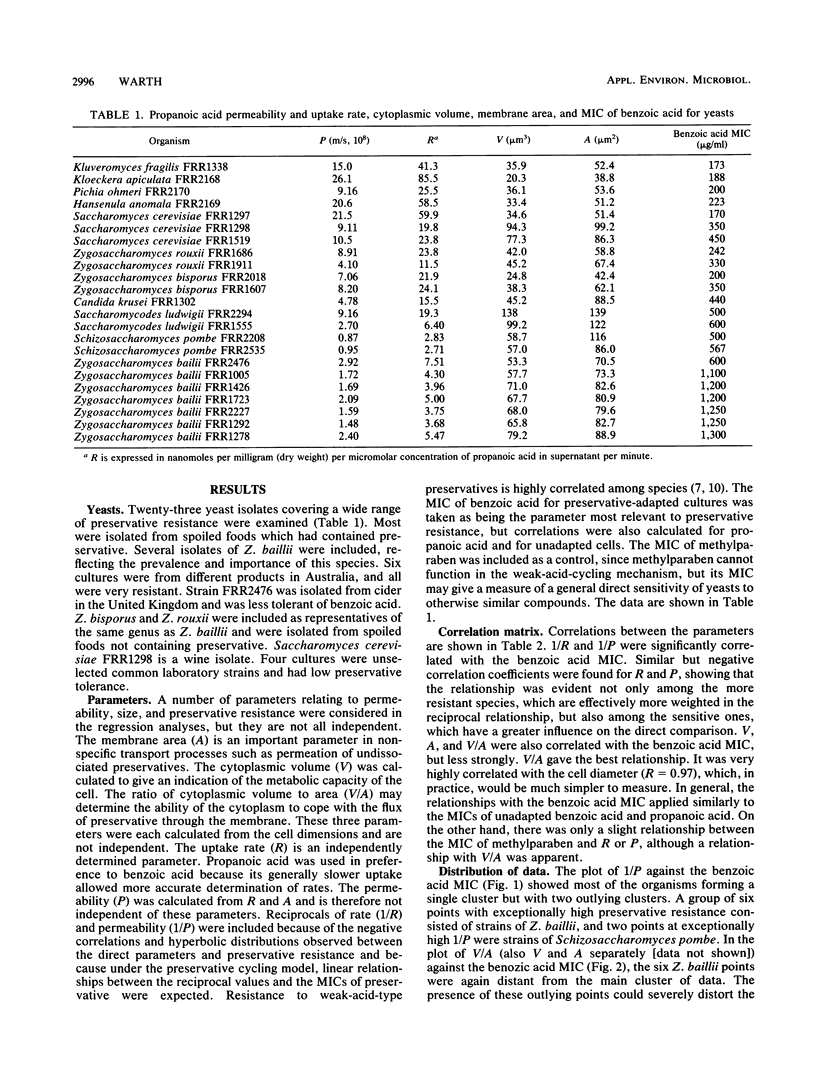
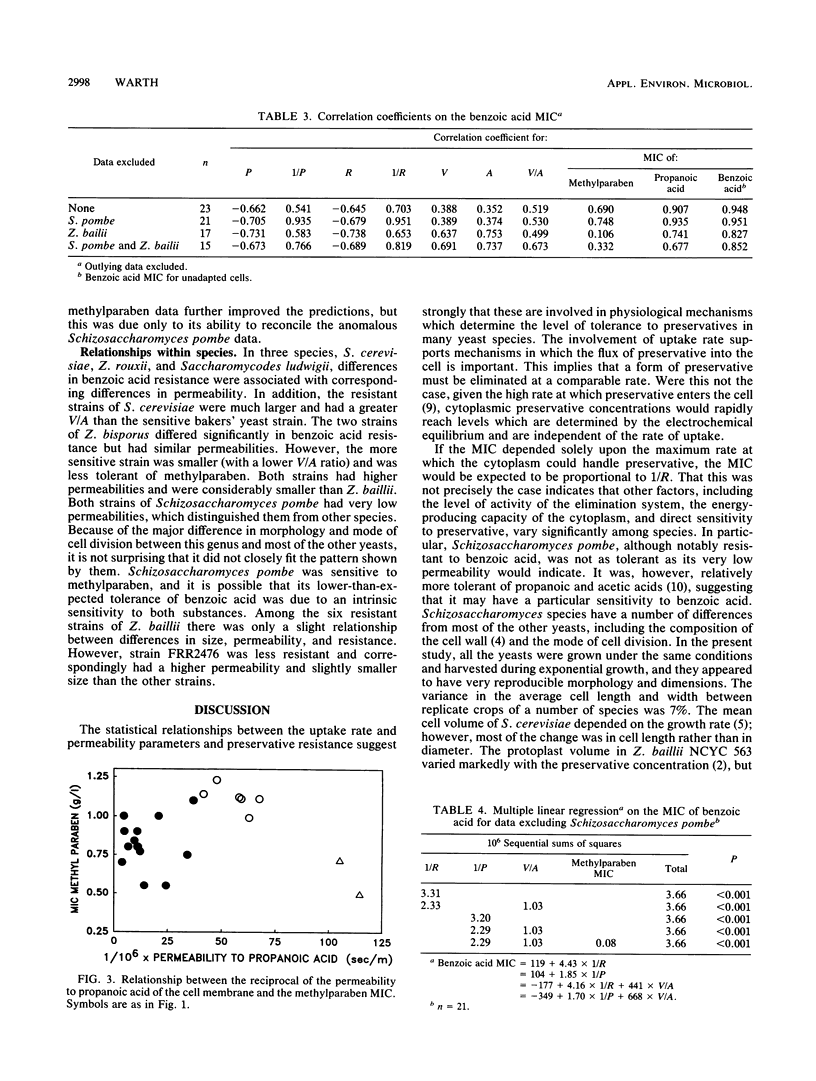
The rate of uptake of propanoic acid and the cell dimensions were measured for 23 yeasts differing in their resistance to weak-acid-type preservatives. Relationships between reciprocal uptake rate, reciprocal permeability, cell volume, cell area, volume/area, and the MICs of benzoic acid and propanoic acid for the yeasts were tested by correlation analysis on pairs of parameters. The MIC of methylparaben, which is not a weak-acid-type preservative, was included. The most significant relationships found were between both reciprocal uptake rate and reciprocal permeability and the MICs of propanoic and benzoic acids Cell volume, area, and volume/area were each individually correlated with propanoic and benzoic acid MICs, but less strongly. In multiple regression analyses, inclusion of terms for volume, area, or volume/area did not markedly increase the significance. The MIC of methylparaben was unrelated to the uptake and permeability parameters, but did show a correlation with cell volume/area. Schizosaccharomyces pombe was anomalous in having very low permeability. Exclusion of these outlying data revealed particularly strong relationships (P < 0.001) between both reciprocal uptake rate and reciprocal permeability and the benzoic acid MIC. MICs for Zygosaccharomyces bailii isolates were substantially higher than for the other species, and therefore Z. baillii isolates had a large influence on the regressions. However, the relationships observed remained significant even after removal of the Z. bailii data. In showing a correlation between the rate at which propanoic acid enters yeast cells and the ability of the cells to tolerate this and other weak-acid-type preservatives, but not methylparaben, the results suggest that the resistance mechanism, in which preservative is continuously removed from the cell, is a common and major determinant of the preservative tolerance of yeast species.
Full text
PDF


Selected References
These references are in PubMed. This may not be the complete list of references from this article.
- KREGER D. R. Observations on cell walls of yeasts and some other fungi by x-ray diffraction and solubility tests. Biochim Biophys Acta. 1954 Jan;13(1):1–9. doi: 10.1016/0006-3002(54)90264-4. [DOI] [PubMed] [Google Scholar]
- Kaneko H., Hosohara M., Tanaka M., Itoh T. Lipid composition of 30 species of yeast. Lipids. 1976 Dec;11(12):837–844. doi: 10.1007/BF02532989. [DOI] [PubMed] [Google Scholar]
- McMurrough I., Rose A. H. Effect of growth rate and substrate limitation on the composition and structure of the cell wall of Saccharomyces cerevisiae. Biochem J. 1967 Oct;105(1):189–203. doi: 10.1042/bj1050189. [DOI] [PMC free article] [PubMed] [Google Scholar]
- Warth A. D. Effect of benzoic Acid on growth yield of yeasts differing in their resistance to preservatives. Appl Environ Microbiol. 1988 Aug;54(8):2091–2095. doi: 10.1128/aem.54.8.2091-2095.1988. [DOI] [PMC free article] [PubMed] [Google Scholar]
- Warth A. D. Relationships between the resistance of yeasts to acetic, propanoic and benzoic acids and to methyl paraben and pH. Int J Food Microbiol. 1989 Jul;8(4):343–349. doi: 10.1016/0168-1605(89)90005-6. [DOI] [PubMed] [Google Scholar]