



Abstract
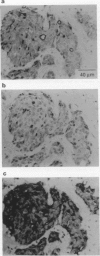
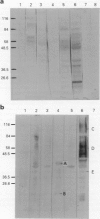
The expression of complex carbohydrates recognised by Helix pomatia lectin (HPA, nominal monosaccharide binding specificity alpha-GalNAc) has been shown to predict unfavourable prognosis in breast and other cancers. It has been suggested that the prognostic significance of HPA binding may be through recognition of either Tn epitope (alpha-GalNAc-O-serine/threonine) or blood group A antigen (terminal alpha-1-->3GalNAc attached to the basic H-antigen, Fuc-alpha-1-->2-Gal-beta-1-->4(or 3) GlcNAc-->R). In this study, the expression of glycoproteins terminating in alpha-GalNAc residues was investigated immunohistochemically using HPA and two monoclonal antibodies--BRIC 66 (anti-alpha-GalNAc) and BRIC 111 (anti-Tn). In paraffin sections, 74/87 (85%) of breast cancers expressed HPA-binding ligands, while 28/87 (32%) were positive for BRIC 66 binding and 25/87 (29%) expressed Tn. Distribution of staining patterns were distinctive and different with the three markers. BRIC 66, BRIC 111 and HPA binding to glycoproteins derived from breast cancer homogenates and to blood group A and Tn positive glycoproteins in Western blots confirmed the immunohistochemistry data. The results suggest that the prognostic significance of HPA binding in breast cancer is unlikely to be simply through recognition of blood group A antigen or Tn epitope on cancer cells. Breast cancers may express a complex profile of related but distinct glycans sharing similar terminal immunodominant sugar GalNAc, which may be implicated in aggressive biological behaviour.
Full text
PDF


Images in this article
Selected References
These references are in PubMed. This may not be the complete list of references from this article.
- Alam S. M., Whitford P., Cushley W., George W. D., Campbell A. M. Flow cytometric analysis of cell surface carbohydrates in metastatic human breast cancer. Br J Cancer. 1990 Aug;62(2):238–242. doi: 10.1038/bjc.1990.267. [DOI] [PMC free article] [PubMed] [Google Scholar]
- Anderson D. E., Haas C. Blood type A and familial breast cancer. Cancer. 1984 Nov 1;54(9):1845–1849. doi: 10.1002/1097-0142(19841101)54:9<1845::aid-cncr2820540913>3.0.co;2-5. [DOI] [PubMed] [Google Scholar]
- Anstee D. J., Tanner M. J. The distribution of blood-group antigens on butanol extraction of human erythrocyte 'ghosts'. Biochem J. 1974 Mar;138(3):381–386. doi: 10.1042/bj1380381. [DOI] [PMC free article] [PubMed] [Google Scholar]
- Baker D. A., Sugii S., Kabat E. A., Ratcliffe R. M., Hermentin P., Lemieux R. U. Immunochemical studies on the combining sites of Forssman hapten reactive hemagglutinins from Dolichos biflorus, Helix pomatia, and Wistaria floribunda. Biochemistry. 1983 May 24;22(11):2741–2750. doi: 10.1021/bi00280a023. [DOI] [PubMed] [Google Scholar]
- Brooks S. A., Leathem A. J. Prediction of lymph node involvement in breast cancer by detection of altered glycosylation in the primary tumour. Lancet. 1991 Jul 13;338(8759):71–74. doi: 10.1016/0140-6736(91)90071-v. [DOI] [PubMed] [Google Scholar]
- Cartron J. P., Nurden A. T. Galactosyltransferase and membrane glycoprotein abnormality in human platelets from Tn-syndrome donors. Nature. 1979 Dec 6;282(5739):621–623. doi: 10.1038/282621a0. [DOI] [PubMed] [Google Scholar]
- Fenlon S., Ellis I. O., Bell J., Todd J. H., Elston C. W., Blamey R. W. Helix pomatia and Ulex europeus lectin binding in human breast carcinoma. J Pathol. 1987 Jul;152(3):169–176. doi: 10.1002/path.1711520305. [DOI] [PubMed] [Google Scholar]
- Fukuda M. N., Papayannopoulou T., Gordon-Smith E. C., Rochant H., Testa U. Defect in glycosylation of erythrocyte membrane proteins in congenital dyserythropoietic anaemia type II (HEMPAS). Br J Haematol. 1984 Jan;56(1):55–68. doi: 10.1111/j.1365-2141.1984.tb01271.x. [DOI] [PubMed] [Google Scholar]
- Fukutomi T., Itabashi M., Tsugane S., Yamamoto H., Nanasawa T., Hirota T. Prognostic contributions of Helix pomatia and carcinoembryonic antigen staining using histochemical techniques in breast carcinomas. Jpn J Clin Oncol. 1989 Jun;19(2):127–134. [PubMed] [Google Scholar]
- Grundbacher F. J. Helix pomatia lectin-binding and predictive value in breast-cancer. Lancet. 1987 Nov 14;2(8568):1145–1145. doi: 10.1016/s0140-6736(87)91566-2. [DOI] [PubMed] [Google Scholar]
- Hakomori S. Blood group ABH and Ii antigens of human erythrocytes: chemistry, polymorphism, and their developmental change. Semin Hematol. 1981 Jan;18(1):39–62. [PubMed] [Google Scholar]
- Hammarström S., Kabat E. A. Purification and characterization of a blood-group A reactive hemagglutinin from the snail Helix pomatia and a study of its combining site. Biochemistry. 1969 Jul;8(7):2696–2705. doi: 10.1021/bi00835a002. [DOI] [PubMed] [Google Scholar]
- Idikio H. A., Manickavel V. Correlation of blood group antigen expression and oncogene-related proteins in malignant prostatic tissues. Pathol Res Pract. 1991 Mar;187(2-3):189–197. doi: 10.1016/S0344-0338(11)80770-3. [DOI] [PubMed] [Google Scholar]
- Inufusa H., Kojima N., Yasutomi M., Hakomori S. Human lung adenocarcinoma cell lines with different lung colonization potential (LCP), and a correlation between expression of sialosyl dimeric Le(x) (defined by MAb FH6) and LCP. Clin Exp Metastasis. 1991 May-Jun;9(3):245–257. doi: 10.1007/BF01753728. [DOI] [PubMed] [Google Scholar]
- Ishikawa M., Dennis J. W., Man S., Kerbel R. S. Isolation and characterization of spontaneous wheat germ agglutinin-resistant human melanoma mutants displaying remarkably different metastatic profiles in nude mice. Cancer Res. 1988 Feb 1;48(3):665–670. [PubMed] [Google Scholar]
- Kakeji Y., Tsujitani S., Mori M., Maehara Y., Sugimachi K. Helix pomatia agglutinin binding activity is a predictor of survival time for patients with gastric carcinoma. Cancer. 1991 Dec 1;68(11):2438–2442. doi: 10.1002/1097-0142(19911201)68:11<2438::aid-cncr2820681119>3.0.co;2-#. [DOI] [PubMed] [Google Scholar]
- King M. J., Parsons S. F., Wu A. M., Jones N. Immunochemical studies on the differential binding properties of two monoclonal antibodies reacting with Tn red cells. Transfusion. 1991 Feb;31(2):142–149. doi: 10.1046/j.1537-2995.1991.31291142945.x. [DOI] [PubMed] [Google Scholar]
- Laemmli U. K. Cleavage of structural proteins during the assembly of the head of bacteriophage T4. Nature. 1970 Aug 15;227(5259):680–685. doi: 10.1038/227680a0. [DOI] [PubMed] [Google Scholar]
- Leathem A. J., Brooks S. A. Predictive value of lectin binding on breast-cancer recurrence and survival. Lancet. 1987 May 9;1(8541):1054–1056. doi: 10.1016/s0140-6736(87)90482-x. [DOI] [PubMed] [Google Scholar]
- Lee J. S., Ro J. Y., Sahin A. A., Hong W. K., Brown B. W., Mountain C. F., Hittelman W. N. Expression of blood-group antigen A--a favorable prognostic factor in non-small-cell lung cancer. N Engl J Med. 1991 Apr 18;324(16):1084–1090. doi: 10.1056/NEJM199104183241603. [DOI] [PubMed] [Google Scholar]
- Mourali N., Muenz L. R., Tabbane F., Belhassen S., Bahi J., Levine P. H. Epidemiologic features of rapidly progressing breast cancer in Tunisia. Cancer. 1980 Dec 15;46(12):2741–2746. doi: 10.1002/1097-0142(19801215)46:12<2741::aid-cncr2820461234>3.0.co;2-w. [DOI] [PubMed] [Google Scholar]
- Schumacher U., Higgs D., Loizidou M., Pickering R., Leathem A., Taylor I. Helix pomatia agglutinin binding is a useful prognostic indicator in colorectal carcinoma. Cancer. 1994 Dec 15;74(12):3104–3107. doi: 10.1002/1097-0142(19941215)74:12<3104::aid-cncr2820741207>3.0.co;2-0. [DOI] [PubMed] [Google Scholar]
- Shiraishi T., Atsumi S., Yatani R. Comparative study of prostatic carcinoma bone metastasis among Japanese in Japan and Japanese Americans and whites in Hawaii. Adv Exp Med Biol. 1992;324:7–16. doi: 10.1007/978-1-4615-3398-6_2. [DOI] [PubMed] [Google Scholar]
- Springer G. F., Desai P. R., Banatwala I. Blood group MN antigens and precursors in normal and malignant human breast glandular tissue. J Natl Cancer Inst. 1975 Feb;54(2):335–339. [PubMed] [Google Scholar]
- Springer G. F., Desai P. R., Wise W., Carlstedt S. C., Tegtmeyer H., Stein R., Scanlon E. F. Pancarcinoma T and Tn epitopes: autoimmunogens and diagnostic markers that reveal incipient carcinomas and help establish prognosis. Immunol Ser. 1990;53:587–612. [PubMed] [Google Scholar]
- Springer G. F., Taylor C. R., Howard D. R., Tegtmeyer H., Desai P. R., Murthy S. M., Felder B., Scanlon E. F. Tn, a carcinoma-associated antigen, reacts with anti-Tn of normal human sera. Cancer. 1985 Feb 1;55(3):561–569. doi: 10.1002/1097-0142(19850201)55:3<561::aid-cncr2820550315>3.0.co;2-1. [DOI] [PubMed] [Google Scholar]