



Abstract
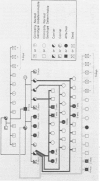
A disease closely resembling the human neutrophil dysfunction syndromes has been identified in a colony of dogs. The syndrome, referred to as the canine granulocytopathy syndrome, is characterized by recurrent-life-threatening bacterial infections and a greatly shortened life span. The disease is genetically determined, being transmitted as an autosomal recessive trait. The increased susceptibity to pyogenic infections and shortened life span is related to an impairment of leukocyte function at the cellular level. Preparation of neutrophils from affected animals exhibit impaired in vitro killing of Esherichia coli. The defect in bactericidal activity is associated with reduced glucose oxidation by the hexose monophosphate shunt and an increase capacity to reduce nitroblue tetrazolium dye. The data obtained thus far indicate the canine granulocytopathy syndrome will be of considerable value as a model for study of granulocytypathy sydromes in man.
Full text
PDF


Images in this article

Selected References
These references are in PubMed. This may not be the complete list of references from this article.
- Azimi P. H., Bodenbender J. G., Hintz R. L., Kontras S. B. Chronic granulomatous disease in three female siblings. JAMA. 1968 Dec 23;206(13):2865–2870. [PubMed] [Google Scholar]
- Babior B. M. Oxygen-dependent microbial killing by phagocytes (second of two parts). N Engl J Med. 1978 Mar 30;298(13):721–725. doi: 10.1056/NEJM197803302981305. [DOI] [PubMed] [Google Scholar]
- Baehner R. L., Boxer L. A., Davis J. The biochemical basis of nitroblue tetrazolium reduction in normal human and chronic granulomatous disease polymorphonuclear leukocytes. Blood. 1976 Aug;48(2):309–313. [PubMed] [Google Scholar]
- Baehner R. L. Disorders of leukocytes leading to recurrent infection. Pediatr Clin North Am. 1972 Nov;19(4):935–956. doi: 10.1016/s0031-3955(16)32775-4. [DOI] [PubMed] [Google Scholar]
- Baehner R. L., Johnston R. B., Jr, Nathan D. G. Comparative study of the metabolic and bactericidal characteristics of severely glucose-6-phosphate dehydrogenase-deficient polymorphonuclear leukocytes and leukocytes from children with chronic granulomatous disease. J Reticuloendothel Soc. 1972 Aug;12(2):150–169. [PubMed] [Google Scholar]
- Baehner R. L., Nathan D. G. Leukocyte oxidase: defective activity in chronic granulomatous disease. Science. 1967 Feb 17;155(3764):835–836. doi: 10.1126/science.155.3764.835. [DOI] [PubMed] [Google Scholar]
- Baehner R. L., Nathan D. G. Quantitative nitroblue tetrazolium test in chronic granulomatous disease. N Engl J Med. 1968 May 2;278(18):971–976. doi: 10.1056/NEJM196805022781801. [DOI] [PubMed] [Google Scholar]
- Clark R. A., Kimball H. R., Padgett G. A. Granulocyte chemotaxis in the Chediak-Higashi syndrome of mink. Blood. 1972 May;39(5):644–649. [PubMed] [Google Scholar]
- Cooper M. R., DeChatelet L. R., McCall C. E., LaVia M. F., Spurr C. L., Baehner R. L. Complete deficiency of leukocyte glucose-6-phosphate dehydrogenase with defective bactericidal activity. J Clin Invest. 1972 Apr;51(4):769–778. doi: 10.1172/JCI106871. [DOI] [PMC free article] [PubMed] [Google Scholar]
- Curnutte J. T., Whitten D. M., Babior B. M. Defective superoxide production by granulocytes from patients with chronic granulomatous disease. N Engl J Med. 1974 Mar 14;290(11):593–597. doi: 10.1056/NEJM197403142901104. [DOI] [PubMed] [Google Scholar]
- Davis W. C., Douglas S. D. Defective granule formation and function in the Chediak-Higashi syndrome in man and animals. Semin Hematol. 1972 Oct;9(4):431–450. [PubMed] [Google Scholar]
- Davis W. C., Huber H., Douglas S. D., Fudenberg H. H. A defect in circulating mononuclear phagocytes in chronicgranulomatous disease of childhood. J Immunol. 1968 Nov;101(5):1093–1095. [PubMed] [Google Scholar]
- Davis W. C., Spicer S. S., Greene W. B., Padgett G. A. Ultrastructure of bone marrow granulocytes in normal mink and mink with the homolog of the Chediak-Higashi trait of humans. I. Origin of the abnormal granules present in the neutrophils of mink with the C-HS trait. Lab Invest. 1971 Apr;24(4):303–317. [PubMed] [Google Scholar]
- Douglas S. D. Analytic review: disorders of phagocyte function. Blood. 1970 Jun;35(6):851–866. [PubMed] [Google Scholar]
- Douglas S. D., Fudenberg H. H. Genetically determined defects in host resistance to infection: cellular immunologic aspects. Med Clin North Am. 1969 Jul;53(4):903–922. [PubMed] [Google Scholar]
- Fudenberg H., Good R. A., Goodman H. C., Hitzig W., Kunkel H. G., Roitt I. M., Rosen F. S., Rowe D. S., Seligmann M., Soothill J. R. Primary immunodeficiencies. Report of a World Health Organization Committee. Pediatrics. 1971 May;47(5):927–946. [PubMed] [Google Scholar]
- Gallin J. I., Bujak J. S., Patten E., Wolff S. M. Granulocyte function in the Chediak-Higashi syndrome of mice. Blood. 1974 Feb;43(2):201–206. [PubMed] [Google Scholar]
- Good R. A., Quie P. G., Windhorst D. B., Page A. R., Rodey G. E., White J., Wolfson J. J., Holmes B. H. Fatal (chronic) granulomatous disease of childhood: a hereditary defect of leukocyte function. Semin Hematol. 1968 Jul;5(3):215–254. [PubMed] [Google Scholar]
- Good R. A. Recent studies on the immunodeficiencies of man. Am J Pathol. 1972 Dec;69(3):484–490. [PMC free article] [PubMed] [Google Scholar]
- Gray G. R., Stamatoyannopoulos G., Naiman S. C., Kliman M. R., Klebanoff S. J., Austin T., Yoshida A., Robinson G. C. Neutrophil dysfunction, chronic granulomatous disease, and non-spherocytic haemolytic anaemia caused by complete deficiency of glucose-6-phosphate dehydrogenase. Lancet. 1973 Sep 8;2(7828):530–534. doi: 10.1016/s0140-6736(73)92350-7. [DOI] [PubMed] [Google Scholar]
- HIRSCH J. G., STRAUSS B. STUDIES ON HEAT-LABILE OPSONIN IN RABBIT SERUM. J Immunol. 1964 Jan;92:145–154. [PubMed] [Google Scholar]
- Holmes B., Page A. R., Good R. A. Studies of the metabolic activity of leukocytes from patients with a genetic abnormality of phagocytic function. J Clin Invest. 1967 Sep;46(9):1422–1432. doi: 10.1172/JCI105634. [DOI] [PMC free article] [PubMed] [Google Scholar]
- Hummeler K., Harris T. N., Tomassini N., Hechtel M., Farber M. B. Electron microscopic observations on antibody-producing cells in lymph and blood. J Exp Med. 1966 Aug 1;124(2):255–262. doi: 10.1084/jem.124.2.255. [DOI] [PMC free article] [PubMed] [Google Scholar]
- Johnston R. B., Jr, Keele B. B., Jr, Misra H. P., Lehmeyer J. E., Webb L. S., Baehner R. L., RaJagopalan K. V. The role of superoxide anion generation in phagocytic bactericidal activity. Studies with normal and chronic granulomatous disease leukocytes. J Clin Invest. 1975 Jun;55(6):1357–1372. doi: 10.1172/JCI108055. [DOI] [PMC free article] [PubMed] [Google Scholar]
- Kaplan E. L., Laxdal T., Quie P. G. Studies of polymorphonuclear leukocytes from patients with chronic granulomatous disease of childhood: bactericidal capacity for streptococci. Pediatrics. 1968 Mar;41(3):591–599. [PubMed] [Google Scholar]
- Klebanoff S. J. Intraleukocytic microbicidal defects. Annu Rev Med. 1971;22:39–62. doi: 10.1146/annurev.me.22.020171.000351. [DOI] [PubMed] [Google Scholar]
- Lehrer R. I., Cline M. J. Leukocyte myeloperoxidase deficiency and disseminated candidiasis: the role of myeloperoxidase in resistance to Candida infection. J Clin Invest. 1969 Aug;48(8):1478–1488. doi: 10.1172/JCI106114. [DOI] [PMC free article] [PubMed] [Google Scholar]
- Lehrer R. I., Hanifin J., Cline M. J. Defective bactericidal activity in myeloperoxidase-deficient human neutrophils. Nature. 1969 Jul 5;223(5201):78–79. doi: 10.1038/223078a0. [DOI] [PubMed] [Google Scholar]
- Lehrer R. I. Measurement of candidacidal activity of specific leukocyte types in mixed cell populations I. Normal, myeloperoxidase-deficient, and chronic granulomatous disease neutrophils. Infect Immun. 1970 Jul;2(1):42–47. doi: 10.1128/iai.2.1.42-47.1970. [DOI] [PMC free article] [PubMed] [Google Scholar]
- Lund J. E., Padgett G. A., Ott R. L. Cyclic neutropenia in grey collie dogs. Blood. 1967 Apr;29(4):452–461. [PubMed] [Google Scholar]
- Mandell G. L., Hook E. W. Leukocyte bactericidal activity in chronic granulomatous disease: correlation of bacterial hydrogen peroxide production and susceptibility to intracellular killing. J Bacteriol. 1969 Oct;100(1):531–532. doi: 10.1128/jb.100.1.531-532.1969. [DOI] [PMC free article] [PubMed] [Google Scholar]
- Mandell G. L., Hook E. W. Leukocyte function in chronic granulomatous disease of childhood. Studies on a seventeen year old boy. Am J Med. 1969 Sep;47(3):473–486. doi: 10.1016/0002-9343(69)90231-9. [DOI] [PubMed] [Google Scholar]
- Miller D. R. Familial reticuloendotheliosis: concurrence of disease in five siblings. Pediatrics. 1966 Dec;38(6):986–995. [PubMed] [Google Scholar]
- Nathan D. G., Baehner R. L. Disorders of phagocytic cell function. Prog Hematol. 1971;7(0):235–254. [PubMed] [Google Scholar]
- Quie P. G. Infections due to neutrophil malfunction. Medicine (Baltimore) 1973 Sep;52(5):411–417. doi: 10.1097/00005792-197309000-00005. [DOI] [PubMed] [Google Scholar]
- Quie P. G., Mills E. L., Holmes B. Molecular events during phagocytosis by human neutrophils. Prog Hematol. 1977;10:193–210. [PubMed] [Google Scholar]
- Quie P. G. Pathology of bactericidal power of neutrophils. Semin Hematol. 1975 Apr;12(2):143–160. [PubMed] [Google Scholar]
- Quie P. G., White J. G., Holmes B., Good R. A. In vitro bactericidal capacity of human polymorphonuclear leukocytes: diminished activity in chronic granulomatous disease of childhood. J Clin Invest. 1967 Apr;46(4):668–679. doi: 10.1172/JCI105568. [DOI] [PMC free article] [PubMed] [Google Scholar]
- Renshaw H. W., Chatburn C., Bryan G. M., Bartsch R. C., Davis W. C. Canine granulocytopathy syndrome: neutrophil dysfunction in a dog with recurrent infections. J Am Vet Med Assoc. 1975 Mar 1;166(5):443–447. [PubMed] [Google Scholar]
- Renshaw H. W., Davis W. C., Fudenberg H. H., Padgett G. A. Leukocyte dysfunction in the bovine homologue of the Chediak-Higashi syndrome of humans. Infect Immun. 1974 Oct;10(4):928–937. doi: 10.1128/iai.10.4.928-937.1974. [DOI] [PMC free article] [PubMed] [Google Scholar]
- Renshaw H. W., Davis W. C., Renshaw S. J. Canine granulocytopathy syndrome: defective bactericidal capacity of neutrophils from a dog with recurrent infections. Clin Immunol Immunopathol. 1977 Nov;8(3):385–395. doi: 10.1016/0090-1229(77)90003-4. [DOI] [PubMed] [Google Scholar]
- Root R. K., Rosenthal A. S., Balestra D. J. Abnormal bactericidal, metabolic, and lysosomal functions of Chediak-Higashi Syndrome leukocytes. J Clin Invest. 1972 Mar;51(3):649–665. doi: 10.1172/JCI106854. [DOI] [PMC free article] [PubMed] [Google Scholar]
- Ruddy S., Gigli I., Austen K. F. The complement system of man. 4. N Engl J Med. 1972 Sep 28;287(13):642–646. doi: 10.1056/NEJM197209282871306. [DOI] [PubMed] [Google Scholar]
- SCHOECK V. W., PETERSON R. D., GOOD R. A. FAMILIAL OCCURRENCE OF LETTERER-SIWE DISEASE. Pediatrics. 1963 Dec;32:1055–1063. [PubMed] [Google Scholar]
- Stossel T. P. Phagocytosis (third of three parts). N Engl J Med. 1974 Apr 11;290(15):833–839. doi: 10.1056/NEJM197404112901506. [DOI] [PubMed] [Google Scholar]
- Strauss R. G., Bove K. E., Jones J. F., Mauer A. M., Fulginiti V. A. An anomaly of neutrophil morphology with impaired function. N Engl J Med. 1974 Feb 28;290(9):478–484. doi: 10.1056/NEJM197402282900903. [DOI] [PubMed] [Google Scholar]
- Windhorst D. B., Page A. R., Holmes B., Quie P. G., Good R. A. The pattern of genetic transmission of the leukocyte defect in fatal granulomatous disease of childhood. J Clin Invest. 1968 May;47(5):1026–1034. doi: 10.1172/JCI105792. [DOI] [PMC free article] [PubMed] [Google Scholar]
- Wolff S. M. The Chediak-Higashi syndrome: studies of host defenses. Ann Intern Med. 1972 Feb;76(2):293–306. doi: 10.7326/0003-4819-76-2-293. [DOI] [PubMed] [Google Scholar]