



Abstract
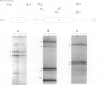
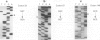
The cell cycle regulatory proteins p16 and p21 cause cell cycle arrest at the G1 checkpoint by inhibiting activity of cyclin D-CDK4 complexes. The TP53 gene, regulating the p21 protein, is mutated at high frequency in ovarian cancer. The CDKN2 gene, encoding the p16 protein, has been mapped to chromosome 9p21 and encompasses three exons. To establish the frequency of CDKN2 gene abnormalities in ovarian tumour specimens, we have studied this gene in five ovarian cancer cell lines and in 32 primary and five metastatic ovarian adenocarcinomas. Using polymerase chain reaction-single strand conformation polymorphism (PCR-SSCP) and sequencing techniques both exon 1 and 2 of the CDKN2 gene, encompassing 97% of the coding sequence, were analysed. In addition, the TP53 gene was studied for the presence of mutations. The cell line HOC-7 showed a 16 bp deletion in exon 2 of the CDKN2 gene, resulting in a stop codon, whereas in cell line SK-OV-3 this gene was found to be homozygously deleted. Nine primary tumour specimens showed a migration shift on SSCP. Sequencing revealed a common polymorphism (Ala148Thr) in seven of these ovarian tumour specimens. The two other tumour samples were found to contain silent mutations, one at codon 23 (GGT-->GGA) and the other at codon 67 (GGC-->GGT). Mutations in the TP53 gene were observed in 46% of the ovarian tumour specimens. We conclude that CDKN2 gene alterations are rare events in human ovarian cancer. The low prevalence of these alterations do not allow for analysis of an association of this gene with prognosis.
Full text
PDF


Images in this article
Selected References
These references are in PubMed. This may not be the complete list of references from this article.
- Berns E. M., Klijn J. G., Smid M., van Staveren I. L., Gruis N. A., Foekens J. A. Infrequent CDKN2 (MTS1/p16) gene alterations in human primary breast cancer. Br J Cancer. 1995 Oct;72(4):964–967. doi: 10.1038/bjc.1995.442. [DOI] [PMC free article] [PubMed] [Google Scholar]
- Cairns P., Mao L., Merlo A., Lee D. J., Schwab D., Eby Y., Tokino K., van der Riet P., Blaugrund J. E., Sidransky D. Rates of p16 (MTS1) mutations in primary tumors with 9p loss. Science. 1994 Jul 15;265(5170):415–417. doi: 10.1126/science.8023167. [DOI] [PubMed] [Google Scholar]
- Caldas C., Hahn S. A., da Costa L. T., Redston M. S., Schutte M., Seymour A. B., Weinstein C. L., Hruban R. H., Yeo C. J., Kern S. E. Frequent somatic mutations and homozygous deletions of the p16 (MTS1) gene in pancreatic adenocarcinoma. Nat Genet. 1994 Sep;8(1):27–32. doi: 10.1038/ng0994-27. [DOI] [PubMed] [Google Scholar]
- Campbell I. G., Foulkes W. D., Beynon G., Davis M., Englefield P. LOH and mutation analysis of CDKN2 in primary human ovarian cancers. Int J Cancer. 1995 Oct 9;63(2):222–225. doi: 10.1002/ijc.2910630213. [DOI] [PubMed] [Google Scholar]
- Chenevix-Trench G., Kerr J., Friedlander M., Hurst T., Sanderson B., Coglan M., Ward B., Leary J., Khoo S. K. Homozygous deletions on the short arm of chromosome 9 in ovarian adenocarcinoma cell lines and loss of heterozygosity in sporadic tumors. Am J Hum Genet. 1994 Jul;55(1):143–149. [PMC free article] [PubMed] [Google Scholar]
- Cheng J. Q., Jhanwar S. C., Klein W. M., Bell D. W., Lee W. C., Altomare D. A., Nobori T., Olopade O. I., Buckler A. J., Testa J. R. p16 alterations and deletion mapping of 9p21-p22 in malignant mesothelioma. Cancer Res. 1994 Nov 1;54(21):5547–5551. [PubMed] [Google Scholar]
- Greenblatt M. S., Bennett W. P., Hollstein M., Harris C. C. Mutations in the p53 tumor suppressor gene: clues to cancer etiology and molecular pathogenesis. Cancer Res. 1994 Sep 15;54(18):4855–4878. [PubMed] [Google Scholar]
- Harper J. W., Adami G. R., Wei N., Keyomarsi K., Elledge S. J. The p21 Cdk-interacting protein Cip1 is a potent inhibitor of G1 cyclin-dependent kinases. Cell. 1993 Nov 19;75(4):805–816. doi: 10.1016/0092-8674(93)90499-g. [DOI] [PubMed] [Google Scholar]
- Hartwell L. H., Kastan M. B. Cell cycle control and cancer. Science. 1994 Dec 16;266(5192):1821–1828. doi: 10.1126/science.7997877. [DOI] [PubMed] [Google Scholar]
- Hayashi K., Yandell D. W. How sensitive is PCR-SSCP? Hum Mutat. 1993;2(5):338–346. doi: 10.1002/humu.1380020503. [DOI] [PubMed] [Google Scholar]
- Hayashi N., Sugimoto Y., Tsuchiya E., Ogawa M., Nakamura Y. Somatic mutations of the MTS (multiple tumor suppressor) 1/CDK4l (cyclin-dependent kinase-4 inhibitor) gene in human primary non-small cell lung carcinomas. Biochem Biophys Res Commun. 1994 Aug 15;202(3):1426–1430. doi: 10.1006/bbrc.1994.2090. [DOI] [PubMed] [Google Scholar]
- Herman J. G., Merlo A., Mao L., Lapidus R. G., Issa J. P., Davidson N. E., Sidransky D., Baylin S. B. Inactivation of the CDKN2/p16/MTS1 gene is frequently associated with aberrant DNA methylation in all common human cancers. Cancer Res. 1995 Oct 15;55(20):4525–4530. [PubMed] [Google Scholar]
- Hunter T., Pines J. Cyclins and cancer. II: Cyclin D and CDK inhibitors come of age. Cell. 1994 Nov 18;79(4):573–582. doi: 10.1016/0092-8674(94)90543-6. [DOI] [PubMed] [Google Scholar]
- Hussussian C. J., Struewing J. P., Goldstein A. M., Higgins P. A., Ally D. S., Sheahan M. D., Clark W. H., Jr, Tucker M. A., Dracopoli N. C. Germline p16 mutations in familial melanoma. Nat Genet. 1994 Sep;8(1):15–21. doi: 10.1038/ng0994-15. [DOI] [PubMed] [Google Scholar]
- Kamb A., Gruis N. A., Weaver-Feldhaus J., Liu Q., Harshman K., Tavtigian S. V., Stockert E., Day R. S., 3rd, Johnson B. E., Skolnick M. H. A cell cycle regulator potentially involved in genesis of many tumor types. Science. 1994 Apr 15;264(5157):436–440. doi: 10.1126/science.8153634. [DOI] [PubMed] [Google Scholar]
- Lydiatt W. M., Murty V. V., Davidson B. J., Xu L., Dyomina K., Sacks P. G., Schantz S. P., Chaganti R. S. Homozygous deletions and loss of expression of the CDKN2 gene occur frequently in head and neck squamous cell carcinoma cell lines but infrequently in primary tumors. Genes Chromosomes Cancer. 1995 Jun;13(2):94–98. doi: 10.1002/gcc.2870130204. [DOI] [PubMed] [Google Scholar]
- Merlo A., Herman J. G., Mao L., Lee D. J., Gabrielson E., Burger P. C., Baylin S. B., Sidransky D. 5' CpG island methylation is associated with transcriptional silencing of the tumour suppressor p16/CDKN2/MTS1 in human cancers. Nat Med. 1995 Jul;1(7):686–692. doi: 10.1038/nm0795-686. [DOI] [PubMed] [Google Scholar]
- Mori T., Miura K., Aoki T., Nishihira T., Mori S., Nakamura Y. Frequent somatic mutation of the MTS1/CDK4I (multiple tumor suppressor/cyclin-dependent kinase 4 inhibitor) gene in esophageal squamous cell carcinoma. Cancer Res. 1994 Jul 1;54(13):3396–3397. [PubMed] [Google Scholar]
- Nobori T., Miura K., Wu D. J., Lois A., Takabayashi K., Carson D. A. Deletions of the cyclin-dependent kinase-4 inhibitor gene in multiple human cancers. Nature. 1994 Apr 21;368(6473):753–756. doi: 10.1038/368753a0. [DOI] [PubMed] [Google Scholar]
- Okamoto A., Demetrick D. J., Spillare E. A., Hagiwara K., Hussain S. P., Bennett W. P., Forrester K., Gerwin B., Serrano M., Beach D. H. Mutations and altered expression of p16INK4 in human cancer. Proc Natl Acad Sci U S A. 1994 Nov 8;91(23):11045–11049. doi: 10.1073/pnas.91.23.11045. [DOI] [PMC free article] [PubMed] [Google Scholar]
- Orita M., Suzuki Y., Sekiya T., Hayashi K. Rapid and sensitive detection of point mutations and DNA polymorphisms using the polymerase chain reaction. Genomics. 1989 Nov;5(4):874–879. doi: 10.1016/0888-7543(89)90129-8. [DOI] [PubMed] [Google Scholar]
- Schmidt E. E., Ichimura K., Reifenberger G., Collins V. P. CDKN2 (p16/MTS1) gene deletion or CDK4 amplification occurs in the majority of glioblastomas. Cancer Res. 1994 Dec 15;54(24):6321–6324. [PubMed] [Google Scholar]
- Schultz D. C., Vanderveer L., Buetow K. H., Boente M. P., Ozols R. F., Hamilton T. C., Godwin A. K. Characterization of chromosome 9 in human ovarian neoplasia identifies frequent genetic imbalance on 9q and rare alterations involving 9p, including CDKN2. Cancer Res. 1995 May 15;55(10):2150–2157. [PubMed] [Google Scholar]
- Serrano M., Hannon G. J., Beach D. A new regulatory motif in cell-cycle control causing specific inhibition of cyclin D/CDK4. Nature. 1993 Dec 16;366(6456):704–707. doi: 10.1038/366704a0. [DOI] [PubMed] [Google Scholar]
- Shelling A. N., Cooke I. E., Ganesan T. S. The genetic analysis of ovarian cancer. Br J Cancer. 1995 Sep;72(3):521–527. doi: 10.1038/bjc.1995.367. [DOI] [PMC free article] [PubMed] [Google Scholar]
- Spruck C. H., 3rd, Gonzalez-Zulueta M., Shibata A., Simoneau A. R., Lin M. F., Gonzales F., Tsai Y. C., Jones P. A. p16 gene in uncultured tumours. Nature. 1994 Jul 21;370(6486):183–184. doi: 10.1038/370183a0. [DOI] [PubMed] [Google Scholar]
- Weitzel J. N., Patel J., Smith D. M., Goodman A., Safaii H., Ball H. G. Molecular genetic changes associated with ovarian cancer. Gynecol Oncol. 1994 Nov;55(2):245–252. doi: 10.1006/gyno.1994.1285. [DOI] [PubMed] [Google Scholar]
- Xiong Y., Hannon G. J., Zhang H., Casso D., Kobayashi R., Beach D. p21 is a universal inhibitor of cyclin kinases. Nature. 1993 Dec 16;366(6456):701–704. doi: 10.1038/366701a0. [DOI] [PubMed] [Google Scholar]
- Xu L., Sgroi D., Sterner C. J., Beauchamp R. L., Pinney D. M., Keel S., Ueki K., Rutter J. L., Buckler A. J., Louis D. N. Mutational analysis of CDKN2 (MTS1/p16ink4) in human breast carcinomas. Cancer Res. 1994 Oct 15;54(20):5262–5264. [PubMed] [Google Scholar]
- Zhang S. Y., Klein-Szanto A. J., Sauter E. R., Shafarenko M., Mitsunaga S., Nobori T., Carson D. A., Ridge J. A., Goodrow T. L. Higher frequency of alterations in the p16/CDKN2 gene in squamous cell carcinoma cell lines than in primary tumors of the head and neck. Cancer Res. 1994 Oct 1;54(19):5050–5053. [PubMed] [Google Scholar]
- el-Deiry W. S., Harper J. W., O'Connor P. M., Velculescu V. E., Canman C. E., Jackman J., Pietenpol J. A., Burrell M., Hill D. E., Wang Y. WAF1/CIP1 is induced in p53-mediated G1 arrest and apoptosis. Cancer Res. 1994 Mar 1;54(5):1169–1174. [PubMed] [Google Scholar]
- el-Deiry W. S., Tokino T., Velculescu V. E., Levy D. B., Parsons R., Trent J. M., Lin D., Mercer W. E., Kinzler K. W., Vogelstein B. WAF1, a potential mediator of p53 tumor suppression. Cell. 1993 Nov 19;75(4):817–825. doi: 10.1016/0092-8674(93)90500-p. [DOI] [PubMed] [Google Scholar]