



Abstract
Objective: To investigate the allocation and management of large medical equipment (LME) in Xuzhou, Jiangsu Province, China, in order to make the best use of LME to meet the medical needs of local people. Methods: The research collected data from all hospitals that have LME in Xuzhou using questionnaire; 38 (97.4%) hospitals returned the questionnaire. Results: In Xuzhou, there are a total of 71 pieces of LME, each serving 126 600 people in an area of 163 km2. Sixty-two percent of them are allocated in urban areas, with Gini coefficient at 0.52, indicating imbalance and biased allocation of LME. Conclusion: The allocation of LME in Xuzhou is out of control and unfairly allocated.
Keywords: Large medical equipment (LME), Computerized tomography (CT), Allocation, Gini coefficient
INTRODUCTION
In medical activities there has been an increasing application of large medical equipment (LME) that plays a critical role in patient’s diagnosis and treatment. However, a disproportion or an over-allocation of LME has caused the waste of medical resources all over the world (Carlsson, 2004; Claudia and Wild, 2005; Eichler et al., 2004; Stolk and Poley, 2005; Oortwijn et al., 2002). The chief aim of the present work is to investigate allocation of LME in Xuzhou, Jiangsu Province, China, to optimize the allocation and to improve the efficiency of LME.
MATERIALS AND METHODS
Investigation was carried out on 38 hospitals with LME in Xuzhou, including 28 local hospitals, 9 corporation hospitals and 1 hospital at the ministry level. These hospitals were classified by levels, with 5 in A-level, 21 in B-level, 8 in C-level, and 4 in non-level. A total of 39 questionnaires were sent out and 38 (97.4%) returned.
The Gini coefficient is used to measure uneven distribution of LME in this paper, which is a number between 0 and 1, where 0 corresponds to a perfect equality and 1 corresponds to a perfect inequality. When a Gini coefficient is smaller than 0.2, it means an absolute equality; values between 0.2 and 0.3 indicate a high equality; between 0.3 and 0.4, an inequality; between 0.4 and 0.6, a high inequality; and greater than 0.6, an absolutely inequality.
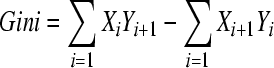 , ,
|
where Xi and Yi are percentages of area and LME instruments of the total number, respectively.
RESULTS
The LME allocation data are presented in Table 1. There are a total of 71 pieces of LME that cover 7 categories, including (1) positron emission computed tomography (PET, 1 piece), (2) gamma knife (γ knife, 3 pieces), (3) computerized tomography (CT, 42 pieces), (4) magnetic resonance imaging (MRI, 9 pieces), (5) digital subtraction angiography (DSA, 9 pieces), (6) single photon emission computed tomography (SPECT, 2 pieces), and (7) linear accelerators (LA, 5 pieces). Out of 71, 58 pieces of LME are in use, 9 on purchase process, 2 in repair, and 2 not being used. Each CT on average has served 212 800 people in an area of 275.5 km2. Each of the other 6 kinds of instruments on average has served more than 1 million people in an area of greater than 1 000 km2.
Table 1.
Situation of LME allocated in Xuzhou
| LME (pieces) |
Average LME per million people | Area (km2) per equipment | |||||
| On purchase | In use | In repair | On cease | Total | |||
| PET | 1 | 0 | 0 | 0 | 1 | 0.1 | 11571.0 |
| γ knife | 0 | 3 | 0 | 0 | 3 | 0.3 | 3857.0 |
| CT | 3 | 36 | 2 | 1 | 42 | 4.7 | 275.5 |
| MRI | 2 | 7 | 0 | 0 | 9 | 1.0 | 1285.7 |
| DSA | 2 | 6 | 0 | 1 | 9 | 1.0 | 1285.7 |
| SPECT | 0 | 2 | 0 | 0 | 2 | 0.2 | 5785.5 |
| LA | 1 | 4 | 0 | 0 | 5 | 0.6 | 2314.2 |
| Total | 9 | 58 | 2 | 2 | 71 | 7.9 | 163.0 |
PET: Positron emission computed tomography; CT: Computerized tomography; MRI: Magnetic resonance imaging; DSA: Digital subtraction angiography; SPECT: Single photon emission computed tomography; LA: Linear accelerators
As the geographic allocation of LME is concerned, Table 2 indicates that 44 LME instruments are allocated in Xuzhou urban areas and 9 in Pei County, 7 in Pizhou County, 3 in Feng County, 3 in Tongshan County, and 2 in Xinyi County.
Table 2.
Indexes of LME allocation in Xuzhou
| LME (pieces) |
ALPH | ALPMP | APE | ||||||||
| PET-CT | γ knife | CT | MRI | DSA | SPECT | LA | Total | ||||
| Feng County | 0 | 0 | 2 | 0 | 0 | 0 | 1 | 3 | 1.5 | 2.7 | 483.3 |
| Pei County | 0 | 0 | 8 | 1 | 0 | 0 | 0 | 9 | 1.3 | 7.6 | 175.1 |
| Pizhou County | 0 | 0 | 6 | 1 | 0 | 0 | 0 | 7 | 1.2 | 4.5 | 299.6 |
| Suining County | 0 | 0 | 2 | 1 | 0 | 0 | 0 | 3 | 1.5 | 2.3 | 589.7 |
| Tongshan County | 0 | 0 | 3 | 0 | 0 | 0 | 0 | 3 | 1.0 | 2.3 | 721.3 |
| Xinyi County | 0 | 0 | 2 | 0 | 0 | 0 | 0 | 2 | 1.0 | 2.1 | 790.0 |
| Urban | 1 | 3 | 19 | 6 | 9 | 2 | 4 | 44 | 2.8 | 27.2 | 21.3 |
| Total | 1 | 3 | 42 | 9 | 9 | 2 | 5 | 71 | 1.9 | 7.9 | 163.0 |
ALPH: Average LME per hospital; ALPMP: Average LME per million people; APE: Area (km2) per equipment; PET: Positron emission computed tomography; CT: Computerized tomography; MRI: Magnetic resonance imaging; DSA: Digital subtraction angiography; SPECT: Single photon emission computed tomography; LA: Linear accelerators
An average of possessing rate of LME is 1.9 per hospital, with 2.8 for urban hospitals and 1.5 for county hospitals. Every million people have an average of 7.9 LME instruments in Xuzhou, with 27.2 in urban and less than 8 in counties. Each LME served 126 600 people in an area of 163.0 km2, 36 800 in an area of 21.3 km2 in urban, and more than 130 000 in an area of more than 175 km2 in counties.
There are 42 (59.2%) CTs out of 71 LME instruments, with 4.7 CTs per million people and each CT serving 212 800 people in an area of 275.5 km2 Among the remaining 29 LME instruments, 25 are allocated in urban (86.2%), and 4 in counties. To the 6 categories of LME except CT, each serves more than 1 million people in an area of more than 1 000 km2. Thus the Gini coefficient was 0.52.
There are 7 LME instruments in the hospital at the ministry level, including 2 γ knives, 2 CTs, 2 DSAs, and 1 MRI. Nine corporation hospitals have 11 CTs, 3 DSAs, 2 MRIs, 2 LAs, 1 γ knife, and 1 SPECT, with an average of 2.2 LME instruments per hospital. Allocation of 29 CTs, 6 MRIs, 4 DSAs, 3 LAs, 1 PET and 1 SPECT in 28 local hospitals indicates each had 1.6 LME instruments in average (Table 3).
Table 3.
Indexes of LME allocation in different affiliation/level hospitals in Xuzhou
| LME (pieces) |
|||||||
| Affiliation of hospitals |
Level of hospitals |
||||||
| Local hospital | Corporation hospital | Hospital at the ministry level | A-level hospital | B-level hospital | C-level hospital | Non-level hospital | |
| PET | 1 | 0 | 0 | 1 | 0 | 0 | 0 |
| γ knife | 0 | 1 | 2 | 3 | 0 | 0 | 0 |
| CT | 29 | 11 | 2 | 7 | 23 | 8 | 4 |
| MRI | 6 | 2 | 1 | 5 | 4 | 0 | 0 |
| DSA | 4 | 3 | 2 | 6 | 2 | 0 | 1 |
| SPECT | 1 | 1 | 0 | 1 | 1 | 0 | 0 |
| LA | 3 | 2 | 0 | 2 | 2 | 0 | 1 |
| Total | 44 | 20 | 7 | 25 | 32 | 8 | 6 |
PET: Positron emission computed tomography; CT: Computerized tomography; MRI: Magnetic resonance imaging; DSA: Digital subtraction angiography; SPECT: Single photon emission computed tomography; LA: Linear accelerators
Analysis from the level of hospitals indicated that there are 25 LME instruments in 5 A-level hospitals, 32 in 21 B-level hospitals, 8 in 8 C-level hospitals and 6 in 4 non-level hospitals (Table 3).
DISCUSSION
In the present investigation, we found that in Xuzhou each city-hospital possesses an average of 2.8 LME instruments, while each hospital in county only 1.3; every million people in urban area have 27.2 pieces of LME, while in rural areas only 3.6; and in urban areas each equipment only serves a region of 21.3 km2, while in rural areas as broad as 508.8 km2. These findings reveal that in Xuzhou city-hospitals have more LME instruments, and less people served and smaller area covered than county-hospitals, suggesting that in Xuzhou the allocation of LME is imbalanced, with LME instruments more concentrated in urban areas than that in rural areas.
In Xuzhou, 44 out of 71 (62.0%) pieces of LME are allocated in urban areas, consistent with the similar situations in many other cities in China. Lei (2000) reported that nationwide 87% of LME were allocated in urban areas, while 70.6% in Tangshan, Hebei Province (Hou et al., 2003; 2004), and 67.7% in Dongying, Shandong Province (Li et al., 2003). Gini coefficient was 0.52 in Xuzhou, indicating the allocation of LME in Xuzhou is unfair, with urban areas and urban people enjoying more health care resources.
According to current local regulation standards, the absolute amount of LME that Xuzhou possesses is over the medical needs in terms of people to serve and areas to cover. Jiangsu Province regulates that each CT and MRI should at least serve 400 000 and 2 million people, respectively; in Xuzhou, however, each CT only serves 21 000 and each MRI only serves 1 million people, which were less than those in Sichuan Province (Liu, 2003; Liu et al., 2004), and more than those in Tangshan, Hebei Province (Hou et al., 2003; 2004), Anyang, He’nan Province (Jiang, 2003; Hu, 2004) and all cities in Jilin Province except Panjin and Huludao (Jia et al., 2005). This further indicates the imbalanced situation of LME allocation in Xuzhou.
In the present investigation, we also found that 57 (80.3%) pieces of LME instruments are allocated in A- and B-levels of hospitals, which may correspond to the nature and functions of the medical services conducted in those higher leveled hospitals, since these hospitals take the referrals from lower hospitals.
In addition, local hospitals that take care of the general population possess an average of 1.6 pieces of LME per hospital, while corporation hospitals that belong to industries and are mainly responsible for internal medical needs within industries have 2.2 pieces of LME and the only minister level hospital in Xuzhou has 7 pieces of LME. This, from another angle, indicates an imbalance in the allocation of medical resources in China.
Interestingly, we found 23 CTs are allocated in 22 hospitals in 6 counties in Xuzhou, with an average of 1.05 CTs per county-hospital. This reflects that an increasing allocation of LME in rural areas. On one hand, it appears positive to correct the widely existing imbalance of LME allocation; on the other hand, however, it also could be considered being driven by other purposes such as profits, since more LME instruments will bring more budgets to the hospitals that own them.
In order to distribute medical resources equally among regions and people, the allocation of LME instruments should be well regulated. However, the current medical authorization systems in China do not seem to run properly, due possibly to a lack of regular inspections, ignorance of regulation, and local protectionism. In addition, as similar to other cities in China, there are multi-systems of hospitals coexisting in Xuzhou, including the affiliated hospitals of a local medical school, military hospitals, and corporation hospitals. Different systems have their own administrations and thus the resultant improper allocation of LME.
In conclusion, Xuzhou may have sufficient amount of LME instruments according to local standards, but the problem is with its imbalanced allocation, with more LME instruments allocated in urban areas and smaller geographic areas to cover and less people to serve than those in rural areas. In order to regulate the allocation of LME, proper measures both based on a strict administrative regulation in public hospitals and cooperation among various medical service systems may be needed.
References
- 1.Carlsson P. Health technology assessment and priority setting for health policy in Sweden. International Journal of Technology Assessment in Health Care. 2004;20(1):44–54. doi: 10.1017/s0266462304000777. [DOI] [PubMed] [Google Scholar]
- 2.Claudia J, Wild T. Ethics of resource allocation: instruments for rational decision making in support of a sustainable health care. Poiesis & Praxis: International Journal of Technology Assessment and Ethics of Science. 2005;3(4):296–309. [Google Scholar]
- 3.Eichler H, Kong S, Gerth W, Mavros P, Jönsson B. Use of cost-effectiveness analysis in health-care resource allocation decision-making: how are cost-effectivenss thresholds expected to emerge? Value in Health. 2004;7(5):518–528. doi: 10.1111/j.1524-4733.2004.75003.x. [DOI] [PubMed] [Google Scholar]
- 4.Hou SL, Chen XX, Li JL. Research on allocation of large medical equipment in Tangshan. Medical Equipment Journal. 2003;1:31–33. (in Chinese) [Google Scholar]
- 5.Hou SL, Li JL, Li YS. Equity method analysis of large medical equipment. Chinese Journal of Health Statistics. 2004;21(3):178–179. (in Chinese) [Google Scholar]
- 6.Hu JL. Investigation and thinking of present situation of large medical equipment. Chinese Health Economics. 2004;23(3):58–59. (in Chinese) [Google Scholar]
- 7.Jia XF, Ren R, Li GM. The collocation of CT and the existing problems and some policies that should be made by the government in Liaoning Province. China Medical Equipment. 2005;2(10):21–23. (in Chinese) [Google Scholar]
- 8.Jiang RP. Analysis and thinking of present situation of large medical equipment. Chinese Health Resources. 2003;6(1):31–32. (in Chinese) [Google Scholar]
- 9.Lei HC. A methodology study on geographic allocation equity evaluation of large medical equipment. Health Economics Research. 2000;8:12–14. (in Chinese) [Google Scholar]
- 10.Li J, Wang B, Tian ZF. Equity research on allocation of large medical equipment in Dongying. Health Economics Research. 2003;10:23–24. (in Chinese) [Google Scholar]
- 11.Liu DM. Investigation and analysis of CT in Sichuan. Journal of Preventive Medicine Information. 2003;19(5):445–447. (in Chinese) [Google Scholar]
- 12.Liu DM, Liu YG, Li CH. Present situation of allocation and utilization of CT in Sichuan. Chinese Journal of Radiological Health. 2004;13(1):19–20. (in Chinese) [Google Scholar]
- 13.Oortwijn WJ, Vondeling H, van Barneveld T, van Vugt C, Bouter L. Priority setting for health technology assessment in the Netherlands: principles and practice. Health Policy. 2002;62(3):227–242. doi: 10.1016/S0168-851002)00037-4. [DOI] [PubMed] [Google Scholar]
- 14.Stolk E, Poley M. Criteria for determining a basic health services package: recent developments in the Netherlands. European Journal of Health Economics. 2005;6(1):2–7. doi: 10.1007/s10198-004-0271-0. [DOI] [PubMed] [Google Scholar]