


Abstract
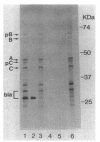
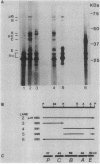
We describe the determination of the nucleotide sequence of two genes (pgtB and pgtC) contained within the 3.4-kilobase DNA segment sandwiched between the transporter gene, pgtP, and the regulatory gene, pgtA. These two genes are involved in the regulation of expression of phosphoglycerate transport in Salmonella typhimurium. The sequence indicates the presence of two large open reading frames, potentially coding for two polypeptides of 397 and 593 amino acid residues. The two gene products were identified by using the bacteriophage T7 RNA polymerase-T7 promoter coupled system of Tabor and Richardson, and the observed apparent mass of 45 and 69 kilodaltons correlated well with the respective open reading frames. The cellular location of these two polypeptides was directly determined, and the polypeptides were found to be associated with the membrane. Although overall these polypeptides appear to be hydrophilic, there is one hydrophobic transmembrane segment in the smaller polypeptide and four such segments in the larger polypeptide which can account for their association with the membrane. In the accompanying paper, we present genetic evidence that pgtB and pgtC genes are involved in the induction of the pgtP expression by modulating derepressor activity.
Full text
PDF


Images in this article
Selected References
These references are in PubMed. This may not be the complete list of references from this article.
- Goldrick D., Yu G. Q., Jiang S. Q., Hong J. S. Nucleotide sequence and transcription start point of the phosphoglycerate transporter gene of Salmonella typhimurium. J Bacteriol. 1988 Aug;170(8):3421–3426. doi: 10.1128/jb.170.8.3421-3426.1988. [DOI] [PMC free article] [PubMed] [Google Scholar]
- Grosjean H., Fiers W. Preferential codon usage in prokaryotic genes: the optimal codon-anticodon interaction energy and the selective codon usage in efficiently expressed genes. Gene. 1982 Jun;18(3):199–209. doi: 10.1016/0378-1119(82)90157-3. [DOI] [PubMed] [Google Scholar]
- Henikoff S. Unidirectional digestion with exonuclease III creates targeted breakpoints for DNA sequencing. Gene. 1984 Jun;28(3):351–359. doi: 10.1016/0378-1119(84)90153-7. [DOI] [PubMed] [Google Scholar]
- Hugenholtz J., Hong J. S., Kaback H. R. ATP-driven active transport in right-side-out bacterial membrane vesicles. Proc Natl Acad Sci U S A. 1981 Jun;78(6):3446–3449. doi: 10.1073/pnas.78.6.3446. [DOI] [PMC free article] [PubMed] [Google Scholar]
- Jiang S. Q., Yu G. Q., Li Z. G., Hong J. S. Genetic evidence for modulation of the activator by two regulatory proteins involved in the exogenous induction of phosphoglycerate transport in Salmonella typhimurium. J Bacteriol. 1988 Sep;170(9):4304–4308. doi: 10.1128/jb.170.9.4304-4308.1988. [DOI] [PMC free article] [PubMed] [Google Scholar]
- Kyte J., Doolittle R. F. A simple method for displaying the hydropathic character of a protein. J Mol Biol. 1982 May 5;157(1):105–132. doi: 10.1016/0022-2836(82)90515-0. [DOI] [PubMed] [Google Scholar]
- Nohno T., Saito T., Hong J. S. Cloning and complete nucleotide sequence of the Escherichia coli glutamine permease operon (glnHPQ). Mol Gen Genet. 1986 Nov;205(2):260–269. doi: 10.1007/BF00430437. [DOI] [PubMed] [Google Scholar]
- Sanger F., Nicklen S., Coulson A. R. DNA sequencing with chain-terminating inhibitors. Proc Natl Acad Sci U S A. 1977 Dec;74(12):5463–5467. doi: 10.1073/pnas.74.12.5463. [DOI] [PMC free article] [PubMed] [Google Scholar]
- Tabor S., Richardson C. C. A bacteriophage T7 RNA polymerase/promoter system for controlled exclusive expression of specific genes. Proc Natl Acad Sci U S A. 1985 Feb;82(4):1074–1078. doi: 10.1073/pnas.82.4.1074. [DOI] [PMC free article] [PubMed] [Google Scholar]
- VOGEL H. J., BONNER D. M. Acetylornithinase of Escherichia coli: partial purification and some properties. J Biol Chem. 1956 Jan;218(1):97–106. [PubMed] [Google Scholar]
- Yu G. Q., Hong J. S. Identification and nucleotide sequence of the activator gene of the externally induced phosphoglycerate transport system of Salmonella typhimurium. Gene. 1986;45(1):51–57. doi: 10.1016/0378-1119(86)90131-9. [DOI] [PubMed] [Google Scholar]