


Abstract
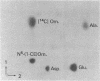
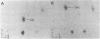
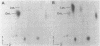
Resting cells of Streptococcus lactis 133 appeared to accumulate [14C]ornithine to a high concentration in the absence of an exogenous energy source. However, analysis of intracellular amino acid pool constituents and results of transport experiments revealed that the accumulation of ornithine represented a homoexchange between extracellular [14C]ornithine and unlabeled ornithine in the cell. The energy-independent exchange of ornithine was not inhibited by proton-conducting uncouplers or by metabolic inhibitors. Intracellular [14C]ornithine was retained by resting cells after suspension in a buffered medium. However, addition of unlabeled ornithine to the suspension elicited rapid exit of labeled amino acid. The initial rate of exit of [14C]ornithine was dependent on the concentration of unlabeled ornithine in the medium, but this accelerative exchange diffusion process caused no net loss of amino acid. By contrast, the presence of a fermentable energy source caused a rapid expulsion of and net decrease in the concentration of intracellular ornithine. Kinetic analyses of amino acid transport demonstrated competitive inhibition between lysine and ornithine, and data obtained by two-dimensional thin-layer chromatography established the heteroexchange of these basic amino acids. The effects of amino acids and of ornithine analogs on both entry and exit of [14C]ornithine have been examined. The data suggest that a common carrier mediates the entry and exchange of lysine, arginine, and ornithine in cells of S. lactis.
Full text
PDF


Images in this article
Selected References
These references are in PubMed. This may not be the complete list of references from this article.
- Abdelal A. T. Arginine catabolism by microorganisms. Annu Rev Microbiol. 1979;33:139–168. doi: 10.1146/annurev.mi.33.100179.001035. [DOI] [PubMed] [Google Scholar]
- Akpemado K. M., Bracquart P. A. Uptake of Branched-Chain Amino Acids by Streptococcus thermophilus. Appl Environ Microbiol. 1983 Jan;45(1):136–140. doi: 10.1128/aem.45.1.136-140.1983. [DOI] [PMC free article] [PubMed] [Google Scholar]
- Asghar S. S., Levin E., Harold F. M. Accumulation of neutral amino acids by Streptococcus faecalis. Energy coupling by a proton-motive force. J Biol Chem. 1973 Aug 10;248(15):5225–5233. [PubMed] [Google Scholar]
- BRITT E. M., GERHARDT P. Bacterial permeability; total uptake of lysine by intact cells, protoplasts, and cell walls of Micrococcus lysodeikticus. J Bacteriol. 1958 Sep;76(3):288–293. doi: 10.1128/jb.76.3.288-293.1958. [DOI] [PMC free article] [PubMed] [Google Scholar]
- BROCK T. D., MOO-PENN G. An amino acid transport system in Streptococcus faecium. Arch Biochem Biophys. 1962 Aug;98:183–190. doi: 10.1016/0003-9861(62)90171-6. [DOI] [PubMed] [Google Scholar]
- Baddiley J. Teichoic acids in cell walls and membranes of bacteria. Essays Biochem. 1972;8:35–77. [PubMed] [Google Scholar]
- Crow V. L., Thomas T. D. Arginine metabolism in lactic streptococci. J Bacteriol. 1982 Jun;150(3):1024–1032. doi: 10.1128/jb.150.3.1024-1032.1982. [DOI] [PMC free article] [PubMed] [Google Scholar]
- Cunin R., Glansdorff N., Piérard A., Stalon V. Biosynthesis and metabolism of arginine in bacteria. Microbiol Rev. 1986 Sep;50(3):314–352. doi: 10.1128/mr.50.3.314-352.1986. [DOI] [PMC free article] [PubMed] [Google Scholar]
- Kuo L. C., Herzberg W., Lipscomb W. N. Substrate specificity and protonation state of ornithine transcarbamoylase as determined by pH studies. Biochemistry. 1985 Aug 27;24(18):4754–4761. doi: 10.1021/bi00339a007. [DOI] [PubMed] [Google Scholar]
- Marquis R. E., Mayzel K., Carstensen E. L. Cation exchange in cell walls of gram-positive bacteria. Can J Microbiol. 1976 Jul;22(7):975–982. doi: 10.1139/m76-142. [DOI] [PubMed] [Google Scholar]
- Mason P. W., Carbone D. P., Cushman R. A., Waggoner A. S. The importance of inorganic phosphate in regulation of energy metabolism of Streptococcus lactis. J Biol Chem. 1981 Feb 25;256(4):1861–1866. [PubMed] [Google Scholar]
- Moran J. W. Branched-chain amino acid transport in Streptococcus agalactiae. Appl Environ Microbiol. 1980 Jul;40(1):25–31. doi: 10.1128/aem.40.1.25-31.1980. [DOI] [PMC free article] [PubMed] [Google Scholar]
- Najjar V. A., Gale E. F. The assimilation of amino-acids by bacteria. 9. The passage of lysine across the cell wall of Streptococcus faecalis. Biochem J. 1950 Jan;46(1):91–95. doi: 10.1042/bj0460091. [DOI] [PMC free article] [PubMed] [Google Scholar]
- Niven D. F., Jeacocke R. E., Hamilton W. A. The membrane potential as the driving force for the accumulation of lysine by Staphylococcus aureus. FEBS Lett. 1973 Feb 1;29(3):248–252. doi: 10.1016/0014-5793(73)80030-4. [DOI] [PubMed] [Google Scholar]
- Postma P. W., Lengeler J. W. Phosphoenolpyruvate:carbohydrate phosphotransferase system of bacteria. Microbiol Rev. 1985 Sep;49(3):232–269. doi: 10.1128/mr.49.3.232-269.1985. [DOI] [PMC free article] [PubMed] [Google Scholar]
- Reizer J., Panos C. Transport of alpha-aminoisobutyric acid by Streptococcus pyogenes and its derived L-form. J Bacteriol. 1982 Jan;149(1):211–220. doi: 10.1128/jb.149.1.211-220.1982. [DOI] [PMC free article] [PubMed] [Google Scholar]
- Seitz E. W., Hochster R. M. Active transport of L-valine by Streptococcus diacetilactis. J Dairy Sci. 1965 Oct;48(10):1282–1286. doi: 10.3168/jds.S0022-0302(65)88448-X. [DOI] [PubMed] [Google Scholar]
- Thompson J. Characteristics and energy requirements of an alpha-aminoisobutyric acid transport system in Streptococcus lactis. J Bacteriol. 1976 Aug;127(2):719–730. doi: 10.1128/jb.127.2.719-730.1976. [DOI] [PMC free article] [PubMed] [Google Scholar]
- Thompson J., Curtis M. A., Miller S. P. N5-(1-carboxyethyl)-ornithine, a new amino acid from the intracellular pool of Streptococcus lactis. J Bacteriol. 1986 Aug;167(2):522–529. doi: 10.1128/jb.167.2.522-529.1986. [DOI] [PMC free article] [PubMed] [Google Scholar]
- Thompson J. In vivo regulation of glycolysis and characterization of sugar: phosphotransferase systems in Streptococcus lactis. J Bacteriol. 1978 Nov;136(2):465–476. doi: 10.1128/jb.136.2.465-476.1978. [DOI] [PMC free article] [PubMed] [Google Scholar]
- Thompson J., Thomas T. D. Phosphoenolpyruvate and 2-phosphoglycerate: endogenous energy source(s) for sugar accumulation by starved cells of Streptococcus lactis. J Bacteriol. 1977 May;130(2):583–595. doi: 10.1128/jb.130.2.583-595.1977. [DOI] [PMC free article] [PubMed] [Google Scholar]
- Thompson J., Torchia D. A. Use of 31P nuclear magnetic resonance spectroscopy and 14C fluorography in studies of glycolysis and regulation of pyruvate kinase in Streptococcus lactis. J Bacteriol. 1984 Jun;158(3):791–800. doi: 10.1128/jb.158.3.791-800.1984. [DOI] [PMC free article] [PubMed] [Google Scholar]
- Wicken A. J., Knox K. W. Characterization of group N streptococcus lipoteichoic acid. Infect Immun. 1975 May;11(5):973–981. doi: 10.1128/iai.11.5.973-981.1975. [DOI] [PMC free article] [PubMed] [Google Scholar]