



Abstract
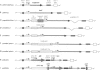
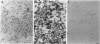
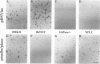
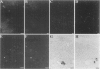
BACKGROUND: Vectors based on herpes simplex virus type 1 (HSV-1) can efficiently transduce hepatocytes in the mouse liver, and vector genomes can persist for at least 2 months. However, 24 hr after gene transfer, the number of cells that express the transgene decreases rapidly and no transduced cells are detectable after 7 days. In this study, we examined the capability of a helper virus-free HSV/AAV hybrid amplicon vector to extend transgene expression in hepatocytes in vivo. MATERIALS AND METHODS: HSV-1 amplicon or HSV/AAV hybrid amplicon vectors that express reporter genes from different transcriptional regulatory sequences were packaged into HSV-1 virions using a helper virus-free packaging system. To determine relative transduction efficiencies, vector stocks were titered on four different cell lines, including hamster kidney (BHK21) and human lung (Hs913T) fibroblasts, and mouse (G6Pase-/-) and human (NPLC) hepatocytes. After in vivo injection of vector stocks into mouse liver, tissue sections were examined for reporter gene expression and cellular inflammatory response. Blood samples were collected to measure serum transaminase levels as a biochemical index of liver toxicity. RESULTS: Expression of a reporter gene from liver-specific promoter sequences was consistently more effective in hepatic cells compared with fibroblasts, whereas the opposite was true when using an HSV-1 immediate-early promoter. Expression in hepatocytes in vivo was markedly longer from HSV/AAV hybrid vector compared with traditional HSV-1 amplicon vector: the number of transduced cells (approximately 2% of all hepatocytes) remained stable over 7 days after injection of HSV/AAV hybrid vector, whereas no transduced cells were detected 7 days after gene transfer with standard HSV-1 amplicon vector. The rapid decline in reporter gene expression from standard amplicons was not solely caused by a B or T lymphocyte-mediated immune response, as it also occurred in RAG2-/- mice. Hepatocyte toxicity and cellular inflammatory effects associated with HSV/AAV hybrid vector-mediated gene transfer were minimal, and readministration of vector stock proved equally effective in naive mice and in animals that received a first vector dose 4 weeks earlier. CONCLUSIONS: HSV/AAV hybrid amplicon vectors support gene expression in vivo for considerably longer than do traditional HSV-1 amplicon vectors. Moreover, expression from these vectors does not provoke an overt inflammatory or immune response, allowing efficacious expression following repeated in vivo dosing. These characteristics suggest that such vectors may hold future promise for hepatic gene replacement therapy.
Full text
PDF


Images in this article
Selected References
These references are in PubMed. This may not be the complete list of references from this article.
- Alt F. W., Rathbun G., Oltz E., Taccioli G., Shinkai Y. Function and control of recombination-activating gene activity. Ann N Y Acad Sci. 1992 May 4;651:277–294. doi: 10.1111/j.1749-6632.1992.tb24626.x. [DOI] [PubMed] [Google Scholar]
- Babiss L. E., Herbst R. S., Bennett A. L., Darnell J. E., Jr Factors that interact with the rat albumin promoter are present both in hepatocytes and other cell types. Genes Dev. 1987 May;1(3):256–267. doi: 10.1101/gad.1.3.256. [DOI] [PubMed] [Google Scholar]
- Balagúe C., Kalla M., Zhang W. W. Adeno-associated virus Rep78 protein and terminal repeats enhance integration of DNA sequences into the cellular genome. J Virol. 1997 Apr;71(4):3299–3306. doi: 10.1128/jvi.71.4.3299-3306.1997. [DOI] [PMC free article] [PubMed] [Google Scholar]
- Carlson J. A., Rogers B. B., Sifers R. N., Hawkins H. K., Finegold M. J., Woo S. L. Multiple tissues express alpha 1-antitrypsin in transgenic mice and man. J Clin Invest. 1988 Jul;82(1):26–36. doi: 10.1172/JCI113580. [DOI] [PMC free article] [PubMed] [Google Scholar]
- Cunningham C., Davison A. J. A cosmid-based system for constructing mutants of herpes simplex virus type 1. Virology. 1993 Nov;197(1):116–124. doi: 10.1006/viro.1993.1572. [DOI] [PubMed] [Google Scholar]
- Ferry N., Duplessis O., Houssin D., Danos O., Heard J. M. Retroviral-mediated gene transfer into hepatocytes in vivo. Proc Natl Acad Sci U S A. 1991 Oct 1;88(19):8377–8381. doi: 10.1073/pnas.88.19.8377. [DOI] [PMC free article] [PubMed] [Google Scholar]
- Fisher K. J., Gao G. P., Weitzman M. D., DeMatteo R., Burda J. F., Wilson J. M. Transduction with recombinant adeno-associated virus for gene therapy is limited by leading-strand synthesis. J Virol. 1996 Jan;70(1):520–532. doi: 10.1128/jvi.70.1.520-532.1996. [DOI] [PMC free article] [PubMed] [Google Scholar]
- Flotte T. R., Afione S. A., Zeitlin P. L. Adeno-associated virus vector gene expression occurs in nondividing cells in the absence of vector DNA integration. Am J Respir Cell Mol Biol. 1994 Nov;11(5):517–521. doi: 10.1165/ajrcmb.11.5.7946381. [DOI] [PubMed] [Google Scholar]
- Folkman J., Philippart A., Tze W. J., Crigler J., Jr Portacaval shunt for glycogen storage disease: value of prolonged intravenous hyperalimentation before surgery. Surgery. 1972 Aug;72(2):306–314. [PubMed] [Google Scholar]
- Fong Y., Federoff H. J., Brownlee M., Blumberg D., Blumgart L. H., Brennan M. F. Rapid and efficient gene transfer in Human hepatocytes by herpes viral vectors. Hepatology. 1995 Sep;22(3):723–729. [PubMed] [Google Scholar]
- Fraefel C., Song S., Lim F., Lang P., Yu L., Wang Y., Wild P., Geller A. I. Helper virus-free transfer of herpes simplex virus type 1 plasmid vectors into neural cells. J Virol. 1996 Oct;70(10):7190–7197. doi: 10.1128/jvi.70.10.7190-7197.1996. [DOI] [PMC free article] [PubMed] [Google Scholar]
- Gao G. P., Yang Y., Wilson J. M. Biology of adenovirus vectors with E1 and E4 deletions for liver-directed gene therapy. J Virol. 1996 Dec;70(12):8934–8943. doi: 10.1128/jvi.70.12.8934-8943.1996. [DOI] [PMC free article] [PubMed] [Google Scholar]
- Geller A. I., Breakefield X. O. A defective HSV-1 vector expresses Escherichia coli beta-galactosidase in cultured peripheral neurons. Science. 1988 Sep 23;241(4873):1667–1669. doi: 10.1126/science.241.4873.1667. [DOI] [PMC free article] [PubMed] [Google Scholar]
- Guo Z. S., Wang L. H., Eisensmith R. C., Woo S. L. Evaluation of promoter strength for hepatic gene expression in vivo following adenovirus-mediated gene transfer. Gene Ther. 1996 Sep;3(9):802–810. [PubMed] [Google Scholar]
- Jaffe H. A., Danel C., Longenecker G., Metzger M., Setoguchi Y., Rosenfeld M. A., Gant T. W., Thorgeirsson S. S., Stratford-Perricaudet L. D., Perricaudet M. Adenovirus-mediated in vivo gene transfer and expression in normal rat liver. Nat Genet. 1992 Aug;1(5):372–378. doi: 10.1038/ng0892-372. [DOI] [PubMed] [Google Scholar]
- Johnson P. A., Yoshida K., Gage F. H., Friedmann T. Effects of gene transfer into cultured CNS neurons with a replication-defective herpes simplex virus type 1 vector. Brain Res Mol Brain Res. 1992 Jan;12(1-3):95–102. doi: 10.1016/0169-328x(92)90072-j. [DOI] [PubMed] [Google Scholar]
- Johnston K. M., Jacoby D., Pechan P. A., Fraefel C., Borghesani P., Schuback D., Dunn R. J., Smith F. I., Breakefield X. O. HSV/AAV hybrid amplicon vectors extend transgene expression in human glioma cells. Hum Gene Ther. 1997 Feb 10;8(3):359–370. doi: 10.1089/hum.1997.8.3-359. [DOI] [PubMed] [Google Scholar]
- Jooss K., Yang Y., Wilson J. M. Cyclophosphamide diminishes inflammation and prolongs transgene expression following delivery of adenoviral vectors to mouse liver and lung. Hum Gene Ther. 1996 Aug 20;7(13):1555–1566. doi: 10.1089/hum.1996.7.13-1555. [DOI] [PubMed] [Google Scholar]
- Koeberl D. D., Alexander I. E., Halbert C. L., Russell D. W., Miller A. D. Persistent expression of human clotting factor IX from mouse liver after intravenous injection of adeno-associated virus vectors. Proc Natl Acad Sci U S A. 1997 Feb 18;94(4):1426–1431. doi: 10.1073/pnas.94.4.1426. [DOI] [PMC free article] [PubMed] [Google Scholar]
- Lei K. J., Chen H., Pan C. J., Ward J. M., Mosinger B., Jr, Lee E. J., Westphal H., Mansfield B. C., Chou J. Y. Glucose-6-phosphatase dependent substrate transport in the glycogen storage disease type-1a mouse. Nat Genet. 1996 Jun;13(2):203–209. doi: 10.1038/ng0696-203. [DOI] [PubMed] [Google Scholar]
- Lei K. J., Shelly L. L., Pan C. J., Sidbury J. B., Chou J. Y. Mutations in the glucose-6-phosphatase gene that cause glycogen storage disease type 1a. Science. 1993 Oct 22;262(5133):580–583. doi: 10.1126/science.8211187. [DOI] [PubMed] [Google Scholar]
- Linden R. M., Winocour E., Berns K. I. The recombination signals for adeno-associated virus site-specific integration. Proc Natl Acad Sci U S A. 1996 Jul 23;93(15):7966–7972. doi: 10.1073/pnas.93.15.7966. [DOI] [PMC free article] [PubMed] [Google Scholar]
- Lu B., Federoff H. J. Herpes simplex virus type 1 amplicon vectors with glucocorticoid-inducible gene expression. Hum Gene Ther. 1995 Apr;6(4):419–428. doi: 10.1089/hum.1995.6.4-419. [DOI] [PubMed] [Google Scholar]
- Lu B., Gupta S., Federoff H. Ex vivo hepatic gene transfer in mouse using a defective herpes simplex virus-1 vector. Hepatology. 1995 Mar;21(3):752–759. [PubMed] [Google Scholar]
- McLaughlin S. K., Collis P., Hermonat P. L., Muzyczka N. Adeno-associated virus general transduction vectors: analysis of proviral structures. J Virol. 1988 Jun;62(6):1963–1973. doi: 10.1128/jvi.62.6.1963-1973.1988. [DOI] [PMC free article] [PubMed] [Google Scholar]
- Miyanohara A., Johnson P. A., Elam R. L., Dai Y., Witztum J. L., Verma I. M., Friedmann T. Direct gene transfer to the liver with herpes simplex virus type 1 vectors: transient production of physiologically relevant levels of circulating factor IX. New Biol. 1992 Mar;4(3):238–246. [PubMed] [Google Scholar]
- Mulligan R. C. The basic science of gene therapy. Science. 1993 May 14;260(5110):926–932. doi: 10.1126/science.8493530. [DOI] [PubMed] [Google Scholar]
- Ohashi T., Watabe K., Uehara K., Sly W. S., Vogler C., Eto Y. Adenovirus-mediated gene transfer and expression of human beta-glucuronidase gene in the liver, spleen, and central nervous system in mucopolysaccharidosis type VII mice. Proc Natl Acad Sci U S A. 1997 Feb 18;94(4):1287–1292. doi: 10.1073/pnas.94.4.1287. [DOI] [PMC free article] [PubMed] [Google Scholar]
- Pinkert C. A., Ornitz D. M., Brinster R. L., Palmiter R. D. An albumin enhancer located 10 kb upstream functions along with its promoter to direct efficient, liver-specific expression in transgenic mice. Genes Dev. 1987 May;1(3):268–276. doi: 10.1101/gad.1.3.268. [DOI] [PubMed] [Google Scholar]
- Rettinger S. D., Kennedy S. C., Wu X., Saylors R. L., Hafenrichter D. G., Flye M. W., Ponder K. P. Liver-directed gene therapy: quantitative evaluation of promoter elements by using in vivo retroviral transduction. Proc Natl Acad Sci U S A. 1994 Feb 15;91(4):1460–1464. doi: 10.1073/pnas.91.4.1460. [DOI] [PMC free article] [PubMed] [Google Scholar]
- Russell D. W., Miller A. D., Alexander I. E. Adeno-associated virus vectors preferentially transduce cells in S phase. Proc Natl Acad Sci U S A. 1994 Sep 13;91(19):8915–8919. doi: 10.1073/pnas.91.19.8915. [DOI] [PMC free article] [PubMed] [Google Scholar]
- Shelly L. L., Lei K. J., Pan C. J., Sakata S. F., Ruppert S., Schutz G., Chou J. Y. Isolation of the gene for murine glucose-6-phosphatase, the enzyme deficient in glycogen storage disease type 1A. J Biol Chem. 1993 Oct 15;268(29):21482–21485. [PubMed] [Google Scholar]
- Shen R. F., Clift S. M., DeMayo J. L., Sifers R. N., Finegold M. J., Woo S. L. Tissue-specific regulation of human alpha 1-antitrypsin gene expression in transgenic mice. DNA. 1989 Mar;8(2):101–108. doi: 10.1089/dna.1.1989.8.101. [DOI] [PubMed] [Google Scholar]
- Strauss M. Liver-directed gene therapy: prospects and problems. Gene Ther. 1994 May;1(3):156–164. [PubMed] [Google Scholar]
- Walsh C. E., Liu J. M., Xiao X., Young N. S., Nienhuis A. W., Samulski R. J. Regulated high level expression of a human gamma-globin gene introduced into erythroid cells by an adeno-associated virus vector. Proc Natl Acad Sci U S A. 1992 Aug 1;89(15):7257–7261. doi: 10.1073/pnas.89.15.7257. [DOI] [PMC free article] [PubMed] [Google Scholar]
- Ward P., Berns K. I. In vitro replication of adeno-associated virus DNA: enhancement by extracts from adenovirus-infected HeLa cells. J Virol. 1996 Jul;70(7):4495–4501. doi: 10.1128/jvi.70.7.4495-4501.1996. [DOI] [PMC free article] [PubMed] [Google Scholar]
- Weitzman M. D., Kyöstiö S. R., Kotin R. M., Owens R. A. Adeno-associated virus (AAV) Rep proteins mediate complex formation between AAV DNA and its integration site in human DNA. Proc Natl Acad Sci U S A. 1994 Jun 21;91(13):5808–5812. doi: 10.1073/pnas.91.13.5808. [DOI] [PMC free article] [PubMed] [Google Scholar]
- Yang Y., Wilson J. M. Clearance of adenovirus-infected hepatocytes by MHC class I-restricted CD4+ CTLs in vivo. J Immunol. 1995 Sep 1;155(5):2564–2570. [PubMed] [Google Scholar]