



Abstract
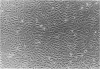
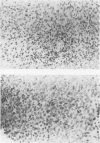
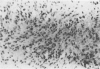
A new human rhabdomyosarcoma cell line (HX170c) has been established from a paratesticular embryonal tumour in a 5-year-old male. The cells grew as an adherent monolayer with a doubling time of 32 h and showed pleomorphic features. Intermediate filament analysis revealed the line to be mesenchymal in origin (reactivity to vimentin and desmin antibodies). The line was tumorigenic in nude mice, possessed elevated levels of creatine phosphokinase (mainly of the MM isoenzyme form) and had a near diploid mean chromosome number of 50. In vitro cell cloning determinations gave colony forming efficiencies of 0.01% in soft agar and 24% in a monolayer anchorage-dependent assay. Radiosensitivity determinations using a monolayer clonogenic assay with feeder layer support showed the cells to be among the more radiosensitive human tumour cell types (surviving fraction at 2 Gy of 0.26) that have been investigated. Furthermore, experiments utilising continuous low dose rate radiation at 3.2 cGy min-1, showed that, under these experimental conditions, the cells possessed only a very low capacity to recover from radiation-induced damage (dose reduction factor at 1% cell survival of 1.07 for 150 versus 3.2 cGy min-1). As other human tumour cells of an embryonal cell origin (e.g. neuroblastoma and germ cell tumours of the testis) have also been shown to be radiosensitive it appears that sensitivity to radiation may be a common property of this group of tumours.
Full text
PDF


Images in this article
Selected References
These references are in PubMed. This may not be the complete list of references from this article.
- Altmannsberger M., Weber K., Droste R., Osborn M. Desmin is a specific marker for rhabdomyosarcomas of human and rat origin. Am J Pathol. 1985 Jan;118(1):85–95. [PMC free article] [PubMed] [Google Scholar]
- Chapman A. L., Bogner P., Behbehani A. M. A study of a new human tumor cell line (rhabdomyosarcoma). Proc Soc Exp Biol Med. 1974 Sep;146(4):1087–1092. doi: 10.3181/00379727-146-38250. [DOI] [PubMed] [Google Scholar]
- Clayton J., Pincott J. R., van den Berghe J. A., Kemshead J. T. Comparative studies between a new human rhabdomyosarcoma cell line, JR-1 and its tumour of origin. Br J Cancer. 1986 Jul;54(1):83–90. doi: 10.1038/bjc.1986.155. [DOI] [PMC free article] [PubMed] [Google Scholar]
- Corson J. M., Pinkus G. S. Intracellular myoglobin--a specific marker for skeletal muscle differentiation in soft tissue sarcomas. An immunoperoxidase study. Am J Pathol. 1981 Jun;103(3):384–389. [PMC free article] [PubMed] [Google Scholar]
- Courtenay V. D., Mills J. An in vitro colony assay for human tumours grown in immune-suppressed mice and treated in vivo with cytotoxic agents. Br J Cancer. 1978 Feb;37(2):261–268. doi: 10.1038/bjc.1978.35. [DOI] [PMC free article] [PubMed] [Google Scholar]
- Deacon J. M., Wilson P. A., Peckham M. J. The radiobiology of human neuroblastoma. Radiother Oncol. 1985 Apr;3(3):201–209. doi: 10.1016/s0167-8140(85)80029-3. [DOI] [PubMed] [Google Scholar]
- Deacon J., Peckham M. J., Steel G. G. The radioresponsiveness of human tumours and the initial slope of the cell survival curve. Radiother Oncol. 1984 Dec;2(4):317–323. doi: 10.1016/s0167-8140(84)80074-2. [DOI] [PubMed] [Google Scholar]
- Debus E., Weber K., Osborn M. Monoclonal antibodies to desmin, the muscle-specific intermediate filament protein. EMBO J. 1983;2(12):2305–2312. doi: 10.1002/j.1460-2075.1983.tb01738.x. [DOI] [PMC free article] [PubMed] [Google Scholar]
- Fertil B., Malaise E. P. Inherent cellular radiosensitivity as a basic concept for human tumor radiotherapy. Int J Radiat Oncol Biol Phys. 1981 May;7(5):621–629. doi: 10.1016/0360-3016(81)90377-1. [DOI] [PubMed] [Google Scholar]
- Garvin A. J., Stanley W. S., Bennett D. D., Sullivan J. L., Sens D. A. The in vitro growth, heterotransplantation, and differentiation of a human rhabdomyosarcoma cell line. Am J Pathol. 1986 Oct;125(1):208–217. [PMC free article] [PubMed] [Google Scholar]
- Giard D. J., Aaronson S. A., Todaro G. J., Arnstein P., Kersey J. H., Dosik H., Parks W. P. In vitro cultivation of human tumors: establishment of cell lines derived from a series of solid tumors. J Natl Cancer Inst. 1973 Nov;51(5):1417–1423. doi: 10.1093/jnci/51.5.1417. [DOI] [PubMed] [Google Scholar]
- Hazelton B. J., Houghton J. A., Parham D. M., Douglass E. C., Torrance P. M., Holt H., Houghton P. J. Characterization of cell lines derived from xenografts of childhood rhabdomyosarcoma. Cancer Res. 1987 Aug 15;47(16):4501–4507. [PubMed] [Google Scholar]
- Iwata K. K., Fryling C. M., Knott W. B., Todaro G. J. Isolation of tumor cell growth-inhibiting factors from a human rhabdomyosarcoma cell line. Cancer Res. 1985 Jun;45(6):2689–2694. [PubMed] [Google Scholar]
- Kelland L. R., Burgess L., Steel G. G. Characterization of four new cell lines derived from human squamous carcinomas of the uterine cervix. Cancer Res. 1987 Sep 15;47(18):4947–4952. [PubMed] [Google Scholar]
- Kelland L. R., Burgess L., Steel G. G. Differential radiosensitization by the poly(ADP-ribose) transferase inhibitor 3-aminobenzamide in human tumor cells of varying radiosensitivity. Int J Radiat Oncol Biol Phys. 1988 Jun;14(6):1239–1246. doi: 10.1016/0360-3016(88)90403-8. [DOI] [PubMed] [Google Scholar]
- Kelland L. R., Burgess L., Steel G. G. Radiation damage repair capacity of a human germ-cell tumour cell line: inhibition by 3-aminobenzamide. Int J Radiat Biol Relat Stud Phys Chem Med. 1987 Feb;51(2):227–241. doi: 10.1080/09553008714550731. [DOI] [PubMed] [Google Scholar]
- Kelland L. R., Steel G. G. Dose-rate effects in the radiation response of four human tumour xenografts. Radiother Oncol. 1986 Nov;7(3):259–268. doi: 10.1016/s0167-8140(86)80037-8. [DOI] [PubMed] [Google Scholar]
- Makin C. A., Bobrow L. G., Bodmer W. F. Monoclonal antibody to cytokeratin for use in routine histopathology. J Clin Pathol. 1984 Sep;37(9):975–983. doi: 10.1136/jcp.37.9.975. [DOI] [PMC free article] [PubMed] [Google Scholar]
- Marchese M. J., Zaider M., Hall E. J. Potentially lethal damage repair in human cells. Radiother Oncol. 1987 May;9(1):57–65. doi: 10.1016/s0167-8140(87)80219-0. [DOI] [PubMed] [Google Scholar]
- McAllister R. M., Melnyk J., Finkelstein J. Z., Adams E. C., Jr, Gardner M. B. Cultivation in vitro of cells derived from a human rhabdomyosarcoma. Cancer. 1969 Sep;24(3):520–526. doi: 10.1002/1097-0142(196909)24:3<520::aid-cncr2820240313>3.0.co;2-m. [DOI] [PubMed] [Google Scholar]
- Mitchell J. B., Bedford J. S., Bailey S. M. Dose-rate effects in mammalian cells in culture III. Comparison of cell killing and cell proliferation during continuous irradiation for six different cell lines. Radiat Res. 1979 Sep;79(3):537–551. [PubMed] [Google Scholar]
- Mitchell J. B., Bedord J. S., Bailey S. M. Dose-rate effects on the cell cycle and survival of S3 HeLa and V79 cells. Radiat Res. 1979 Sep;79(3):520–536. [PubMed] [Google Scholar]
- Nanni P., Schiaffino S., De Giovanni C., Nicoletti G., Prodi G., Del Re B., Eusebi V., Ceccarelli C., Saggin L., Lollini P. L. RMZ: a new cell line from a human alveolar rhabdomyosarcoma. In vitro expression of embryonic myosin. Br J Cancer. 1986 Dec;54(6):1009–1014. doi: 10.1038/bjc.1986.273. [DOI] [PMC free article] [PubMed] [Google Scholar]
- Osborn M., Weber K. Intermediate filaments: cell-type-specific markers in differentiation and pathology. Cell. 1982 Dec;31(2 Pt 1):303–306. doi: 10.1016/0092-8674(82)90122-2. [DOI] [PubMed] [Google Scholar]
- Quesada E. M., Diez B., Silva M., Muriel F. S., Chemes H. Paratesticular rhabdomyosarcoma in children. J Urol. 1986 Jul;136(1 Pt 2):303–304. doi: 10.1016/s0022-5347(17)44849-x. [DOI] [PubMed] [Google Scholar]
- Steel G. G., Deacon J. M., Duchesne G. M., Horwich A., Kelland L. R., Peacock J. H. The dose-rate effect in human tumour cells. Radiother Oncol. 1987 Aug;9(4):299–310. doi: 10.1016/s0167-8140(87)80151-2. [DOI] [PubMed] [Google Scholar]
- Steel G. G., Down J. D., Peacock J. H., Stephens T. C. Dose-rate effects and the repair of radiation damage. Radiother Oncol. 1986 Apr;5(4):321–331. doi: 10.1016/s0167-8140(86)80181-5. [DOI] [PubMed] [Google Scholar]
- Steel G. G. The radiobiology of human tumour cells. Br J Radiol Suppl. 1988;22:116–120. [PubMed] [Google Scholar]
- Thames H. D. An 'incomplete-repair' model for survival after fractionated and continuous irradiations. Int J Radiat Biol Relat Stud Phys Chem Med. 1985 Mar;47(3):319–339. doi: 10.1080/09553008514550461. [DOI] [PubMed] [Google Scholar]
- Weichselbaum R. R., Beckett M. The maximum recovery potential of human tumor cells may predict clinical outcome in radiotherapy. Int J Radiat Oncol Biol Phys. 1987 May;13(5):709–713. doi: 10.1016/0360-3016(87)90289-6. [DOI] [PubMed] [Google Scholar]
- Weichselbaum R. R., Schmit A., Little J. B. Cellular repair factors influencing radiocurability of human malignant tumours. Br J Cancer. 1982 Jan;45(1):10–16. doi: 10.1038/bjc.1982.2. [DOI] [PMC free article] [PubMed] [Google Scholar]
- Young J. L., Jr, Miller R. W. Incidence of malignant tumors in U. S. children. J Pediatr. 1975 Feb;86(2):254–258. doi: 10.1016/s0022-3476(75)80484-7. [DOI] [PubMed] [Google Scholar]