



Abstract
Specific IgM antibody production in patients with serologically proven Mycoplasma pneumoniae infection by the complement fixation (CF) test was studied using a mu-capture ELISA. Sera from 79% of patients were found to be IgM positive. Patients could be divided into two groups relating to the amount of specific antibody produced. High levels of specific IgM (greater than or equal to 10 units) were more commonly found in younger patients. Seventy-six per cent of patients under the age of 20 produced relatively high levels of IgM compared to 35% of patients over the age of 20. In contrast, the number of patients who produced low or undetectable levels of IgM (less than 10 units) was found to increase with age. This trend was found to be significant which suggests that low or undetectable levels of IgM may be due to reinfection with M. pneumoniae. Specific IgM was found to appear in the serum at approximately 7 days after the onset of symptoms, peaking at between 10 and 30 days, and then falling to undetectable levels at an estimated 12-26 weeks post onset of symptoms. Twenty-eight per cent of acute-phase sera (CF titres less than 256) from patients whose sera subsequently showed a fourfold or greater rise in M. pneumoniae CF antibody titre were IgM positive. Thus using mu-capture ELISA a diagnosis of M. pneumoniae infection may often be made more rapidly than by the complement fixation test.
Full text
PDF



Selected References
These references are in PubMed. This may not be the complete list of references from this article.
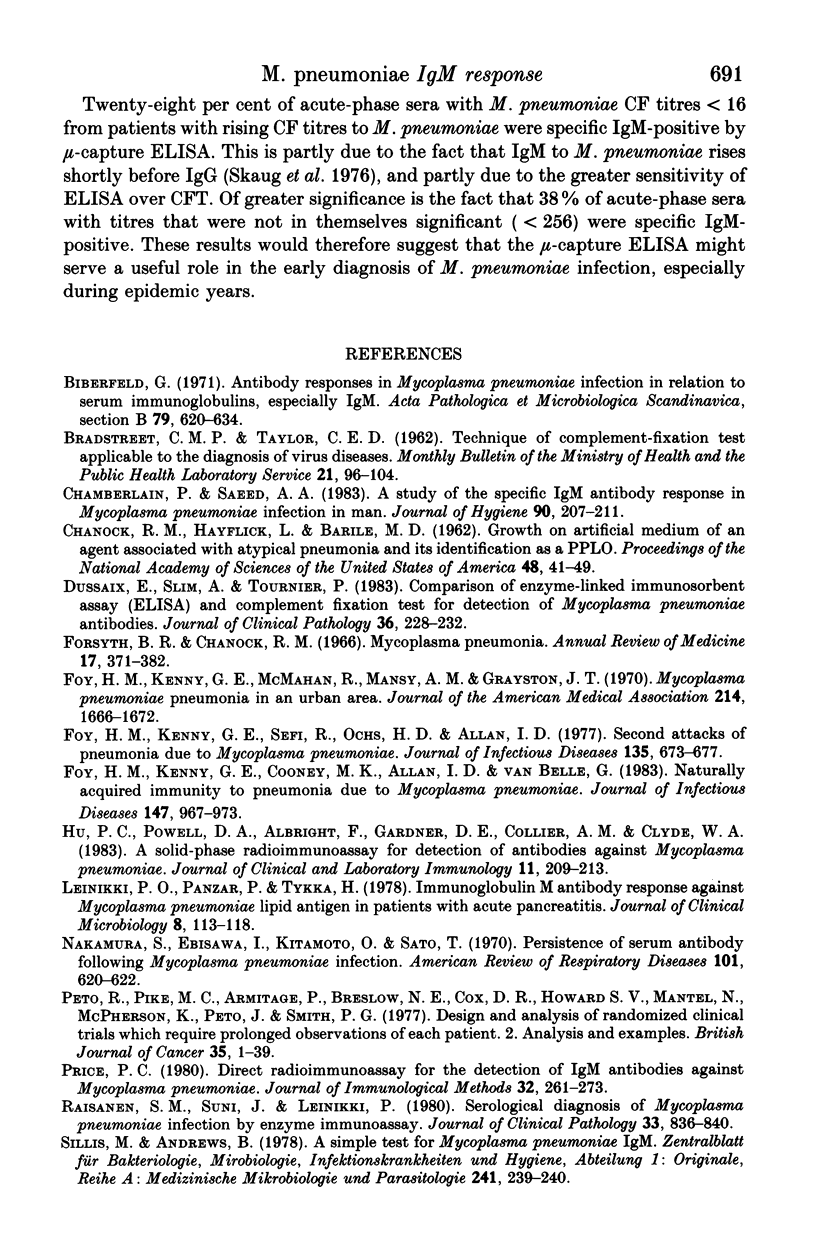
- BRADSTREET C. M., TAYLOR C. E. Technique of complementfixation test applicable to the diagnosis of virus diseases. Mon Bull Minist Health Public Health Lab Serv. 1962 May;21:96–104. [PubMed] [Google Scholar]
- CHANOCK R. M., HAYFLICK L., BARILE M. F. Growth on artificial medium of an agent associated with atypical pneumonia and its identification as a PPLO. Proc Natl Acad Sci U S A. 1962 Jan 15;48:41–49. doi: 10.1073/pnas.48.1.41. [DOI] [PMC free article] [PubMed] [Google Scholar]
- Chamberlain P., Saeed A. A. A study of the specific IgM antibody response in Mycoplasma pneumoniae infection in man. J Hyg (Lond) 1983 Apr;90(2):207–211. doi: 10.1017/s0022172400028874. [DOI] [PMC free article] [PubMed] [Google Scholar]
- Dussaix E., Slim A., Tournier P. Comparison of enzyme-linked immunosorbent assay (ELISA) and complement fixation test for detection of Mycoplasma pneumoniae antibodies. J Clin Pathol. 1983 Feb;36(2):228–232. doi: 10.1136/jcp.36.2.228. [DOI] [PMC free article] [PubMed] [Google Scholar]
- Forsyth B. R., Chanock R. M. Mycoplasma pneumonia. Annu Rev Med. 1966;17:371–382. doi: 10.1146/annurev.me.17.020166.002103. [DOI] [PubMed] [Google Scholar]
- Foy H. M., Kenny G. E., Cooney M. K., Allan I. D., van Belle G. Naturally acquired immunity to pneumonia due to Mycoplasma pneumoniae. J Infect Dis. 1983 Jun;147(6):967–973. doi: 10.1093/infdis/147.6.967. [DOI] [PubMed] [Google Scholar]
- Foy H. M., Kenny G. E., McMahan R., Mansy A. M., Grayston J. T. Mycoplasma pneumoniae pneumonia in an urban area. Five years of surveillance. JAMA. 1970 Nov 30;214(9):1666–1672. [PubMed] [Google Scholar]
- Foy H. M., Kenny G. E., Sefi R., Ochs H. D., Allan I. D. Second attacks of pneumonia due to Mycoplasma pneumoniae. J Infect Dis. 1977 Apr;135(4):673–677. doi: 10.1093/infdis/135.4.673. [DOI] [PubMed] [Google Scholar]
- Hu P. C., Powell D. A., Albright F., Gardner D. E., Collier A. M., Clyde W. A., Jr A solid-phase radioimmunoassay for detection of antibodies against Mycoplasma pneumoniae. J Clin Lab Immunol. 1983 Aug;11(4):209–213. [PubMed] [Google Scholar]
- Leinikki P. O., Panzar P., Tykkä H. Immunoglobulin M antibody response against Mycoplasma pneumoniae lipid antigen in patients with acute pancreatitis. J Clin Microbiol. 1978 Aug;8(2):113–118. doi: 10.1128/jcm.8.2.113-118.1978. [DOI] [PMC free article] [PubMed] [Google Scholar]
- Nakamura S., Ebisawa I., Kitamoto O., Sato T. Persistence of serum antibody following Mycoplasma pneumoniae infection. Am Rev Respir Dis. 1970 Apr;101(4):620–622. doi: 10.1164/arrd.1970.101.4.620. [DOI] [PubMed] [Google Scholar]
- Peto R., Pike M. C., Armitage P., Breslow N. E., Cox D. R., Howard S. V., Mantel N., McPherson K., Peto J., Smith P. G. Design and analysis of randomized clinical trials requiring prolonged observation of each patient. II. analysis and examples. Br J Cancer. 1977 Jan;35(1):1–39. doi: 10.1038/bjc.1977.1. [DOI] [PMC free article] [PubMed] [Google Scholar]
- Price P. C. Direct radioimmunoassay for the detection of IgM antibodies against Mycoplasma pneumoniae. J Immunol Methods. 1980;32(3):261–273. doi: 10.1016/0022-1759(80)90191-x. [DOI] [PubMed] [Google Scholar]
- Räisänen S. M., Suni J. I., Leinikki P. Serological diagnosis of Mycoplasma pneumoniae infection by enzyme immunoassay. J Clin Pathol. 1980 Sep;33(9):836–840. doi: 10.1136/jcp.33.9.836. [DOI] [PMC free article] [PubMed] [Google Scholar]
- Skaug K., Eng J., Orstavik I., Haug K. W. The diagnostic value of determination of IgM antibodies against Mycoplasma pneumoniae by the indirect immunofluorescent antibody test. Acta Pathol Microbiol Scand B. 1976 Aug;84(4):170–176. doi: 10.1111/j.1699-0463.1976.tb01922.x. [DOI] [PubMed] [Google Scholar]
- Wreghitt T. G., Sillis M. A micro-capture ELISA for detecting Mycoplasma pneumoniae IgM: comparison with indirect immunofluorescence and indirect ELISA. J Hyg (Lond) 1985 Apr;94(2):217–227. doi: 10.1017/s0022172400061428. [DOI] [PMC free article] [PubMed] [Google Scholar]