



Abstract
Intracellular Na+ and H+ inhibit Na+-Ca2+ exchange. ATP regulates exchange activity by altering kinetic parameters for , and . The role of the regulatory site on --ATP interactions was explored by measuring the -dependent 45Ca2+ efflux (-Ca2+i exchange) and -dependent 22Na+ efflux (- exchange) in intracellular-dialysed squid axons. Our results show that: (1) without ATP, inhibition by is strongly dependent on . Lowering the pHi by 0.4 units from its physiological value of 7.3 causes 80 % inhibition of - exchange; (2) in the presence of MgATP, and inhibition is markedly diminished; and (3) experiments on - exchange indicate that the drastic changes in the --ATP interactions take place at the regulatory site. The increase in affinity induced by ATP at acid pH (6.9) can be mimicked by a rise in pHi from 6.9 to 7.3 in the absence of the nucleotide. We conclude that ATP modulation of the Na+-Ca2+ exchange occurs by protection from intracellular proton and sodium inhibition. These findings are predicted by a model where: (i) the binding of Ca2+ to the regulatory site is essential for translocation but not for the binding of or to the transporting site; (ii) competes with for the same form of the exchanger without an effect on the transporting site; (iii) protonation of the carrier increases the apparent affinity and changes the cooperativity for binding; and (iv) ATP prevents both and effects. The relief of H+ and Na+ inhibition induced by ATP could be important in cardiac ischaemia, in which a combination of acidosis and rise in [Na+]i occurs.
The electrogenic Na+-Ca2+ exchanger is a membrane-bound protein that reversibly moves Ca2+ in exchange for Na+ and is primarily responsible for Ca2+ extrusion in many cells. This mechanism is particularly important during the rise in intracellular Ca2+ concentration ([Ca2+]i) that occurs during cell signalling and secretion (for overview of recent work see Blaustein & Lederer, 1999). The two main types of regulation of this transporter, which are likely to take place in the large intracellular loop of the exchange protein are: (i) ionic regulation, which comprises -dependent inactivation, regulation and modulation; and (ii) metabolic regulation, which includes MgATP and phosphagen modulation (for references see Hilgemann, Philipson & Vassort, 1996). It is also known that these modes of regulation are related. For instance, intracellular Na+ inhibition of the Na+-Ca2+ exchanger seems to result not only from simple competition between and for the transporting sites, but also from bringing the carrier into a Na+-occluded state (Hilgeman et al. 1992). Also, in both squid axons and cardiac cells, cytoplasmic calcium and MgATP decrease the extent of inhibition (Requena, 1978; Hilgemann & Matsuoka, 1992). Furthermore, it has been shown that acts as a cofactor by increasing inhibition of the exchanger (Doering & Lederer, 1993).
Proton inhibition of the Na+-Ca2+ exchanger was first shown in squid axons (Baker & McNaughton, 1977; DiPolo & Beauge, 1982) and later characterized in cardiac sarcolemmal vesicles (Wakabayashi & Goshima, 1981; Philipson et al. 1982). The high sensitivity of the exchanger to inhibition by intracellular protons and the strong synergism of the - interaction (Doering & Lederer, 1993, 1994) make this mode of regulation important not only under physiological conditions, but also under pathological conditions such as ischaemia and hypoxia where there is an increase in and intracellular Na+. Although important information exists on - interaction and -ATP antagonism, little is known of the effects of metabolic modulation of the Na+-Ca2+ exchanger by ATP on inhibition and - interaction.
Dialysed squid giant axons, which allow accurate control of intracellular pHi, pCai, and ATP, provide an excellent preparation in which to examine the mechanisms by which intracellular protons affect the Na+-Ca2+ exchanger and, in particular, how -- interactions are modulated by intracellular ATP. In the present paper, we show that the regulatory site is central to and ATP modulation of the exchanger. In addition, we develop a simple kinetic model of the exchanger that explains most of the features of the observed effects of ATP on the -- interactions. Some of these findings were presented in abstract form (DiPolo & Beaugé, 1999).
METHODS
Squid giant axons were obtained (after decapitation) from two squid species: Loligo pealei (Marine Biological Laboratory, Woods Hole, MA, USA) and Loligo plei (Instituto Venezolano de Investigaciones Cientificas; Fundaciencia-IVIC, Venezuela) and dialysed with highly permeable capillaries of regenerated cellulose fibres (210 μm o.d.; 200 μm i.d.; molecular mass 18 kDa; Spectrapor Number 132226; Spectrum, Houston, TX, USA). The standard dialysis medium had the following composition (mm): Tris-Mops, 385; NaCl, 45; MgCl2, 2; glycine, 285; and Tris-EGTA, 1; pH 7.3 and temperature between 17 and 18 °C. The standard external solution consisted of (mm): NaCl, 440; CaCl2, 0.3; MgCl2, 60; and Tris-Cl, 10; pH 7.6. The osmolarity of all solutions was adjusted to 940 mosmol l−1. The estimation of [Ca2+] was made using the WinMaxc computer program (Version 2.00, 1999; Chris Patton, Hopkins Marine Station, CA, USA). To control the [Ca2+]i in a pH range between 6.9 and 8.8 we employed two pH-independent calcium buffers: BAPTA and dibromoBAPTA. The former (1–3 mm) was used to buffer [Ca2+]i from 0.3 to 0.7 μm, the latter (1–3 mm) to buffer [Ca2+]i from 1.2 to 10 μm. Higher values of [Ca2+]i were taken as equal to the CaCl2 added in excess to that required to obtain 10 μm in the presence of dibromoBAPTA. Removal of external sodium was compensated with lithium. In order to stop any endogenous production of ATP, 1 mm NaCN was always present in the external media. Addition of ATP (3 mm) to the dialysis medium was done at a constant free [Mg2+]i of 1 mm. The Ca2+ pump component of Ca2+ efflux and the operation of the Na+-K+ pump were eliminated by adding 100 μm vanadate to the dialysis media. Na+ channels were blocked with 100 nm TTX in the external solutions. Before including [45Ca2+] in the dialysis solution, axons were routinely dialysed for about 45 min with a standard medium containing 0.2 mm EGTA that was free of calcium and ATP. In all experiments each axon served as its own control, since steady-state 45Ca2+ effluxes or 22Na effluxes were always measured before and after a given experimental condition. BAPTA and dibromoBAPTA were purchased from Molecular Probes (Eugene, OR, USA). All other reagents were from Sigma (St Louis, MO, USA).
RESULTS
Inhibition of the - exchange by and in ATP-depleted axons
Our initial experiments were designed to characterize the effect of intracellular protons on the steady-state levels of -dependent Ca2+ efflux without interactions with and ATP. For that purpose, Na+ and ATP were completely removed from the cytosol before changes in pHi. Figure 1 shows the effects, in a single axon, of changing the pHi between 6.9 and 7.7 at a constant [Ca2+]i of 1.2 μm. At a physiological pH of 7.3 the efflux of Ca2+ stabilizes at about 100 fmol cm−2 s−1. Lowering pHi by only 0.4 pH units to 6.9, causes a marked inhibition (about 80 %), while raising it to 7.7 increases the exchange rate to a level 20 times higher than that seen at pH 6.9.
Figure 1. Effect of intracellular protons on the forward Na+-Ca2+ exchange in the absence of and ATP.
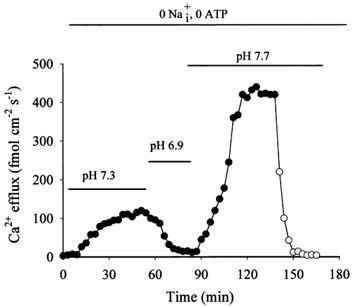
Ca2+ efflux in the presence (•) and absence (○) of . Note the strong inhibition by protons of the forward Na+-Ca2+ exchange. Axon diameter, 650 μm. Temperature, 17.5 °C.
In Fig. 2A the collected data from 11 axons illustrates the effect of different values of pHi on the steady-state -dependent Ca2+ efflux with [Ca2+]i ranging from 0.7 to 1000 μm. With [Ca2+]i between 0.7 and 10 μm and in the absence of and ATP, protons always have an inhibitory effect on the forward Na+-Ca2+ exchange (i.e. Ca2+ efflux, Na+ influx). However, at 1 mm [Ca2+]i protons have little effect on the exchanger. this result is predicted by the model depicted in Fig. 9. From the results shown in Fig. 2A it is possible to determine whether proton inhibition is affected by [Ca2+]i. Figure 2B shows a plot of the ratio of the forward Na+-Ca2+ exchange at pH 6.9 relative to that at pH 7.3, 7.7 and 8.8. Clearly, the fractional proton inhibition decreases with increasing [Ca2+]i, becoming non-existant at 1 mm [Ca2+]i, indicating antagonism between the two ligands at the intracellular side of the exchanger.
Figure 2. -dependent activation of forward Na+-Ca2+ exchange flux at different values of pHi in the absence of and ATP.
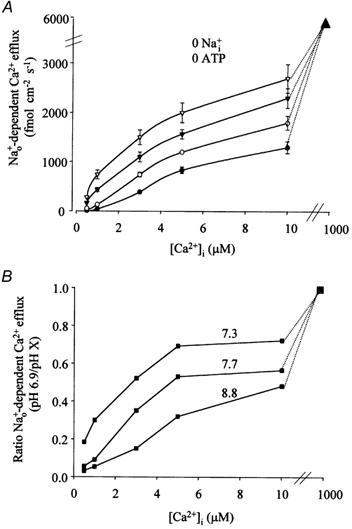
A, -dependent Ca2+ efflux at different values of [Ca2+]i at pH 6.9 (•), 7.3 (○), 7.7 (▾) and 8.8 (▿). The error bars indicate s.e.m. The mean temperature was 17 °C. B, fractional inhibition by expressed as the ratio of the forward Na+-Ca2+ exchange at pH 6.9 relative to that at pH 7.3, 7.7 and 8.8 as a function of [Ca2+]i. The graph was constructed using data from the experiments shown in Fig. 2A.
Figure 9.
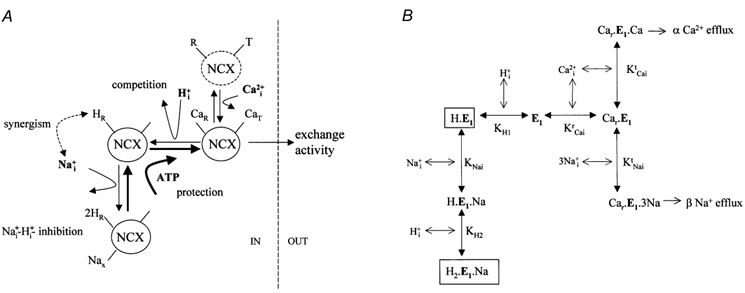
A, cartoon showing ligand interactions between - (competition-synergism) and the protective effect of ATP on these interactions. NCX, Na+-Ca2+ exchanger; R, regulatory site; and T, transport site. B, state diagram of the Na+-Ca2+ exchanger. See text for detaspan
In giant excised patches of guinea-pig cardiac sarcolemma, intracellular Na+ acts as a cofactor in proton inhibition of the Na+-Ca2+ exchanger (Doering & Lederer, 1994), presumably by acting on the large intracellular loop of the exchange protein (Philipson et al. 1982). We explored whether this - synergism is present in dialysed squid axons. Figure 3A, B and C shows the results from three different axons in which the effect of [Na+]i on the steady-state -dependent Ca2+ efflux was explored at physiological (7.3), acidic (6.9) and alkaline pH (8.8). In these experiments the protocol consisted of obtaining a steady-state baseline of Ca2+ efflux in the absence of and ATP, and then following the changes in Ca2+ efflux as the concentration of was increased. Two important results can be observed. First, in the absence of , the values of the -dependent Ca2+ efflux were 22, 61 and 600 fmol cm−2 s−1 at pH values of 6.9, 7.3 and 8.8 respectively, indicating that is not essential for proton inhibition. Second, an increase in [Na+]i caused progressive inhibition of the forward - exchange at every pHi investigated. In addition, became a more powerful inhibitor as pH was reduced, i.e. inhibition was more noticeable at higher [H+]i. Figure 3D summarizes the results of several experiments in which the percentage -dependent Ca2+ efflux (- exchange) was explored in the range from 0 to 200 mm[Na+]i at acidic (6.9), physiological (7.3) and alkaline (8.8) pH in axons completely depleted of ATP. It is clear that: (i) and inhibit synergistically; (ii) the - cooperativity, noticeable at acid pHi, is greatly diminished at pHi 8.8 (the K0.5 values for this effect of were 10, 40 and 90 mm at pH 6.9, 7.3 and 8.8 respectively); and (iii) at pH 8.8 the curve for inhibition suggests that more than one Na+ ion is involved, whereas a single Na+ ion kinetics seems to account for the results at pHi values of 7.3 and 6.9.
Figure 3. Effect of on the forward Na+-Ca2+ exchange at different values of pHi in the absence of ATP.
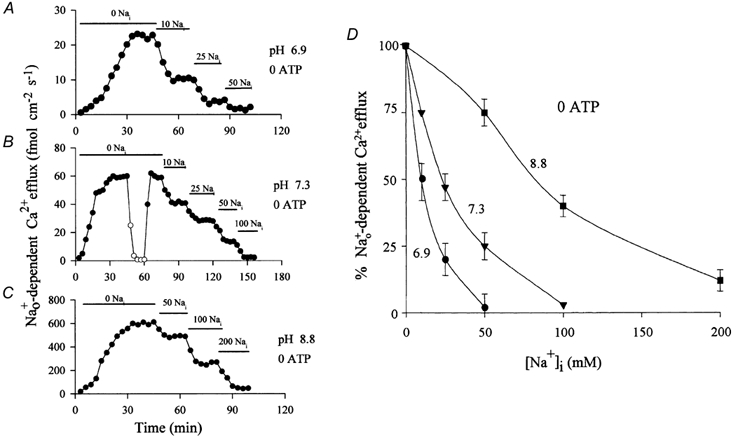
-dependent Ca2+ efflux at pH 6.9 (A) 7.3 (B) and 8.8 (C) in the presence (•) and absence (○) of . All concentrations are millimolar. Notice the marked synergism between and in inhibiting the exchanger at acidic pHi. D, -dependent inhibition of forward Na+-Ca2+ exchange at different values of pHi in the absence of ATP. Ordinate, percentage -dependent Ca2+ efflux (- exchange). The error bars indicate s.e.m. The mean temperature was 17 °C. Notice the exquisite sensitivity of the exchange activity to at the acidic pH.
The effect of ATP on and interactions
In squid axons, stimulation of Na+-Ca2+ exchange by ATP involves changes in several kinetic parameters, including a decreased capability of intracellular Na+ to inhibit the forward - exchange (Requena, 1978; DiPolo & Beaugé, 1986). To determine whether ATP affects proton inhibition of the exchanger, and its synergism with intracellular Na+ inactivation, we recorded the ATP stimulation of the -dependent Ca2+ efflux, in the absence and presence of , from pHi 6.9 to 8.8. Figure 4A shows that in an axon dialysed without and ATP at a physiological pH of 7.3, addition of ATP causes a modest 20 % increment in the -dependent Ca2+ efflux, which slowly disappears upon removal of the nucleotide. Lowering the pHi to 6.9 in the absence of both and ATP produces the already described marked inhibition of the Na+-Ca2+ exchanger. Interestingly, at this acidic pH and in the absence of , ATP induces a pronounced (400 %) stimulation of the -dependent Ca2+ efflux. Figure 4B shows a representative axon from a different set of experiments in which the effect of ATP was tested in the presence of at both physiological (7.3) and alkaline pHi (8.8). Contrasting with the results shown in Fig. 4A, at pH 7.3 ATP greatly increases (about 600 %) the rate of the -dependent Ca2+ efflux. After the Nao-dependent Ca2+ efflux had reached a baseline value following the removal of ATP, pHi was changed to 8.8, causing a tenfold increase in the forward Na+-Ca2+ exchange. Remarkably, at alkaline pHi readdition of ATP caused a quite small increment (less than 10 %) in the exchange activity. A summary of results of these experiments is given in Fig. 4C, which shows the degree of activation of the -dependent Ca2+ efflux by ATP in the pHi range of 6.9–8.8, at a constant [Na+]i (40 mm) and [Ca2+]i. It can be concluded that activation of the -dependent Ca2+ efflux by ATP is highly dependent on pHi, being larger at acidic and almost non-existant at alkaline pH.
Figure 4. Effect of ATP on forward Na+-Ca2+ exchange in the presence and absence of at different values of intracellular pHi.
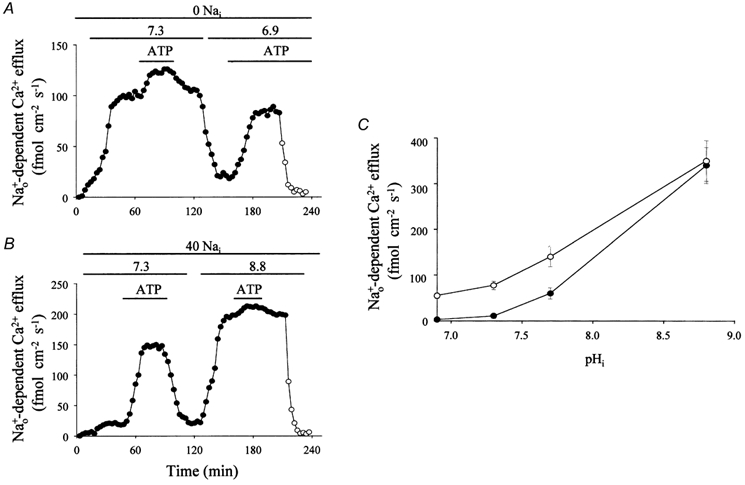
A, -dependent Ca2+ efflux in the absence of in the presence (•) and absence (○) of . Notice the small effect of ATP at pH 7.3 compared to the large activation at pH 6.9. Axon diameter, 525 μm. B, -dependent Ca2+ efflux in the presence of a physiological [Na+]i of 40 mm in the presence (•) and absence (○) of . Observe the large effect of ATP at pH 7.3 and its miniscule effect at pH 8.8. Axon diameter, 620 μm. C, -dependent inhibition of forward Na+-Ca2+ exchange at physiological (40 mm) in the absence (•) and presence (○) of ATP (3 mm). The error bars indicate s.e.m. The mean temperature was 17 °C. Notice that the major fractional activation of the Na+-Ca2+ exchange by ATP occurs between pH 6.9 and 7.3.
In order to obtain further insight into the ATP-- interactions we measured the [Na+]i inhibition of the -dependent Ca2+ efflux at pHi 6.9 and 8.0 in the absence and presence of intracellular ATP. In the experiment shown in Fig. 5A, the axon was first dialysed without and ATP, causing the Ca2+ efflux to reach a level near 50 fmol cm−2 s−1. Addition of 10 and 25 mm in the absence of ATP caused a 55 and 80 % inhibition of the exchange flux respectively. This inhibition completely reverted upon removal of . Figure 5A also shows that even in the absence of Na+ and at pH 6.9, ATP caused a large activation of the -dependent Ca2+ efflux, but in this case much higher concentrations of were required to inhibit the exchange flux. This clearly shows that ATP at a physiological concentration (3 mm) causes a marked relief of the - inhibition of the Na+-Ca2+ exchanger. It should be pointed out that a similar protective effect of ATP was observed at [ATP] near its apparent affinity constant of 0.3 mm (experiments not shown).
Figure 5. ATP relief of - inhibition of forward Na+-Ca2+ exchange.
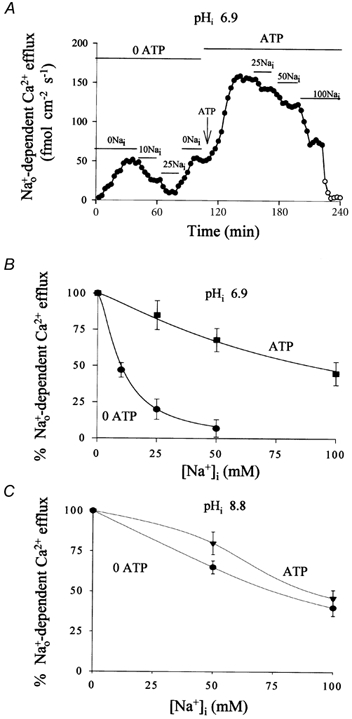
A, -induced inhibition of -dependent Ca2+ efflux at pH 6.9 in an axon dialysed first without ATP, then with 3 mm ATP. Notice first, the large activation in the exchange activity induced by ATP in the absence of and second, the relief of inhibition. B, -dependent inhibition of forward Na+-Ca2+ exchange at pH 6.9 in the presence and absence of ATP. C, -dependent inhibition of forward Na+-Ca2+ exchange at pH 8.8 with and without ATP. The error bars indicate s.e.m.
Figure 5B and C summarizes the results of several experiments on the effect of ATP on inhibition of the forward Na+-Ca2+ exchange at pHi 6.9 and 8.8, at a constant buffer [Ca2+]i of 1.2 μm. In Fig. 5B at pH 6.9, in the virtual absence of ATP, 10 mm brings a strong 50 % inhibition of the -dependent Ca2+ efflux, which is almost complete at 50 mm. However, in this acidic condition, ATP reduces inhibition, which is almost non-existant at 10 mm and only 50 % at 100 mm . In contrast, Fig. 5C shows that when the experiments were performed at pH 8.8, at the same constant buffer [Ca2+]i, inhibition by was markedly reduced and barely modified by the addition of ATP. In other words, inhibition of the Na+-Ca2+ exchanger is antagonized by both ATP and alkalinization.
The effect of and ATP on the regulatory site
In squid axons ATP stimulation of the Na+-Ca2+ exchanger occurs at limiting [Ca2+]i via an increase in the affinity of the intracellular regulatory site (DiPolo & Beaugé, 1987). Therefore, another set of experiments was carried out to test whether the ATP- antagonism shown above might be associated with interactions of these ionic substrates at the regulatory site. In dialysed squid axons there are two ways to explore the apparent affinity of the regulatory site for Ca2+. One approach uses the stimulation of the reverse partial reaction of the exchanger (-dependent Ca2+ influx), while the other uses the stimulation of the homologous - exchange (DiPolo & Beaugé, 1987). For the sake of simplicity (to measure effluxes is technically less complicated than to estimate influxes), we decided to use the - partial reaction of the exchanger. Figure 6A and 6B shows two experiments designed to measure the apparent affinity of the exchanger for at pHi 6.9 and 8.8 in the absence of ATP. Initially, a baseline value of Na+ efflux was obtained at a physiological , (40 mm) in the absence of ATP and (see Methods), followed by activation of -dependent Na+ efflux through progressive increases in [Ca2+]i. At pH 6.9 (Fig. 6A), activates the - exchanger with low affinity. In this particular axon, 50 % activation took place at a [Ca2+]i greater than 10 μm. An important implication for the mechanisms of inhibition of the exchanger is seen in Fig. 6B, which shows a similar experiment carried out at pH 8.8. In this case the apparent affinity for activation of - exchange increases to around 0.5 μm; i.e. about 20-fold higher than that observed at acid pH. It is worth noticing in Fig. 6A and B that the level of the -dependent Na+ efflux attained at saturating [Ca2+]i is almost the same at pH 6.9 and 8.8, suggesting that the effect of protons reflects changes in the affinity of the regulatory site rather than in the rate of Na+ translocation.
Figure 6. Effect of acid and alkaline pHi on the Ca2*i-dependent - exchange.
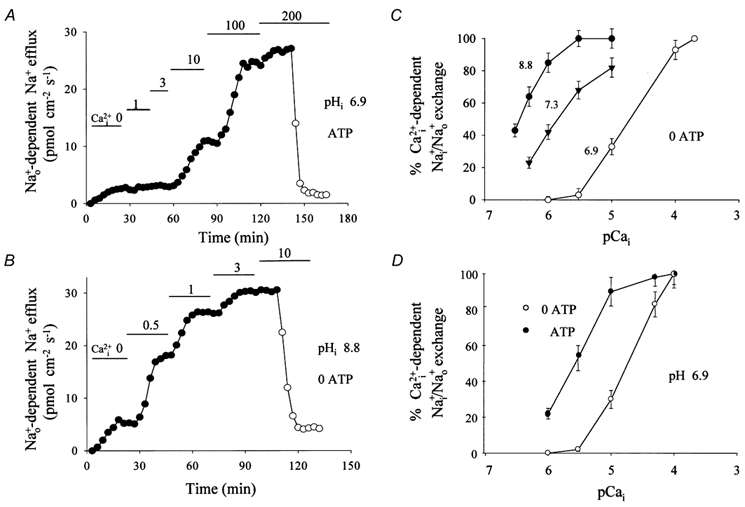
Steady-state -dependent Na+ efflux at pH 6.9 induced by increasing the [Ca2+]I from 0 to 200 μm (A) and steady-state -dependent Na+ efflux at pH 8.8 induced by increasing [Ca2+]i from 0 to 10 μm (B) in the presence (•)and absence (○) of . The [Ca2+]i was controlled with dibromoBAPTA (see Methods). Notice the large change in the apparent affinity of the - exchange for between acid and alkaline pH. C, percentage -dependent - exchange at pH 6.9 (○), 7.3 (▾) and 8.8 (•) in the absence of ATP at a physiological [Na+]i. The measurements at 0.3 μm were obtained with BAPTA as Ca2+ chelator. All other measurements were carried out with dibromoBAPTA. The error bars indicate s.e.m.D, percentage -dependent - exchange at pH 6.9 in the presence (•) and absence (○) of 3 mm ATP. The error bars indicate s.e.m. The mean temperature was 17.5 °C.
Figure 6C collects the results of several experiments on the dependence of - exchange in the absence of ATP at a constant physiological [Na+]i of 40 mm. Notice that the apparent affinity of the regulatory site for is strongly pHi dependent, varying from 0.3–0.5 μm at pHi 8.8 to 2 μm at pHi 7.3 and 20 μm at pHi 6.9. This illustrates that, in the absence of ATP, relatively minor variations in [H+]i from its physiological value of 7.3 have pronounced effects in the exchange activity, which are mostly the consequence of changes in the binding affinity of the regulatory site. The role of ATP in this process is clearly seen in the series of experiments shown in Fig. 6D. At pH 6.9, addition of ATP reduces the K0.5 for stimulation of - exchange about sevenfold, from 20 to about 3 μm. Interestingly, this increase in affinity induced by the nucleotide is close to that seen in its absence when the pHi is raised from 6.9 to its physiological value of 7.3 (see Fig. 6C).
Additional evidence supporting the hypothesis that and ATP antagonize each other by modifying the affinity of the regulatory site comes from the use of the sulfhydryl blocking reagent p-chloromercuryphenylsulphonic acid (pCMBS). This compound was shown to modify the reactivity of the regulatory site, preventing the increase in its affinity for induced by ATP, but without affecting the Vmax of the Na+-Ca2+ exchanger (DiPolo & Beaugé, 1993). The effect of increasing pHi from 7.3 to 8.8 in the presence and absence of pCMBS on the two partial reactions of the exchanger is illustrated in Fig. 7 (- exchange in Fig. 7A and - exchange in Fig. 7B). Figure 7A shows that after obtaining a steady-state Na+ efflux in the absence of and ATP at pH 7.3, addition of 1.0 μm activates the -dependent Na+ efflux. The efflux of Na+ is increased further when pH is raised to 8.8 and returns to its previous level at pHi 7.3. Addition of 1 mmpCMBS causes a complete inhibition of the -activated -dependent Na+ efflux and under these conditions alkalinization to pHi 8.8 does not modify the level of - exchange. As reported previously (DiPolo & Beaugé, 1994), pCMBS does not cause a simple unspecific inhibition, since when [Ca2+]i was raised to 100 μm, normal levels of exchange were obtained (cf. Fig. 6B). In the experiment shown in Fig. 7B the axon was submitted to a similar protocol but in this case the forward -dependent Ca2+ efflux was the measured partial reaction. Before pCMBS was applied, - exchange was stimulated by intracellular alkalinization from pH 7.3 to 8.8. After addition of pCMBS, similar changes in pH were completely ineffective. Also in this case, raising [Ca2+]i to 100 μm increased the -dependent Ca2+ efflux to normal values. Therefore, in agreement with the results shown in Fig. 6A and B, the experiments with pCMBS strongly suggest that intracellular proton inhibition of the Na+-Ca2+ exchanger occurs at the regulatory site without significantly affecting either the affinities of the or transporting sites or the translocation rates of these cations.
Figure 7. The effect of pCMBS on the alkalinization-induced increase in - and - exchange in axons dialysed without ATP.
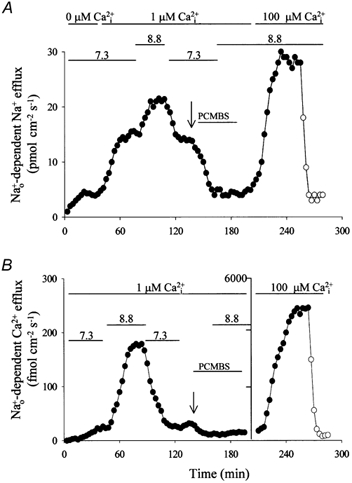
-dependent Na+ efflux (A) and -dependent Ca2+ efflux (B) in the presence (•) and absence (○) of . The numbers above the lines represent the buffered intracellular pH. The arrows indicate the addition of 1 mmpCMBS. Notice that pCMBS completely blocks the alkalinization-induced increase in both - and - exchange. Notice also that at the end of both experiments increasing to saturating values reactivates the fluxes to normal levels. The mean temperature was 17.5 °C.
DISCUSSION
Primary inhibition by and competition with
In dialysed squid axons, in the complete absence of and ATP, intracellular protons strongly inhibit the forward - exchange even at [Ca2+]i as high as 10 μm (see Fig. 2A) while inhibition is absent at 1 mm [Ca2+]i. In contrast to the cardiac exchanger, in which there is no conclusive evidence that calcium ions displace protons (Doering & Lederer, 1993), our experiments show a significant decrease in the fractional proton inhibition when [Ca2+]i is increased (see Fig. 2B). In other words, in the squid, and are antagonists. The - exchange experiments, which unequivocally provide a method for estimation of the affinity for of the regulatory Ca2+ site, indicate that modulation by protons involves interaction(s) with that modulatory site. Other experimental evidence favours this conclusion. First, the sulfhydryl agent pCMBS, which in squid axons markedly reduces the affinity of the regulatory site without affecting the Vmax of the exchanger, completely blocks the stimulation of the Na+-Ca2+ exchanger induced by alkaline pH (see Fig. 7A and B). Second, at [Ca2+]i of 1 mm, protons have little effect on the rate of the forward exchange (see Fig. 2A). It could be argued that the same thing happens in the cardiac Na+-Ca2+ exchanger because in that preparation alkalinization of the cytoplasmic side of inside-out patches shifts the secondary dependence of the outward exchange current towards lower [Ca2+]i (Hilgemann et al. 1992). Nevertheless, these results are not conclusive because, as pHi was increased, a significant outward current through the reverse Na+-Ca2+ exchange occurred, even in the complete absence of cytosolic Ca2+ (Hilgemann et al. 1992). In our experiments, we found no evidence that alkaline pHi may activate the Na+-Ca2+ exchanger in the absence of (see Fig. 6B).
- interactions in metabolically depleted axons
An important finding in the cardiac Na+-Ca2+ exchanger is that protons act as cofactors in inactivation (Doering & Lederer, 1994). Similar interactions between sodium and protons are shown in the present experiments in ATP-depleted nerve fibres, where the - synergism is quite remarkable. As shown in Fig. 3D, at physiological pH (7.3) the activity of the Na+-Ca2+ exchanger is inhibited by more than 60 % at a physiological [Na+]i of 40 mm. In the range of pH and [Na+]i explored in this work (pH 6.9–8.8 and [Na+]i 0–200 mm), it is noticeable that 10 mm at pH 6.9 causes 50 % inhibition of the forward Na+-Ca2+ exchanger compared to about 100 mm at pH 8.8.
ATP antagonizes intracellular sodium-proton synergism
In squid axons as well as in the cardiac Na+-Ca2+ exchanger, ATP intrinsically regulates the exchange activity (Hilgeman & Matsuoka, 1992; DiPolo & Beaugé, 1999). In both preparations, when ATP levels are depleted (> 90 %) either by treatment with metabolic inhibitors (Haworth et al. 1987) or by intracellular dialysis (DiPolo, 1973), the exchange activity drops by more than 80 %. It is thought that the activation of the cardiac Na+-Ca2+ exchanger (NCX1) by ATP is a result of the synthesis of PIP2 (Hilgemann, 1997; Berberián et al. 1998), particularly of that strongly bound to the carrier protein (Asteggiano et al. 2001). In the squid, MgATP regulation of this exchanger seems to occur by a different mechanism, apparently unrelated to PIP2 production (DiPolo et al. 2000) and probably associated with a phosphorylation-dephosphorylation process that involves a soluble cytosolic regulatory protein (DiPolo et al. 1997). The squid preparation has been extensively used to study the effects of ATP on the kinetics of interactions between transported and non-transported ligands with the Na+-Ca2+ exchanger (DiPolo & Beaugé, 1999). Until now, it was known that regulation of the squid Na+-Ca2+ exchanger by ATP involves: (i) an increase in the affinity of both intra- and extracellular sites of the transported cations (Na+ and Ca2+); (ii) an increase in the affinity of the regulatory site for calcium ions; and (iii) a decrease in the inhibition by .
The main contribution of the present study is to have found a link between the ionic (--) and the ATP-induced modulations of the squid Na+-Ca2+ exchanger. A finding that has been difficult to explain in squid axons is that, in the absence of intracellular Na+ and at a physiological pH of 7.3, the effect of ATP is rather small (DiPolo & Beaugé, 1984). A possible explanation for this effect can be seen in Fig. 4A in which, at pH 6.9 and in the absence of , ATP stimulation of the exchange activity is much greater than at pH 7.3. The relationship between ATP modulation and inhibition becomes even more clear in the experiment of Fig. 4B in which, at physiological , ATP has a large stimulatory effect on the exchange activity at pH 7.3, but that stimulation vanishes at alkaline pH. This dependence of the ATP effect on [H+]i indicates that the larger fractional activation of the Na+-Ca2+ exchanger induced by ATP at physiological [Na+]i occurs mostly between pHi 6.9 and 7.3. In these conditions the magnitude of the ATP effect is 12.5-, 4.0-, 2.3- and 1.05-fold at pH values of 6.9, 7.3, 7.7 and 8.8 respectively (see Fig. 4C).
It is known from previous studies that inhibition of the Na+-Ca2+ exchange activity is modulated by multiple factors including , ATP and (Miura & Kimura, 1989; Hilgemann & Matsuoka, 1992; DiPolo & Beaugé, 1999). As shown in Fig. 5B, the synergism between and on the inhibition of Na+-Ca2+ exchange activity is strongly attenuated or prevented by ATP. In fact, at pH 6.9 the exchange activity at a physiological [Na+]i of 40 mm is almost 90 % inhibited in the absence of ATP, while inhibition amounts only to 10 % in the presence of ATP. As shown in Fig. 5C, at pH 8.8 the flux difference between the presence and absence of ATP is seen only at physiological [Na+]i, while both curves tend to superimpose at high [Na+]i (> 100 mm). This observation, which may look bizarre, can be accounted for by the kinetic model proposed below (see Fig. 9 and Appendix). In Fig. 5B and C it can be seen that in the presence of 40 mm internal Na+ the sizeable fraction of stimulation by ATP decreases as pH is raised from 6.9 and becomes nil at pH 8.8. This is another indication that ATP modulation of the exchanger occurs by protection from intracellular proton inhibition. Our present hypothesis on the relationship between intracellular proton inhibition and modulation by ATP (see below) predicts that, at acidic pH, ATP substantially increases the affinity of the regulatory site and therefore, in the absence of ATP, increasing the pHi from 6.9 to 8.0 should markedly increase the affinity of the regulatory site for Ca2+ ions. These predictions are fulfilled in the experiments described in Fig. 6C and D.
The experiments reported here may explain some of the controversial aspects relating to the affinity of the regulatory -binding site reported in intact myocytes (K1/2 of 20 nmol l−1; Miura & Kimura, 1989) compared to giant patch preparations (100–400 nmol l−1), excised myocyte blebs (Hilgemann et al. 1992), oocytes expressing the cloned Na+-Ca2+ exchanger (Matsuoka et al. 1997) and large inside-out macropatches excised from intact myocytes (Fujioka et al. 2000). Taking into consideration the present results, the absence of ATP in the reported giant patch experiments may account for the underestimation of the affinity of the regulatory site.
Analysis of the proposed kinetic model
The steady-state regulation kinetics of the Na+-Ca2+ exchanger were well simulated by the model shown in Fig. 9 in the Appendix. This model incorporates basic elements from other studies (Hilgemann et al. 1992; Doering & Lederer, 1994) and emphasizes the central role played by the intracellular regulatory site for , in particular the - cooperative inhibition of the exchanger and the protection exerted by MgATP against this inhibition. Figure 8 shows the results of several key simulations of the ATP-- interactions using the model illustrated in Fig. 9B. Figure 8A simulates the -dependent Ca2+ efflux as a function of [Ca2+]i. At any given pHi, the -dependent Ca2+ efflux increases with increasing [Ca2+]i. The increase is greater as the pHi is shifted from acidic to alkaline. Furthermore, the model predicts the results of Fig. 2A where, at 1 mm [Ca2+]i, pHi has little effect on the level of the exchange flux. Qualitatively this simulation reproduces all the experimental findings of Fig. 2. However, quantitatively (and this is so far the only drawback of the model) it fails to show the initial saturation kinetics seen in Fig. 2. In Fig. 8B, the modelled effects of on the forward Na+-Ca2+ exchange at different values of pHi and in the absence of ATP are almost an exact replica of the experiments of Fig. 3D, which show the synergism between and protons in inhibiting the exchanger. In addition, the simulations of the effects of ATP in reverting - inhibition (Fig. 8C and D) reproduce quite well the experimental data of Fig. 5B and C. Figure 8E shows a simulated -dependent Ca2+ efflux and its pHi dependence, corresponding to Fig. 4C. The simulated effects of intracellular pH in the range of 6.9–8.8 in the presence of 40 mm with and without ATP are almost identical to the experiments shown in Fig. 4C, i.e. the model predicts, and the experiments corroborate, that the fractional activation of the Na+-Ca2+ exchanger by ATP occurs at the acidic end of the pH range and vanishes at the alkaline end. A simulation of the increase in the affinity of the regulatory site with increasing pHi is shown in Fig. 8F.
Figure 8. Kinetic model simulations for the , , and ATP interactions in the regulation of the squid Na+-Ca2+ exchanger.
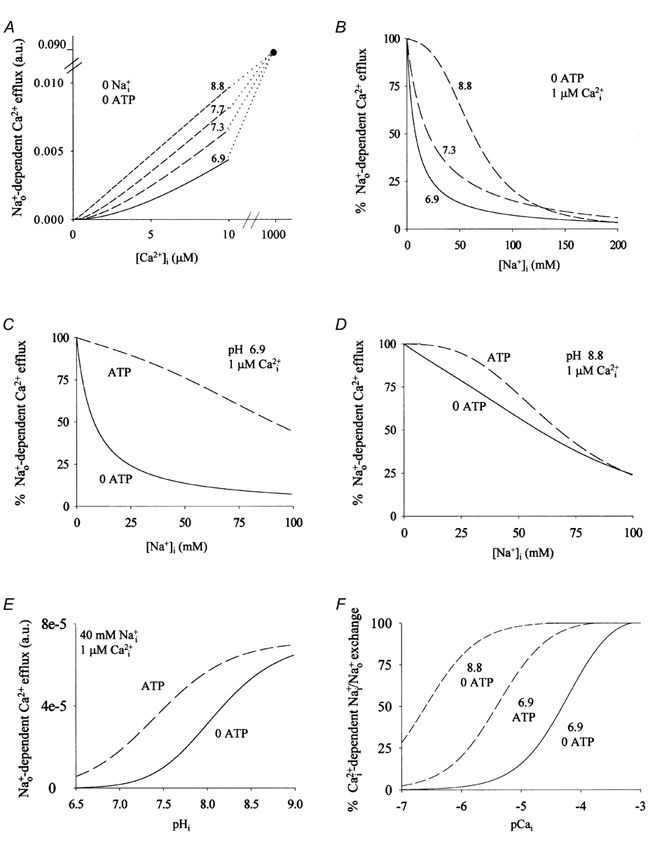
Notice that with the values of the constant used, at physiological pH, and , the fraction of carriers available for translocation is quite small. See text for details.
In summary, a model based on the hypothesis that proton interaction with the exchanger and its reversion by ATP occur at the intracellular Ca2+ regulatory site predicts all the experimental results described in this study.
Possible pathophysiological implications of the ATP relief of - cooperativity
Myocardial infarction is a complex syndrome with multiple variables, including a rise in intracellular Na+, acidosis and ATP depletion. Early ischaemic episodes (ischaemic preconditioning) change the time course of myocardial damage in sustained final ischaemia (Murry et al. 1986; Li et al.1990). Reduced ATP consumption during ischaemic preconditioning, or repetitive acidosis, appears to be the most important factor in the preservation of both ATP and pHi and has been implicated as playing a major role in protection of the myocardium during ischaemia (Murry et al. 1990; Kida et al. 1991; Lundmark et al. 1999). In addition, decreased ATP hydrolysis during the preconditioning phenomenon would make more ATP available at the time of reperfusion to maintain membrane homeostatic mechanisms such as the Na+,K+-ATPase (Grinwald, 1992), and possibly Na+-Ca2+ exchange and the Ca2+ pump. Although the definitive mechanism(s) of preconditioning ischaemia has not been elucidated, it seems that glycogen depletion (Schaeffer et al. 1995), reduction in glycolysis (Murphy et al. 1991), limitation of acidosis and preservation of ATP play a critical role. In that regard, our experimental finding of a protective effect of ATP on the - synergistic inhibition of the Na+-Ca2+ exchanger might be important for maintaining a functional Na+-Ca2+ exchanger during sustained ischaemia, thus avoiding the rundown of a major extrusion mechanism in the heart.
Acknowledgments
This work was supported by grants from the USA National Science Foundation (IBN-01309962), Consejo Nacional de Investigaciones Científicas y Tecnólogicas (MCT-CONICIT-Venezuela S1–99000946, Proyecto de Grupo IVIC-UCV-2001), Fundación Polar (Venezuela), Fundaciencias-IVIC, Consejo Nacional de Investigaciones Científicas y Técnicas (CONICET-Argentina 4904/97), Agencia Nacional de Promoción Científica y Tecnológica-FONCYT-Argentina (PICT99 05–05158) and Agencia Córdoba Ciencia, Argentina (181/01). We wish to thank Beca Ramón Carrillo Oñativia and Guillermo Whittembury for their comments on the manuscript.
APPENDIX
Figure 9A shows a simplified model summarizing the effect of - and ATP on the Na+-Ca2+ exchange activity, emphazising - competition, - synergism and ATP protection of these interactions. Figure 9B shows a model of the Na+-Ca2+ exchanger in which, for simplicity, only the intracellular ionic interactions have been taken into account. E1 is the state of the exchanger in which the ion binding site faces the intracellular medium. Car.E1 is the cytoplasmic carrier loaded with Ca2+ at the regulatory site. Car.E1.Ca and Car.E1.3Na are the cytoplasmic-facing carriers loaded with 1Ca2+ or 3Na+ and ready to perform either Ca2+ or Na+ efflux, respectively. H.E1, H.E1.Na and H2.E1.Na are carriers binding H+ and Na+ at their inhibitory sites.
The elements we considered in designing the model, and which are shown in the Results, were the following. (a) Proton inhibition occurs even in the absence of (first dead end, H.E1), but the presence of strongly potentiates that inhibition (second dead end, H2.E1.Na). The way in which acts results in simulated curves which seem to require a single Na+ ion at acid pH but become more complex as pH becomes more alkaline. In simulating the experimental data using the kinetic model we found that the best results were obtained by considering that two protons interact with the exchanger, one by competing with at the regulatory site and the other by taking the H.E1.Na state into a dead end, H2.E1.Na. The model then assumes two types of inhibition, one favouring inhibition by , while the other, independent of [H+]i, occurs by competition with at the transporting sites. (b) ATP antagonizes inhibition by protons in the absence but, more conspicuously, in the presence of . (c) Protons induce a striking reduction in the apparent affinity of the intracellular Ca2+ regulatory site. Conversely, antagonizes inhibition. (d) Experiments where [Ca2+]i was increased to as much as 1 mm show, in addition to counteracting inhibition, the following: (i) Ca2+ efflux through the forward - exchange does not reach saturation at 1 mm; and (ii) no inhibition of the - exchange through the Na+-Ca2+ exchanger is seen; this happens at all pH values and with or without ATP. According to these results, in the proposed model the minimal true dissociation constant for the transporting site becomes 10 mm.
Given the above, the basic features of this model are the following. (1) It takes into account only interactions between ligands at the cytoplasmic side. It makes no distinction whether the efflux of the cations is in exchange for external Ca2+ or Na+. We consider this to be sufficient at this stage. A more elaborate model can be designed by adding the external part of the transport cycle. (2) The binding of all ions is instantaneous (rapid random equilibrium). In addition, the binding of 3 are simultaneous. (3) The binding of Ca2+ to the regulatory site is essential for the binding of or to the transporting sites. (4) Intracellular protons compete with for the same form of the exchanger (not necessarily the same binding site), resulting in competitive inhibition by at the regulatory site. (5) The binding of one proton to the carrier allows the binding of one intracellular Na+ ion to form the H.E1.Na complex. The site(s) at which this Na+ ion binds is not specified. (6) The formation of the H.E1.Na complex allows the binding of a second proton to form the dead end inhibitory H2.E1.Na complex. (7) MgATP, through a process requiring phosphorylation, acts on the carrier by decreasing the apparent affinity for and its counterpart binding to the carrier. However, the intimate mechanism for this ATP protection is not explicit.
For the rapid equilibrium solution of the present scheme we took the following values.
Dissociation constants:
, true affinity for the regulatory site, 1 × 10⁻⁷m;
, true affinity for the transport site, 1 × 10⁻²m;
, true affinity for each transport site, 6 × 10⁻²m;
KH10, true affinity for the first proton site, 1 × 10⁻⁹m;
KH20, true affinity of the H.E1.Na2 for the second proton, 1 × 10⁻⁸m; and
KNai0, true affinity for of the H.E1 complex, 1 × 10⁻¹m.
Other constants:
n = number of Na+ ions binding to the H.E1 complex = 1; KATP, Km for the effects of MgATP, 200 μm;
factor-ATP-KH1, decrease by ATP of the apparent affinity for binding to E1 = 2;
factor-ATP-KH2, decrease by ATP of the apparent affinity for binding to H.E1.Na = 2;
factor-ATP-KNai, decrease by ATP of the apparent affinity for binding to H.E1 = 10;
KH1 = KH10 × (1 + (factor-ATP-KH1 × [ATP]/(KATP + [ATP]));
KH2 = KH20 × (1 + (factor-ATP-KH2 × [ATP]/(KATP + [ATP]));
and
KNai = KNai0 × (1 + (factor-ATP-KNai × [ATP]/(KATP + [ATP])).
These last three equations express the fact that in the presence of ATP the affinity of the carrier for (KH1 and KH2) and of the H.E1 complex for Na+(KNai) is reduced.
The fluxes are proportional to the relative concentration of the ‘active’ carrier form: bound to the regulatory site plus either or bound to the transporting sites. In this way, the resulting equations have a common denominator (D) and different numerators for Ca2+ (numCa2+) and Na+ (numNa+) efflux. Thus,
numCa2+ = [Ca2+]/ × ;
numNa+ = [Ca2+] × [Na+]3/ × 3; and
D = 1 + [Ca2+]/ + [Ca2+]2)/ × + [Na+]3/3 + [Ca2+] × [Na+]3/Kcr × Kn3 + [H+]/KH1 +[H+] × [Na+]n/ (KH1 × Knin) +[H+]2 × [Na+]n/KH1 × KH2 × KNain).
Notice that with the values of the constants used, at physiological pHi, and , the fraction of carriers available for translocation is quite small.
REFERENCES
- Asteggiano C, Berberián G, Beaugé L. Phosphatidylinositol-4,5-biphosphate bound to bovine cardiac Na/Ca exchanger displays a MgATP regulation similar to that of the exchange fluxes. European Journal of Biochemistry. 2001;268:437–442. doi: 10.1046/j.1432-1033.2001.01906.x. [DOI] [PubMed] [Google Scholar]
- Baker PF, McNaughton PA. Selective inhibition of the Ca-dependent Na efflux from intact squid axons by a fall in intracellular pH. Journal of Physiology. 1977;269:78P–79P. [PubMed] [Google Scholar]
- Berberián G, Hidalgo C, DiPolo R, Beaugé L. ATP stimulation of Na+/Ca2+ exchange in cardiac sarcolemmal vesicles. American Journal of Physiology. 1998;274:C724–C733. doi: 10.1152/ajpcell.1998.274.3.C724. [DOI] [PubMed] [Google Scholar]
- Blaustein MP, Lederer WJ. Sodium/calcium exchange: its physiological implications. Physiological Reviews. 1999;79:763–854. doi: 10.1152/physrev.1999.79.3.763. [DOI] [PubMed] [Google Scholar]
- DiPolo R. Calcium efflux from internally dialyzed squid giant axons. Journal of General Physiology. 1973;62:575–589. doi: 10.1085/jgp.62.5.575. [DOI] [PMC free article] [PubMed] [Google Scholar]
- DiPolo R, Beaugé L. The effect of pH on Ca extrusion mechanism in dialyzed squid axons. Biochimica et Biophysica Acta. 1982;688:237–245. doi: 10.1016/0005-2736(82)90599-5. [DOI] [PubMed] [Google Scholar]
- DiPolo R, Beaugé L. Interactions of ligands with the Ca pump and Na/Ca exchange. Journal of General Physiology. 1984;84:895–914. doi: 10.1085/jgp.84.6.895. [DOI] [PMC free article] [PubMed] [Google Scholar]
- DiPolo R, Beaugé L. In squid axons, ATP modulates Na/Ca exchange by a Ca2+-dependent phosphorylation. Biochimica et Biophysica Acta. 1987;897:347–354. doi: 10.1016/0005-2736(87)90432-9. [DOI] [PubMed] [Google Scholar]
- DiPolo R, Beaugé L. In squid axons the regulatory site of the Na+/Ca2+ exchanger is drastically modified by sulfhydryl blocking agents. Evidences that intracellular regulatory and transport sites are different. Biochimica et Biophysica Acta. 1993;1145:75–84. doi: 10.1016/0005-2736(93)90383-b. [DOI] [PubMed] [Google Scholar]
- DiPolo R, Beaugé L. Metabolic regulation of the Na/Ca exchange, the role of phosphorylation and dephosphorylation. Biochimica et Biophysica Acta. 1999;1422:57–71. doi: 10.1016/s0005-2736(99)00002-4. [DOI] [PubMed] [Google Scholar]
- DiPolo R, Berberián G, Beaugé L. In squid nerves intracellular Mg promotes deactivation of the ATP-upregulated Na/Ca exchanger. American Journal of Physiology. 2000;279:C1631–C1639. doi: 10.1152/ajpcell.2000.279.5.C1631. [DOI] [PubMed] [Google Scholar]
- DiPolo R, Berberian G, Delgado D, Rojas H, Beaugé L. A novel 13 kD cytoplasmic soluble protein is required for the nucleotide modulation of the Na/Ca exchange in squid nerve fibers. FEBS Letters. 1997;401:6–10. doi: 10.1016/s0014-5793(96)01416-0. [DOI] [PubMed] [Google Scholar]
- Doering AE, Lederer WJ. The mechanism by which cytoplasmic protons inhibit the sodium-calcium exchange in guinea-pig heart cells. Journal of Physiology. 1993;466:481–499. [PMC free article] [PubMed] [Google Scholar]
- Doering AE, Lederer WJ. The action of Na+ as a cofactor in the inhibition by cytoplasmic protons of the cardiac Na+-Ca2+ exchanger in the guinea-pig. Journal of Physiology. 1994;480:9–20. doi: 10.1113/jphysiol.1994.sp020336. [DOI] [PMC free article] [PubMed] [Google Scholar]
- Fujioka Y, Hiroe K, Matsuoka S. Regulation kinetics of the Na+-Ca2+ exchange in guinea-pig ventricular myocytes. Journal of Physiology. 2000;529:611–623. [PubMed] [Google Scholar]
- Grinwald PM. Sodium pump failure in hypoxia and reoxigenation. Journal of Molecular and Cell Cardiology. 1992;24:1393–1398. doi: 10.1016/0022-2828(92)91080-o. [DOI] [PubMed] [Google Scholar]
- Haworth RA, Goknur AB, Hunter DR, Hegge JO, Berkoff HA. Inhibition of calcium influx in isolated adult rat heart cells by ATP depletion. Circulation Research. 1987;60:586–594. doi: 10.1161/01.res.60.4.586. [DOI] [PubMed] [Google Scholar]
- Hilgemann DW. Cytoplasmic ATP-dependent regulation of ion transporters and channels: mechanism and messenger. Annual Review of Physiology. 1997;59:193–220. doi: 10.1146/annurev.physiol.59.1.193. [DOI] [PubMed] [Google Scholar]
- Hilgemann DW, Matsuoka S. Steady-state and dynamic properties of cardiac sodium-calcium exchanger. Secondary modulation by cytoplasm calcium and ATP. Journal of General Physiology. 1992;100:933–961. doi: 10.1085/jgp.100.6.933. [DOI] [PMC free article] [PubMed] [Google Scholar]
- Hilgemann DW, Matsuoka S, Nagel GA, Collins A. Steady-state and dynamic properties of cardiac sodium-calcium exchanger. Sodium-dependent inactivation. Journal of General Physiology. 1992;100:905–932. doi: 10.1085/jgp.100.6.905. [DOI] [PMC free article] [PubMed] [Google Scholar]
- Hilgemann DW, Philipson KD, Vassort G. Sodium-calcium exchange. Proccedings of the Third International Conference. Annals of the New York Academy of Science. 1996;779:1–593. [Google Scholar]
- Kida M, Fujiwara H, Ishida M, Kawai C, Ohura M, Miura I, Yabuuchi Y. Ischemic preconditioning preserves creatine phosphate and intracellular pH. Circulation. 1991;84:2495–2503. doi: 10.1161/01.cir.84.6.2495. [DOI] [PubMed] [Google Scholar]
- Li GC, Vazques JA, Gallagher KP, Lucchesi BR. Myocardial protection with preconditioning. Circulation. 1990;82:609–619. doi: 10.1161/01.cir.82.2.609. [DOI] [PubMed] [Google Scholar]
- Lundmark JA, Trueblood N, Wang LF, Ramasamy Y, Shaefer S. Repetitive acidosis protects the ischemic heart: implications for mechanism in preconditioned hearts. Journal of Molecular Cell Cardiology. 1999;31:907–917. doi: 10.1006/jmcc.1998.0931. [DOI] [PubMed] [Google Scholar]
- Matsuoka S, Nicoll DA, He Z, Philipson KD. Regulation of cardiac Na+-Ca2* exchanger by the endogenous XIP region. Journal of General Physiology. 1997;109:273–286. doi: 10.1085/jgp.109.2.273. [DOI] [PMC free article] [PubMed] [Google Scholar]
- Matsuoka S, Nicoll DA, Hryshko LV, Levitsky DO, Weiss JN, Philipson KD. Regulation of the cardiac Na+-Ca2+ exchanger by : mutational analysis of the Ca2+ binding domain. Journal of General Physiology. 1995;105:403–420. doi: 10.1085/jgp.105.3.403. [DOI] [PMC free article] [PubMed] [Google Scholar]
- Miura Y, Kimura J. Sodium-calcium exchange current. Dependence on internal Ca and Na and competitive binding of external Na and Ca. Journal of General Physiology. 1989;93:1129–1145. doi: 10.1085/jgp.93.6.1129. [DOI] [PMC free article] [PubMed] [Google Scholar]
- Murphy, et al. 1991 [Google Scholar]
- Murry CE, Jennings RB, Reimer KA. Preconditioning with ischemia: a delay of lethal cell injury in ischemic myocardium. Circulation. 1986;74:1124–1136. doi: 10.1161/01.cir.74.5.1124. [DOI] [PubMed] [Google Scholar]
- Murry CE, Richard VJ, Reimer KA, Jennings R. Ischemic preconditioning slows energy metabolism and delays ultrastructural damage during a sustained ischemic episode. Circulation Research. 1990;66:913–931. doi: 10.1161/01.res.66.4.913. [DOI] [PubMed] [Google Scholar]
- Philipson KD, Bersonhn MM, Nishimoto AY. Effects of pH on Na+-Ca2+ exchange in canine cardiac sarcolemmal vesicles. Circulation Research. 1982;50:287–293. doi: 10.1161/01.res.50.2.287. [DOI] [PubMed] [Google Scholar]
- Requena J. Calcium efflux from squid axons under constant sodium electrochemical gradient. Journal of General Physiology. 1978;72:443–470. doi: 10.1085/jgp.72.4.443. [DOI] [PMC free article] [PubMed] [Google Scholar]
- Schaefer S, Karr LJ, Prussel E, Ramasamy R. Effects of glycogen depletion on ischemic injury in the isolated rat heart: insights into preconditioning. American Journal of Physiology. 1995;268:H935–H944. doi: 10.1152/ajpheart.1995.268.3.H935. [DOI] [PubMed] [Google Scholar]
- Wakabayashi S, Goshima K. Kinetic studies on sodium-dependent calcium uptake by myocardial cells and neuroblastoma cells in culture. Biochimica et Biophysica Acta. 1981;642:158–172. doi: 10.1016/0005-2736(81)90146-2. [DOI] [PubMed] [Google Scholar]