


Abstract
Hodgkin's disease mortality rates steadily declined by about 75% between the late 1960's and the late 1990's in the current European Union countries and the USA, and Japan. Eastern European countries, however, showed only an approximately 40% decline between the late 1960's and the early 1990's, and no further fall thereafter.
British Journal of Cancer (2002) 87, 291–293. doi:10.1038/sj.bjc.6600452 www.bjcancer.com
© 2002 Cancer Research UK
Keywords: Hodgkin's disease, mortality, trends, Europe
Effective integrated chemo- and radiotherapy has made Hodgkin's disease (HD) a largely curable disease (Hoppe et al, 1994; La Vecchia et al, 1991). Between 1960 and 1990 mortality from Hodgkin's disease declined by over 60% in western Europe, and even to a greater extent in the USA and Japan. However, in former non-market economy eastern European countries the fall has been only about 30% (Levi et al, 1995). Recent economical and social developments in several eastern European countries have been associated with a fall in total mortality (Zatonski and Boyle, 1996; Zatonski et al, 1998) as well as in mortality from curable neoplasm such as testicular cancer (Becker and Boyle, 1997; Levi et al, 2001).
METHODS
We considered, therefore, recent trends in mortality from Hodgkin's disease in the European Union (EU, comprising Austria, Belgium, Denmark, Finland. France, Germany, Greece, Ireland, Italy, Luxembourg, Netherlands, Portugal, Spain, Sweden, UK), six eastern European countries providing data to the WHO mortality database (Bulgaria, the Czech Republic, Hungary, Poland, Romania, Slovakia), and, for comparative purposes, the USA and Japan. We obtained estimates of the resident population and numbers of deaths from the WHO Database, recoding the latter according to the Ninth Revision of the International Classification of Diseases. Age-adjusted rates, by 5-year age groups, were based on the world standard population (Doll and Smith, 1982). The methods have been discussed in detail elsewhere (Levi et al, 1999); however, mortality for HD in European countries has not been comprehensively examined.
RESULTS
Figure 1 gives trends in mortality from HD in four broad geographic areas. In the late 1960's, mortality rates from Hodgkin's disease were very similar in the EU, eastern European countries and the USA, i.e. around 2/100 000 men and 1.2/100 000 women. Rates were appreciably lower (around 0.7/100 000 men, 0.4 for women) in Japan. In all the areas considered, substantial falls in mortality were observed, which were earlier and greater throughout the 1970's and 1980's in the USA as compared to the EU, and only in the late 1990's did HD mortality in the EU (0.53/100 000 men, 0.33 for women) approach that in the USA (0.47/100 000 men, 0.32 for women). The overall fall in men between 1965 and 1998 was 74% in the EU and 77% in the USA, and 71 and 72%, respectively, for women. Between the late 1980's and the late 1990's, the fall was 40% for males and 34% for females in the EU, 34% for males and 24% for females in the USA. Although Japan had very low rates in the 1960's, a further appreciable fall was observed, to reach rates of 0.08/100 000 men and 0.04 for women in 1995–98.
Figure 1.
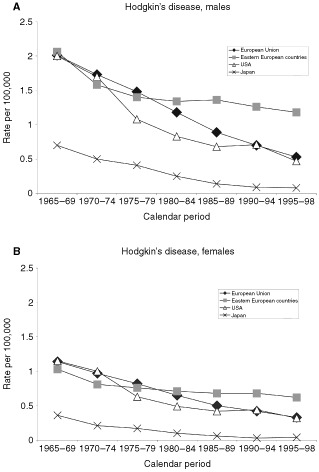
Trends in age-adjusted (world population) overall death certification rates from Hodgkin's disease per 100 000 men (a) and women (b) in the European Union, selected eastern European countries (Bulgaria, Czech Republic, Hungary, Poland, Romania and Slovakia), USA and Japan, from 1965–69 to 1995–98.
Eastern European countries showed an approximately 40% decline in HD mortality between the late 1960's and the early 1990's, to reach 1.26/100 000 men and 0.68 women. However, no appreciable further fall was observed over more recent years, and the rates were 1.18/100 000 men and 0.62 for women in 1995–98.
Table 1 shows age-adjusted death rates from HD for men and women in 19 European countries besides the EU, USA and Japan in 1965–69 and 1995–98. In most western European countries, rates fell by 70–80% over the last three decades. However, the decline in HD mortality was much less (10 to 30%) in selected eastern European countries. About a third of patients dying from HD are aged 15 to 44 years. The pattern of trends in the young across most countries was similar to that for all ages. For men aged 15 to 44 the fall was 79% (from 1.9 to 0.4/100 000) in the EU, 77% (from 2.1 to 0.5/100 000) in the USA, and 82% (from 0.3 to 0.1/100 000) in Japan. Corresponding values for women were −79% (from 1.3 to 0.3/100 000) in the EU, −75% (from 1.2 to 0.3/100 000) in the USA, and −80% (from 0.2 to 0.04/100 000) in Japan.
Table 1. Trends in age-adjusted (world population) overall death certification rates per 100 000 men and women and average annual number of certified deaths from Hodgkin' disease in the European Union, Eastern countries (Bulgaria, Czech Republic, Hungary, Poland, Romania and Slovakia), the USA, Japan and 19 European countries between 1965–69 and 1995–98 (unless otherwise specified in parenthesis).

DISCUSSION
The present data indicate that HD mortality in the EU, the USA and Japan has continued to decline, though to a smaller degree, over more recent calendar periods, and hence confirms the persistence of advancements in the integrated treatment of HD. Rates are exceedingly low in Japan, whose HD mortality was already a third than those of North America and Europe in the 1960's, and is now less than a fifth than in other developed areas of the world. It is unlikely that differences in death certification validity and accuracy can explain such large differences.
The decline in HD mortality was similar in the older age groups, while for leukaemias the falls tend to be greater at younger age (Levi et al, 2000). This suggests that advancements in treatment for HD had a favourable impact also in the elderly.
In eastern Europe, there has been not only a substantial delay in the fall of HD mortality, but no progress has been observed during the 1990's, although efficacious chemotherapy schemes for HD (Hoppe et al, 1994), as well as radiotherapy, should, in principle, now be available in those countries, too. These unfavourable trends contrast with the declines in mortality from cardiovascular diseases and total mortality observed from the early 1990's onwards in Poland, Hungary, the Czech Republic and other major eastern European countries (Zatonski and Boyle, 1996 ; Zatonski et al, 1998). Thus, over a thousand potentially avoidable deaths per year from HD, largely at younger ages, with an associated loss of many decades of life expectancy, are still taking place in these countries every year.
As already observed for childhood leukaemia (La Vecchia et al, 1998; Levi et al, 2000) and testicular cancer (Levi et al, 2001), the fall in mortality for HD has been earlier and greater in North America than in western Europe. Even to a more dramatic extent than for childhood leukaemias or testicular cancer, the present data indicate that substantial inadequacies are persistent in the management of curable neoplasms in eastern European countries, pointing to the need for a rational organization of cancer control and treatment in those countries.
Acknowledgments
This work was supported by the Swiss League against Cancer and the Italian Association for Cancer Research.
References
- BeckerNBoyleP1997Decline in mortality from testicular cancer in West Germany after reunification Lancet 350744. [DOI] [PubMed] [Google Scholar]
- DollRSmithPG1982Comparison between registries: age-standardized ratesInCancer Incidence in Five Continents Vol. IV(Waterhouse JAH, Muir CS, Shanmugaratnam K, Powell J, Peacham D, Whelan S (eds)pp671675IARC Scientific Publication No 42 Lyon IARC [Google Scholar]
- HoppeRTHantonALHanksGEOwenBO1994Progress in the treatment of Hodgkin's disease in the United States, 1973 versus 1983 Cancer 7431983203 [DOI] [PubMed] [Google Scholar]
- La VecchiaCLeviFLucchiniFKayeSBBoyleP1991Hodgkin's mortality in Europe Br J Cancer 64723734 [DOI] [PMC free article] [PubMed] [Google Scholar]
- La VecchiaCLeviFLucchiniFLagiouPTrichopoulosDNegriE1998Trends in childhood cancer mortality as indicators of quality of medical care in the developed world Cancer 8322232227 [PubMed] [Google Scholar]
- LeviFLa VecchiaCLucchiniFTeVCFranceschiS1995Mortality from Hodgkin's disease and other lymphomas in Europe, 1960-1990 Oncology 529396 [DOI] [PubMed] [Google Scholar]
- LeviFLucchiniFNegriEBoylePLa VecchiaC1999Cancer mortality in Europe, 1990–94, and an overview of trends 1955 to 1994 Eur J Cancer 3514771516 [DOI] [PubMed] [Google Scholar]
- LeviFLucchiniFNegriEBarbuiTLa VecchiaC2000Trends in mortality from leukemia in subsequent age groups Leukemia 1419801985 [DOI] [PubMed] [Google Scholar]
- LeviFLa VecchiaCBoylePLucchiniFNegriE2001Western and eastern European trends in testicular cancer mortality Lancet 35718531854 [DOI] [PubMed] [Google Scholar]
- ZatonskiWABoyleP1996Health transformations in Poland after 1988 J Epidemiol Biostat 4185193 [Google Scholar]
- ZatonskiWAMcMichaelAJPowlesJW1998Ecological study of reasons for sharp decline in mortality from ischaemic disease in Poland in 1991 Br Med J 31610471051 [DOI] [PMC free article] [PubMed] [Google Scholar]