



Abstract
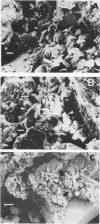
A study was undertaken to determine why bacteria could penetrate lengths of consolidated sandstone (Berea) faster when the sandstone was sterilized by autoclaving than when dry heat (150°C, 3 h) was used. Changes in permeability, porosity, and pore entrance size of the rock as a result of autoclaving were not sufficient to explain the differences in penetration times observed, but electron dispersion spectroscopy and electron microscopy of the rock revealed changes in mineral composition and clay morphology. Autoclaved cores contained more chloride than dry-heated cores, and the clays of autoclaved cores were aggregated and irregularly shaped. Therefore, the decreases in bacterial penetration rates caused by autoclave sterilization were probably the result of a change in surface charge of the pores of the rock and of a reduction in surface area of clays available for adhesion. The results implied that dry-heat sterilization was preferable to autoclaving when examining biotic and abiotic interactions in a native-state rock model.
Full text
PDF


Images in this article
Selected References
These references are in PubMed. This may not be the complete list of references from this article.
- Chang P. L., Yen T. F. Interaction of Escherichia coli B and B/4 and Bacteriophage T4D with Berea Sandstone Rock in Relation to Enhanced Oil Recovery. Appl Environ Microbiol. 1984 Mar;47(3):544–550. doi: 10.1128/aem.47.3.544-550.1984. [DOI] [PMC free article] [PubMed] [Google Scholar]
- Jang L. K., Chang P. W., Findley J. E., Yen T. F. Selection of bacteria with favorable transport properties through porous rock for the application of microbial-enhanced oil recovery. Appl Environ Microbiol. 1983 Nov;46(5):1066–1072. doi: 10.1128/aem.46.5.1066-1072.1983. [DOI] [PMC free article] [PubMed] [Google Scholar]
- Jenneman G. E., McInerney M. J., Knapp R. M. Microbial Penetration through Nutrient-Saturated Berea Sandstone. Appl Environ Microbiol. 1985 Aug;50(2):383–391. doi: 10.1128/aem.50.2.383-391.1985. [DOI] [PMC free article] [PubMed] [Google Scholar]
- Shaw J. C., Bramhill B., Wardlaw N. C., Costerton J. W. Bacterial fouling in a model core system. Appl Environ Microbiol. 1985 Mar;49(3):693–701. doi: 10.1128/aem.49.3.693-701.1985. [DOI] [PMC free article] [PubMed] [Google Scholar]