



Abstract
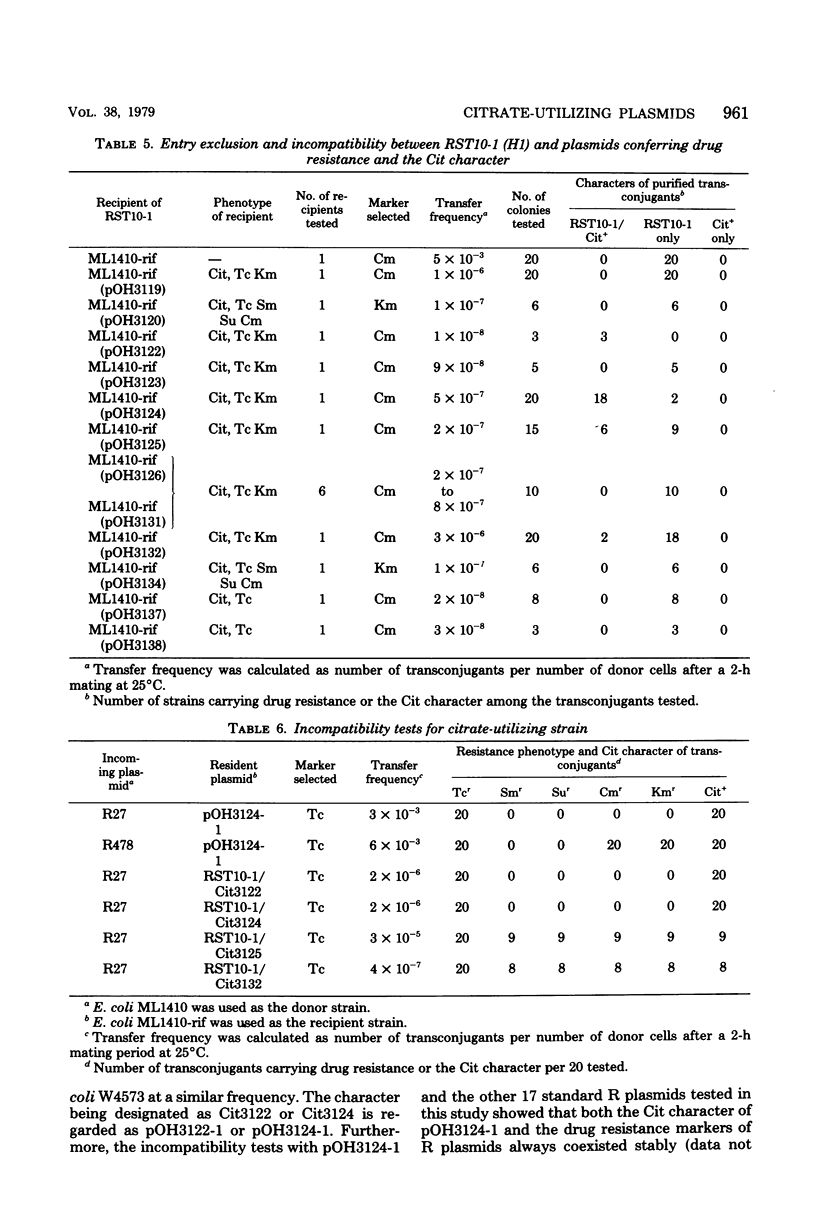
The citrate-utilizing ability of 19 out of 22 citrate-positive Escherichia coli strains isolated from pig sewage was transferred via conjugation to E. coli K-12. The conjugal transfer of citrate-utilizing (Cit) abilities was thermosensitive and concurrent with transfer of drug resistance. Weakly citrate-positive colonies were readily obtained in conjugation experiments. Their Cit characters could be transmitted to the other E. coli strains at a similar frequency in the retransfer experiments, and the transconjugants obtained still showed same characteristic growth on Simmons citrate agar plates. The 19 thermosensitive plasmids conferring citrate utilization and drug resistance were Fi-, and 16 of these plasmids belonged to incompatibility group H1. However, occasionally two conjugative plasmids (pOH3122-1 and pOH3124-1) carrying only the citrate utilization were also obtained in the conjugation experiments, and they were Fi+ and compatible with 19 reference R plasmids. In the two citrate-positive E. coli strains, it was suggested that the conjugative Cit plasmid showing Fi+ character and the more thermosensitive H1 plasmid conferring both the Cit character and drug resistance coexisted in the strain. The characterization of citrate utilization plasmids derived from pig farm sewage is discussed.
Full text
PDF




Images in this article

Selected References
These references are in PubMed. This may not be the complete list of references from this article.
- Imai K., Iijima T., Hasegawa T. Transport of tricarboxylic acids in Salmonella typhimurium. J Bacteriol. 1973 Jun;114(3):961–965. doi: 10.1128/jb.114.3.961-965.1973. [DOI] [PMC free article] [PubMed] [Google Scholar]
- Ishiguro N., Oka C., Sato G. Isolation of citrate-positive variants of Escherichia coli from domestic pigeons, pigs, cattle, and horses. Appl Environ Microbiol. 1978 Aug;36(2):217–222. doi: 10.1128/aem.36.2.217-222.1978. [DOI] [PMC free article] [PubMed] [Google Scholar]
- LENNOX E. S. Transduction of linked genetic characters of the host by bacteriophage P1. Virology. 1955 Jul;1(2):190–206. doi: 10.1016/0042-6822(55)90016-7. [DOI] [PubMed] [Google Scholar]
- Le Minor L., Coynault C., Chabbert Y., Gerbaud G., Le Minor S. Groupes de compatibilité de plasmides métaboliques. Ann Microbiol (Paris) 1976 Jul;127(1):31–40. [PubMed] [Google Scholar]
- Mise K., Nakaya R. Transduction of R plasmids by bacteriophages P1 and P22: distinction between generalized and specialized transduction. Mol Gen Genet. 1977 Nov 29;157(2):131–138. doi: 10.1007/BF00267390. [DOI] [PubMed] [Google Scholar]
- Orskov I., Orskov F. Plasmid-determined H2S character in Escherichia coli and its relation to plasmid-carried raffinose fermentation and tetracycline resistance characters. Examination of 32 H2S-positive strains isolated during the years 1950 to 1971. J Gen Microbiol. 1973 Aug;77(2):487–499. doi: 10.1099/00221287-77-2-487. [DOI] [PubMed] [Google Scholar]
- Powers E. M., Latt T. G. Simplified 48-hour IMVic test: an agar plate method. Appl Environ Microbiol. 1977 Sep;34(3):274–279. doi: 10.1128/aem.34.3.274-279.1977. [DOI] [PMC free article] [PubMed] [Google Scholar]
- Sato G., Asagi M., Oka C., Ishiguro N., Terakado N. Transmissible citrate-utilizing ability in Escherichia coli isolated from pigeons, pigs and cattle. Microbiol Immunol. 1978;22(6):357–360. doi: 10.1111/j.1348-0421.1978.tb00380.x. [DOI] [PubMed] [Google Scholar]
- Smith H. W., Parsell Z., Green P. Thermosensitive H1 plasmids determining citrate utilization. J Gen Microbiol. 1978 Dec;109(2):305–311. doi: 10.1099/00221287-109-2-305. [DOI] [PubMed] [Google Scholar]
- Smith H. W., Parsell Z., Green P. Thermosensitive antibiotic resistance plasmids in enterobacteria. J Gen Microbiol. 1978 Nov;109(1):37–47. doi: 10.1099/00221287-109-1-37. [DOI] [PubMed] [Google Scholar]
- Smith H. W., Parsell Z. Transmissible substrate-utilizing ability in enterobacteria. J Gen Microbiol. 1975 Mar;87(1):129–140. doi: 10.1099/00221287-87-1-129. [DOI] [PubMed] [Google Scholar]
- Taylor D. E., Grant R. B. Inhibition of bacteriophage lambda, T1, and T7 development by R plasmids of the H incompatibility group. Antimicrob Agents Chemother. 1976 Oct;10(4):762–764. doi: 10.1128/aac.10.4.762. [DOI] [PMC free article] [PubMed] [Google Scholar]
- Terakado N., Sato G. Demonstration of the so-called Mexican type R plasmids in Escherichia coli isolated from domestic animals and pigeons. Microbiol Immunol. 1978;22(4):227–229. doi: 10.1111/j.1348-0421.1978.tb00366.x. [DOI] [PubMed] [Google Scholar]