



Abstract
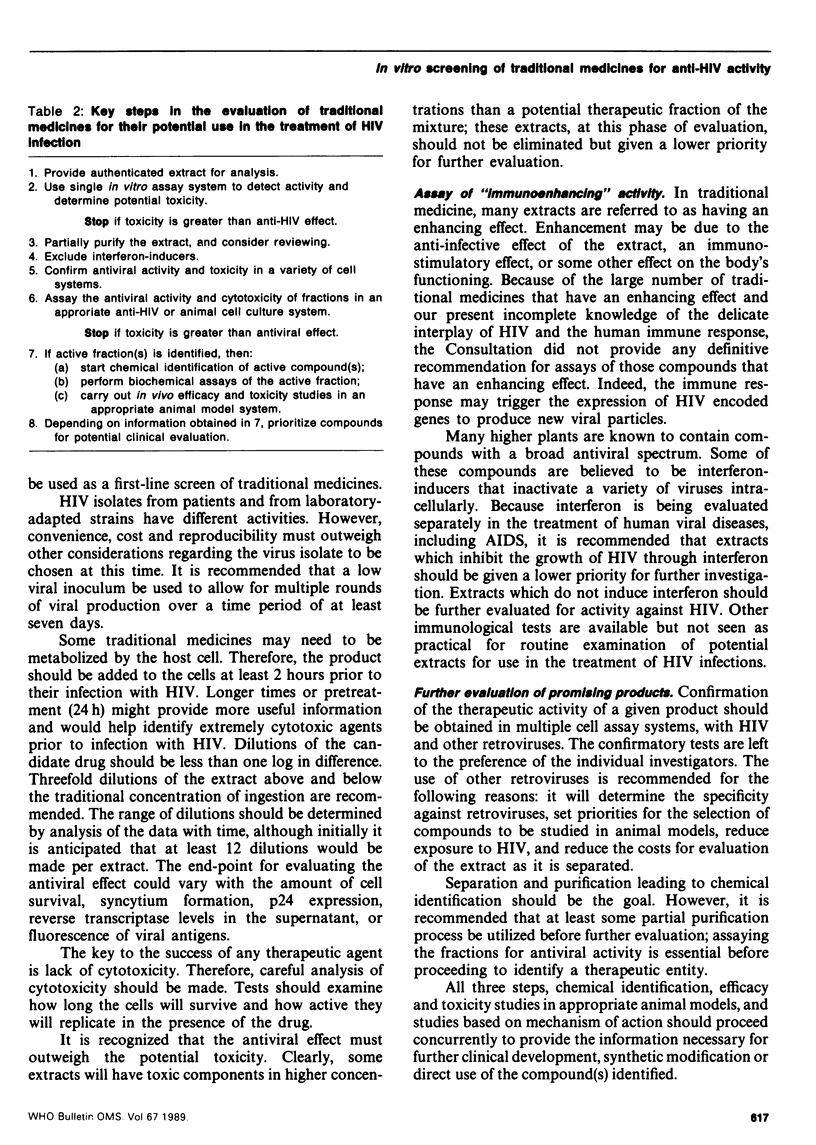
Many plant products are being used by patients with acquired immunodeficiency syndrome (AIDS) in some countries without any scientific proof that they possess anti-HIV (human immunodeficiency virus) activity. Traditional healers are now offering their remedies for scientific evaluation, and a few studies provide information on the inhibitory activity against HIV of plants such as Viola yedoensis, Arctium lappa, Epimedium grandiflorum, Glycyrrhiza uralensis and Castanospermum australe. Natural products can be selected for biological screening based on ethnomedical use, random collection or a chemotaxonomic approach (i.e., screening of species of the same botanical family for similar compounds), but the follow-up and selection of plants based on literature leads would seem to be the most cost-effective way of identifying plants with anti-HIV activity. No single in vitro screening methodology for anti-HIV activity is ideal and confirmatory assays in multiple systems are needed to examine completely the potential use of a compound. To promote further research in traditional medicine and AIDS, appropriate institutions will be identified where the different activities for the scientific evaluation of plants and their extracts for possible treatment of AIDS can be carried out.
Full text
PDF
Selected References
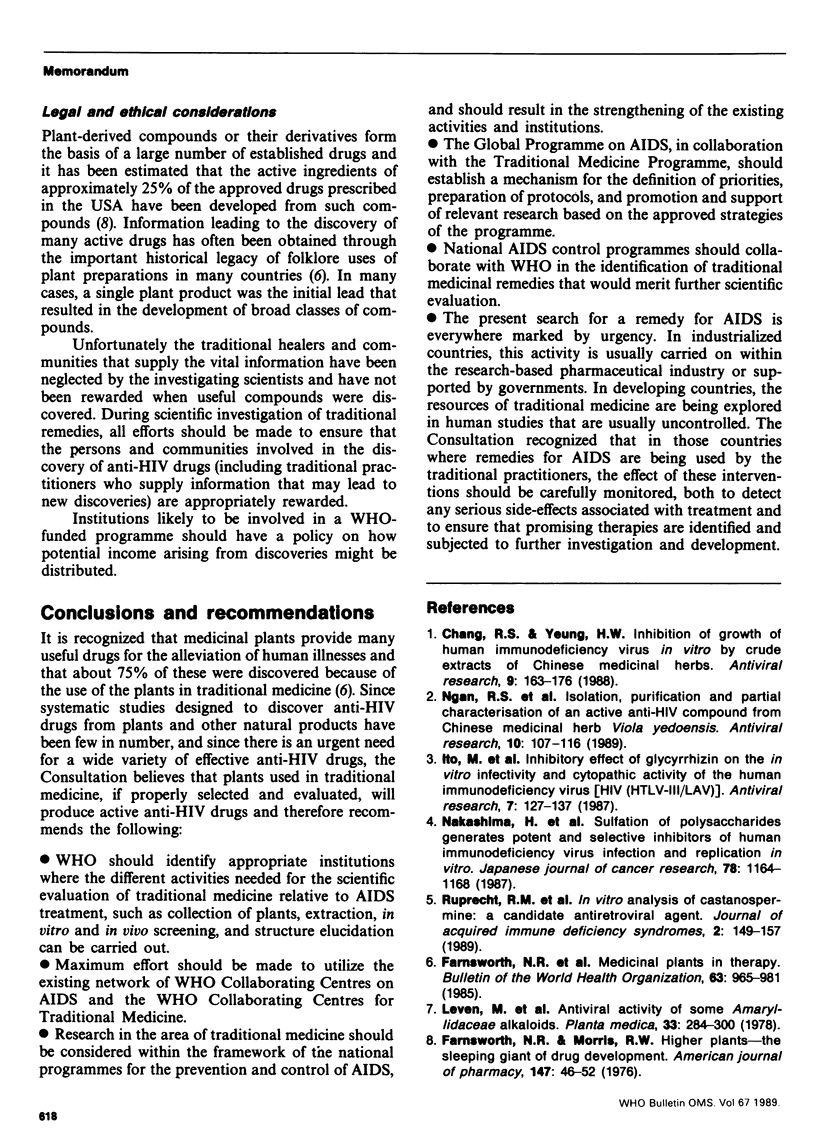
These references are in PubMed. This may not be the complete list of references from this article.
- Chang R. S., Yeung H. W. Inhibition of growth of human immunodeficiency virus in vitro by crude extracts of Chinese medicinal herbs. Antiviral Res. 1988 Apr;9(3):163–175. doi: 10.1016/0166-3542(88)90001-0. [DOI] [PubMed] [Google Scholar]
- Farnsworth N. R., Akerele O., Bingel A. S., Soejarto D. D., Guo Z. Medicinal plants in therapy. Bull World Health Organ. 1985;63(6):965–981. [PMC free article] [PubMed] [Google Scholar]
- Ito M., Nakashima H., Baba M., Pauwels R., De Clercq E., Shigeta S., Yamamoto N. Inhibitory effect of glycyrrhizin on the in vitro infectivity and cytopathic activity of the human immunodeficiency virus [HIV (HTLV-III/LAV)]. Antiviral Res. 1987 Mar;7(3):127–137. doi: 10.1016/0166-3542(87)90001-5. [DOI] [PubMed] [Google Scholar]
- Nakashima H., Yoshida O., Tochikura T. S., Yoshida T., Mimura T., Kido Y., Motoki Y., Kaneko Y., Uryu T., Yamamoto N. Sulfation of polysaccharides generates potent and selective inhibitors of human immunodeficiency virus infection and replication in vitro. Jpn J Cancer Res. 1987 Nov;78(11):1164–1168. [PubMed] [Google Scholar]
- Ngan F., Chang R. S., Tabba H. D., Smith K. M. Isolation, purification and partial characterization of an active anti-HIV compound from the Chinese medicinal herb viola yedoensis. Antiviral Res. 1988 Nov;10(1-3):107–116. doi: 10.1016/0166-3542(88)90019-8. [DOI] [PubMed] [Google Scholar]
- Ruprecht R. M., Mullaney S., Andersen J., Bronson R. In vivo analysis of castanospermine, a candidate antiretroviral agent. J Acquir Immune Defic Syndr. 1989;2(2):149–157. [PubMed] [Google Scholar]