



Abstract
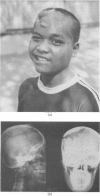
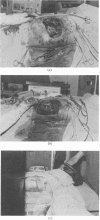
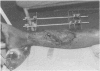
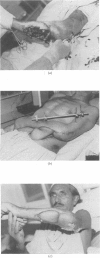
Reconstructive surgery can be used within a framework of management of war wounds by basic principles. It falls into three groups: i. Primary (emergency) reconstruction; performed as part of initial surgery and as a life-saving procedure. ii. Delayed primary (essential) reconstruction; performed at the time of delayed closure. iii. Elective or non-essential reconstruction. All surgeons involved with the early management of war wounds should be prepared to perform primary and delayed primary reconstruction.
Full text
PDF


Images in this article
Selected References
These references are in PubMed. This may not be the complete list of references from this article.
- Byrnes D. P., Crockard H. A., Gordon D. S., Gleadhill C. A. Penetrating craniocerebral missile injuries in the civil disturbances in Northern Ireland. Br J Surg. 1974 Mar;61(3):169–176. doi: 10.1002/bjs.1800610302. [DOI] [PubMed] [Google Scholar]
- Coupland R. M. Amputation for antipersonnel mine injuries of the leg: preservation of the tibial stump using a medial gastrocnemius myoplasty. Ann R Coll Surg Engl. 1989 Nov;71(6):405–408. [PMC free article] [PubMed] [Google Scholar]
- Coupland R. M. Technical aspects of war wound excision. Br J Surg. 1989 Jul;76(7):663–667. doi: 10.1002/bjs.1800760704. [DOI] [PubMed] [Google Scholar]
- Debakey M. E., Simeone F. A. Battle Injuries of the Arteries in World War II : An Analysis of 2,471 Cases. Ann Surg. 1946 Apr;123(4):534–579. [PMC free article] [PubMed] [Google Scholar]
- Ger R. Muscle transposition for treatment and prevention of chronic post-traumatic osteomyelitis of the tibia. J Bone Joint Surg Am. 1977 Sep;59(6):784–791. [PubMed] [Google Scholar]
- HUGHES C. W. Arterial repair during the Korean war. Ann Surg. 1958 Apr;147(4):555–561. [PMC free article] [PubMed] [Google Scholar]
- LOWRY K. F., CURTIS G. M. Delayed suture in the management of wounds; analysis of 721 traumatic wounds illustrating the influence of time interval in wound repair. Am J Surg. 1950 Sep;80(3):280–287. doi: 10.1016/0002-9610(50)90496-x. [DOI] [PubMed] [Google Scholar]
- Mathes S. J., Alpert B. S., Chang N. Use of the muscle flap in chronic osteomyelitis: experimental and clinical correlation. Plast Reconstr Surg. 1982 May;69(5):815–829. doi: 10.1097/00006534-198205000-00018. [DOI] [PubMed] [Google Scholar]
- Mercer N. S., Moss A. L. Soft tissue management of compound leg fractures: a 5-year experience. J R Coll Surg Edinb. 1988 Oct;33(5):263–266. [PubMed] [Google Scholar]
- Schramek A., Hashmonai M. Vascular injuries in the extremities in battle casualties. Br J Surg. 1977 Sep;64(9):644–648. doi: 10.1002/bjs.1800640911. [DOI] [PubMed] [Google Scholar]
- Trouwborst A., Weber B. K., Dufour D. Medical statistics of battlefield casualties. Injury. 1987 Mar;18(2):96–99. doi: 10.1016/0020-1383(87)90181-1. [DOI] [PubMed] [Google Scholar]