


Abstract
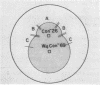
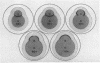
Nonconidiating (Con−) mutants were isolated from wild-type and color mutants of the fungus Trichoderma viride Pers. ex Fries. Heterokaryons were easily produced and maintained, and the complementation relationships among the Con− mutants were established. Most Con− mutants could complement one or more of the other Con− mutants. When marked Con− mutants were mixed with marked Con+ testers, conidiating heterokaryons were formed. The conidia thus obtained produced only the parental type colonies after replating, indicating that nonconidiation is a nuclear characteristic. Allowing two Con− colonies to meet and produce a heterokaryon, it was found that the migration of nuclei reached a rate of 5 mm per hr, which is several times greater than the rate of hyphal elongation; it was also found that heterokaryosis of a mycelial region preceded its ability to conidiate.
Full text
PDF


Images in this article
Selected References
These references are in PubMed. This may not be the complete list of references from this article.
- DOWDING E. S. Nuclear streaming in gelasinospora. Can J Microbiol. 1958 Jun;4(3):295–301. doi: 10.1139/m58-031. [DOI] [PubMed] [Google Scholar]
- Galun E., Gressel J. Morphogenesis in Trichoderma: suppression of photoinduction by 5-fluorouracil. Science. 1966 Feb 11;151(3711):696–698. doi: 10.1126/science.151.3711.696. [DOI] [PubMed] [Google Scholar]
- Gressel J., Galun E. Effect of 5 fluorouracil on the soluble RNA of Trichoderma. Biochem Biophys Res Commun. 1966 Jul 20;24(2):162–168. doi: 10.1016/0006-291x(66)90713-3. [DOI] [PubMed] [Google Scholar]
- Gressel J., Galun E. Morphogenesis in Trichoderma: photoinduction and RNA. Dev Biol. 1967 Jun;15(6):575–598. doi: 10.1016/0012-1606(67)90054-1. [DOI] [PubMed] [Google Scholar]