



Abstract
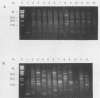
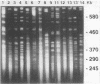
We used DNA fingerprinting by the arbitrarily primed polymerase chain reaction (AP-PCR) technique for an epidemiological investigation of 23 Pseudomonas cepacia isolates obtained from 11 cystic fibrosis (CF) patients attending our CF center. This approach was compared with ribotyping, pulsed-field gel electrophoresis (PFGE), and conventional phenotypic typing. AP-PCR and ribotyping were identical in resolving power, since the two methods generated four different profiles and identified the same group of strains. Six patients on the one hand and four on the other harbored strains of the same genotype, thus raising the possibility of either patient-to-patient transmission or acquisition from a common hospital environmental source. PFGE results were in good agreement with those of the other two methods, but PFGE seems more discriminative since it generated a fifth profile for a single strain in a group of four. Our results show in vivo stability for the three methods during a period extending from 3 to 41 months. These genotypic techniques are particularly promising for clinical laboratories to help to clarify the epidemiology of P. cepacia in CF patients. The AP-PCR method constitutes an easier alternative to the well-established ribotyping method. AP-PCR provides the quickest results with minimal technical complexity. However, our results suggest that it is less discriminative than the labor-intensive PFGE method.
Full text
PDF


Images in this article

Selected References
These references are in PubMed. This may not be the complete list of references from this article.
- Anderson D. J., Kuhns J. S., Vasil M. L., Gerding D. N., Janoff E. N. DNA fingerprinting by pulsed field gel electrophoresis and ribotyping to distinguish Pseudomonas cepacia isolates from a nosocomial outbreak. J Clin Microbiol. 1991 Mar;29(3):648–649. doi: 10.1128/jcm.29.3.648-649.1991. [DOI] [PMC free article] [PubMed] [Google Scholar]
- Bingen E. H., Denamur E., Lambert-Zechovsky N. Y., Bourdois A., Mariani-Kurkdjian P., Cezard J. P., Navarro J., Elion J. DNA restriction fragment length polymorphism differentiates crossed from independent infections in nosocomial Xanthomonas maltophilia bacteremia. J Clin Microbiol. 1991 Jul;29(7):1348–1350. doi: 10.1128/jcm.29.7.1348-1350.1991. [DOI] [PMC free article] [PubMed] [Google Scholar]
- Bingen E., Boissinot C., Desjardins P., Cave H., Brahimi N., Lambert-Zechovsky N., Denamur E., Blot P., Elion J. Arbitrarily primed polymerase chain reaction provides rapid differentiation of Proteus mirabilis isolates from a pediatric hospital. J Clin Microbiol. 1993 May;31(5):1055–1059. doi: 10.1128/jcm.31.5.1055-1059.1993. [DOI] [PMC free article] [PubMed] [Google Scholar]
- Bingen E., Cavé H., Aujard Y., Lambert-Zechovsky N., Desjardins P., Elion J., Denamur E. Molecular analysis of multiply recurrent meningitis due to Escherichia coli K1 in an infant. Clin Infect Dis. 1993 Jan;16(1):82–85. doi: 10.1093/clinids/16.1.82. [DOI] [PubMed] [Google Scholar]
- Bingen E., Denamur E., Lambert-Zechovsky N., Aujard Y., Brahimi N., Geslin P., Elion J. Analysis of DNA restriction fragment length polymorphism extends the evidence for breast milk transmission in Streptococcus agalactiae late-onset neonatal infection. J Infect Dis. 1992 Mar;165(3):569–573. doi: 10.1093/infdis/165.3.569. [DOI] [PubMed] [Google Scholar]
- Bingen E., Denamur E., Picard B., Goullet P., Lambert-Zechovsky N., Foucaud P., Navarro J., Elion J. Molecular epidemiological analysis of Pseudomonas aeruginosa strains causing failure of antibiotic therapy in cystic fibrosis patients. Eur J Clin Microbiol Infect Dis. 1992 May;11(5):432–437. doi: 10.1007/BF01961858. [DOI] [PubMed] [Google Scholar]
- Carson L. A., Anderson R. L., Panlilio A. L., Beck-Sague C. M., Miller J. M. Isoenzyme analysis of Pseudomonas cepacia as an epidemiologic tool. Am J Med. 1991 Sep 16;91(3B):252S–255S. doi: 10.1016/0002-9343(91)90377-a. [DOI] [PubMed] [Google Scholar]
- Esanu J. G., Schubert R. H. Zur Taxonomie und Nomenklatur von Pseudomonas cepacia. Zentralbl Bakteriol Orig A. 1973 Oct;224(4):478–483. [PubMed] [Google Scholar]
- Fekete A., Bantle J. A., Halling S. M., Stich R. W. Amplification fragment length polymorphism in Brucella strains by use of polymerase chain reaction with arbitrary primers. J Bacteriol. 1992 Dec;174(23):7778–7783. doi: 10.1128/jb.174.23.7778-7783.1992. [DOI] [PMC free article] [PubMed] [Google Scholar]
- Goldmann D. A., Klinger J. D. Pseudomonas cepacia: biology, mechanisms of virulence, epidemiology. J Pediatr. 1986 May;108(5 Pt 2):806–812. doi: 10.1016/s0022-3476(86)80749-1. [DOI] [PubMed] [Google Scholar]
- Gonzalez C. F., Vidaver A. K. Bacteriocin, plasmid and pectolytic diversity in Pseudomonas cepacia of clinical and plant origin. J Gen Microbiol. 1979 Jan;110(1):161–170. doi: 10.1099/00221287-110-1-161. [DOI] [PubMed] [Google Scholar]
- Govan J. R., Harris G. Typing of Pseudomonas cepacia by bacteriocin susceptibility and production. J Clin Microbiol. 1985 Oct;22(4):490–494. doi: 10.1128/jcm.22.4.490-494.1985. [DOI] [PMC free article] [PubMed] [Google Scholar]
- Heidt A., Monteil H., Richard C. O and H serotyping of Pseudomonas cepacia. J Clin Microbiol. 1983 Sep;18(3):738–740. doi: 10.1128/jcm.18.3.738-740.1983. [DOI] [PMC free article] [PubMed] [Google Scholar]
- Kostman J. R., Edlind T. D., LiPuma J. J., Stull T. L. Molecular epidemiology of Pseudomonas cepacia determined by polymerase chain reaction ribotyping. J Clin Microbiol. 1992 Aug;30(8):2084–2087. doi: 10.1128/jcm.30.8.2084-2087.1992. [DOI] [PMC free article] [PubMed] [Google Scholar]
- Lalande M., Noolandi J., Turmel C., Rousseau J., Slater G. W. Pulsed-field electrophoresis: application of a computer model to the separation of large DNA molecules. Proc Natl Acad Sci U S A. 1987 Nov;84(22):8011–8015. doi: 10.1073/pnas.84.22.8011. [DOI] [PMC free article] [PubMed] [Google Scholar]
- Larsen G. Y., Stull T. L., Burns J. L. Marked phenotypic variability in Pseudomonas cepacia isolated from a patient with cystic fibrosis. J Clin Microbiol. 1993 Apr;31(4):788–792. doi: 10.1128/jcm.31.4.788-792.1993. [DOI] [PMC free article] [PubMed] [Google Scholar]
- Lehmann P. F., Lin D., Lasker B. A. Genotypic identification and characterization of species and strains within the genus Candida by using random amplified polymorphic DNA. J Clin Microbiol. 1992 Dec;30(12):3249–3254. doi: 10.1128/jcm.30.12.3249-3254.1992. [DOI] [PMC free article] [PubMed] [Google Scholar]
- LiPuma J. J., Dasen S. E., Nielson D. W., Stern R. C., Stull T. L. Person-to-person transmission of Pseudomonas cepacia between patients with cystic fibrosis. Lancet. 1990 Nov 3;336(8723):1094–1096. doi: 10.1016/0140-6736(90)92571-x. [DOI] [PubMed] [Google Scholar]
- LiPuma J. J., Fisher M. C., Dasen S. E., Mortensen J. E., Stull T. L. Ribotype stability of serial pulmonary isolates of Pseudomonas cepacia. J Infect Dis. 1991 Jul;164(1):133–136. doi: 10.1093/infdis/164.1.133. [DOI] [PubMed] [Google Scholar]
- LiPuma J. J., Mortensen J. E., Dasen S. E., Edlind T. D., Schidlow D. V., Burns J. L., Stull T. L. Ribotype analysis of Pseudomonas cepacia from cystic fibrosis treatment centers. J Pediatr. 1988 Nov;113(5):859–862. doi: 10.1016/s0022-3476(88)80018-0. [DOI] [PubMed] [Google Scholar]
- Mazurier S. I., Wernars K. Typing of Listeria strains by random amplification of polymorphic DNA. Res Microbiol. 1992 Jun;143(5):499–505. doi: 10.1016/0923-2508(92)90096-7. [DOI] [PubMed] [Google Scholar]
- Nakamura Y., Hyodo S., Chonan E., Shigeta S., Yabuuchi E. Serological classification of Pseudomonas cepacia by somatic antigen. J Clin Microbiol. 1986 Jul;24(1):152–154. doi: 10.1128/jcm.24.1.152-154.1986. [DOI] [PMC free article] [PubMed] [Google Scholar]
- Noolandi J., Slater G. W., Lim H. A., Viovy J. L. Generalized tube model of biased reptation for gel electrophoresis of DNA. Science. 1989 Mar 17;243(4897):1456–1458. doi: 10.1126/science.2928779. [DOI] [PubMed] [Google Scholar]
- Rabkin C. S., Jarvis W. R., Anderson R. L., Govan J., Klinger J., LiPuma J., Martone W. J., Monteil H., Richard C., Shigeta S. Pseudomonas cepacia typing systems: collaborative study to assess their potential in epidemiologic investigations. Rev Infect Dis. 1989 Jul-Aug;11(4):600–607. doi: 10.1093/clinids/11.4.600. [DOI] [PubMed] [Google Scholar]
- Rabkin C. S., Jarvis W. R., Martone W. J. Current status of Pseudomonas cepacia typing systems. Eur J Epidemiol. 1987 Dec;3(4):343–346. doi: 10.1007/BF00145643. [DOI] [PubMed] [Google Scholar]
- Richard C., Monteil H., Mégraud F., Chatelain R., Laurent B. Caractères phénotypiques de 100 souches de Pseudomonas cepacia. Proposition d'un schéma de biovars. Ann Biol Clin (Paris) 1981;39(1):9–15. [PubMed] [Google Scholar]
- Tablan O. C., Chorba T. L., Schidlow D. V., White J. W., Hardy K. A., Gilligan P. H., Morgan W. M., Carson L. A., Martone W. J., Jason J. M. Pseudomonas cepacia colonization in patients with cystic fibrosis: risk factors and clinical outcome. J Pediatr. 1985 Sep;107(3):382–387. doi: 10.1016/s0022-3476(85)80511-4. [DOI] [PubMed] [Google Scholar]
- Taylor R. F., Dalla Costa L., Kaufmann M. E., Pitt T. L., Hodson M. E. Pseudomonas cepacia pulmonary infection in adults with cystic fibrosis: is nosocomial acquisition occurring? J Hosp Infect. 1992 Jul;21(3):199–204. doi: 10.1016/0195-6701(92)90076-x. [DOI] [PubMed] [Google Scholar]
- Thomassen M. J., Demko C. A., Klinger J. D., Stern R. C. Pseudomonas cepacia colonization among patients with cystic fibrosis. A new opportunist. Am Rev Respir Dis. 1985 May;131(5):791–796. doi: 10.1164/arrd.1985.131.5.791. [DOI] [PubMed] [Google Scholar]
- Welsh J., McClelland M. Fingerprinting genomes using PCR with arbitrary primers. Nucleic Acids Res. 1990 Dec 25;18(24):7213–7218. doi: 10.1093/nar/18.24.7213. [DOI] [PMC free article] [PubMed] [Google Scholar]
- Welsh J., Pretzman C., Postic D., Saint Girons I., Baranton G., McClelland M. Genomic fingerprinting by arbitrarily primed polymerase chain reaction resolves Borrelia burgdorferi into three distinct phyletic groups. Int J Syst Bacteriol. 1992 Jul;42(3):370–377. doi: 10.1099/00207713-42-3-370. [DOI] [PubMed] [Google Scholar]
- Williams J. G., Kubelik A. R., Livak K. J., Rafalski J. A., Tingey S. V. DNA polymorphisms amplified by arbitrary primers are useful as genetic markers. Nucleic Acids Res. 1990 Nov 25;18(22):6531–6535. doi: 10.1093/nar/18.22.6531. [DOI] [PMC free article] [PubMed] [Google Scholar]