



Abstract
Three commercial indirect enzyme-linked immunosorbent assays (ELISAs) (Enzygnost-Rubella, RUBELISA, and ORTHO Rubella) were evaluated for the determination of immune status by testing 1,090 serum specimens, 410 of which were from nonimmune patients. In comparison with the standard reference technique, the hemagglutination inhibition (HAI) test, the sensitivities of ORTHO Rubella (100%) and Enzygnost-Rubella (99.26%) were excellent, whereas the sensitivity of RUBELISA (95.60%) was marginally lower because of the inability of this assay to detect antibody in 22% of the serum specimens with HAI titers of 10 and 11% of sera with HAI titers of 20. The specificity of all three systems was greater than 97%. There was a linear correlation between mean ELISA values and increasing HAI titers (r greater than or equal to 0.94). Both ORTHO Rubella and Enzygnost-Rubella were shown to be suitable replacements for the HAI test, provided that an equivocal zone is incorporated in the ORTHO system and only unheated sera are used in the Enzygnost system.
Full text
PDF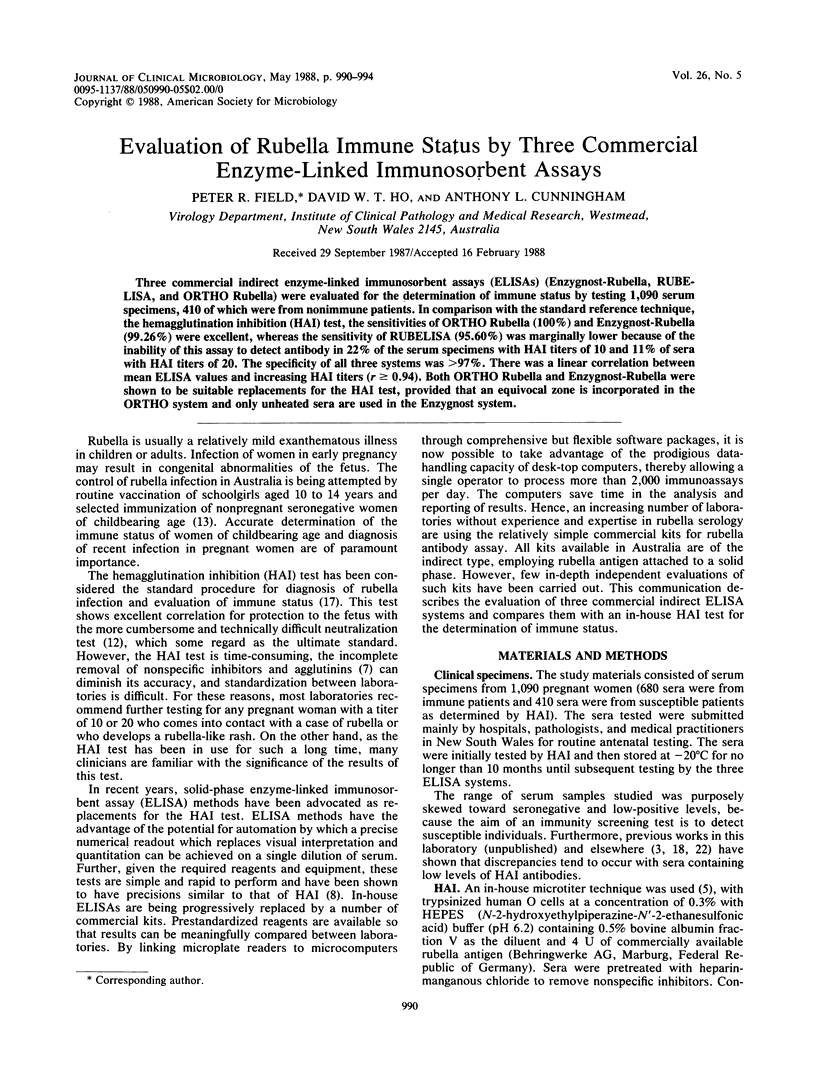


Selected References
These references are in PubMed. This may not be the complete list of references from this article.
- Boteler W. L., Barnes K. J., Buimovici-Klein E., O'Beirne A. J. Multicenter evaluation of a 1-h enzyme-linked immunosorbent assay for rubella serology. J Clin Microbiol. 1984 Dec;20(6):1140–1144. doi: 10.1128/jcm.20.6.1140-1144.1984. [DOI] [PMC free article] [PubMed] [Google Scholar]
- Bradstreet C. M., Kirkwood B., Pattison J. R., Tobin J. O. The derivation of a minimum immune titre of rubella haemagglutination-inhibition (HI) antibody. A Public Health Laboratory Service collaborative survey. J Hyg (Lond) 1978 Dec;81(3):383–388. doi: 10.1017/s0022172400025262. [DOI] [PMC free article] [PubMed] [Google Scholar]
- Castellano G. A., Madden D. L., Hazzard G. T., Cleghorn C. S., Vails D. V., Ley A. C., Tzan N. R., Sever J. L. Evaluation of commercially available diagnostic test kits for rubella. J Infect Dis. 1981 Apr;143(4):578–584. doi: 10.1093/infdis/143.4.578. [DOI] [PubMed] [Google Scholar]
- Field P. R., Gong C. M. Diagnosis of postnatally acquired rubella by use of three enzyme-linked immunosorbent assays for specific immunoglobulins G and M and single radial hemolysis for specific immunoglobulin G. J Clin Microbiol. 1984 Nov;20(5):951–958. doi: 10.1128/jcm.20.5.951-958.1984. [DOI] [PMC free article] [PubMed] [Google Scholar]
- Forghani B., Schmidt N. J. Antigen requirements, sensitivity, and specificity of enzyme immunoassays for measles and rubella viral antibodies. J Clin Microbiol. 1979 Jun;9(6):657–664. doi: 10.1128/jcm.9.6.657-664.1979. [DOI] [PMC free article] [PubMed] [Google Scholar]
- Haukenes G., Blom H. False positive rubella virus haemagglutination inhibition reactions: occurrence and disclosure. Med Microbiol Immunol. 1975;161(2):99–106. doi: 10.1007/BF02121750. [DOI] [PubMed] [Google Scholar]
- Herrmann K. L. Available rubella serologic tests. Rev Infect Dis. 1985 Mar-Apr;7 (Suppl 1):S108–S112. doi: 10.1093/clinids/7.supplement_1.s108. [DOI] [PubMed] [Google Scholar]
- Jankowski M. A., Gut W., Nawrocka E., Kantoch M. Detection and differentiation of cytomegalovirus antibodies by radioimmunoassay. J Virol Methods. 1980;1(3):133–138. doi: 10.1016/0166-0934(80)90009-9. [DOI] [PubMed] [Google Scholar]
- Kleeman K. T., Kiefer D. J., Halbert S. P. Rubella antibodies detected by several commercial immunoassays in hemagglutination inhibition-negative sera. J Clin Microbiol. 1983 Nov;18(5):1131–1137. doi: 10.1128/jcm.18.5.1131-1137.1983. [DOI] [PMC free article] [PubMed] [Google Scholar]
- Lennette E. H., Schmidt N. J., Magoffin R. L. The hemagglutination inhibition test for rubella: a comparison of its sensitivity to that of neutralization, complement fixation and fluorescent antibody tests for diagnosis of infection and determination of immunity status. J Immunol. 1967 Oct;99(4):785–793. [PubMed] [Google Scholar]
- Menser M. A., Hudson J. R., Murphy A. M., Cossart Y. E. Impact of rubella vaccination in Australia. Lancet. 1984 May 12;1(8385):1059–1062. doi: 10.1016/s0140-6736(84)91461-2. [DOI] [PubMed] [Google Scholar]
- Mortimer P. P., Parry J. V., Mortimer J. Y. Which anti-HTLV III/LAV assays for screening and confirmatory testing? Lancet. 1985 Oct 19;2(8460):873–877. doi: 10.1016/s0140-6736(85)90136-9. [DOI] [PubMed] [Google Scholar]
- Ronalds C. J., Hardiman A. E., Grint P. C., Kangro H. D. Rubella-specific IgM determination on heat-treated sera. Lancet. 1985 Nov 9;2(8463):1071–1072. doi: 10.1016/s0140-6736(85)90943-2. [DOI] [PubMed] [Google Scholar]
- Spire B., Dormont D., Barré-Sinoussi F., Montagnier L., Chermann J. C. Inactivation of lymphadenopathy-associated virus by heat, gamma rays, and ultraviolet light. Lancet. 1985 Jan 26;1(8422):188–189. doi: 10.1016/s0140-6736(85)92026-4. [DOI] [PubMed] [Google Scholar]
- Stewart G. L., Parkman P. D., Hopps H. E., Douglas R. D., Hamilton J. P., Meyer H. M., Jr Rubella-virus hemagglutination-inhibition test. N Engl J Med. 1967 Mar 9;276(10):554–557. doi: 10.1056/NEJM196703092761006. [DOI] [PubMed] [Google Scholar]
- Truant A. L., Barksdale B. L., Huber T. W., Elliott L. B. Comparison of an enzyme-linked immunosorbent assay with indirect hemagglutination and hemagglutination inhibition for determination of rubella virus antibody: evaluation of immune status with commercial reagents in a clinical laboratory. J Clin Microbiol. 1983 Jan;17(1):106–108. doi: 10.1128/jcm.17.1.106-108.1983. [DOI] [PMC free article] [PubMed] [Google Scholar]
- Vaheri A., Salonen E. M. Evaluation of solid-phase enzyme-immunoassay procedure in immunity surveys and diagnosis of rubella. J Med Virol. 1980;5(3):171–181. doi: 10.1002/jmv.1890050302. [DOI] [PubMed] [Google Scholar]
- Vejtorp M., Leerhoy J. Comparison of the sensitivity of ELISA and the haemagglutination-inhibition test for routine diagnosis of rubella. Acta Pathol Microbiol Scand B. 1980 Dec;88(6):349–350. doi: 10.1111/j.1699-0463.1980.tb02655.x. [DOI] [PubMed] [Google Scholar]
- Vejtorp M. Serodiagnosis of postnatal rubella. A survey of methods with special reference to the enzyme-linked immunosorbent assay. Dan Med Bull. 1983 Mar;30(2):53–66. [PubMed] [Google Scholar]
- Wittenburg R. A., Roberts M. A., Elliott L. B., Little L. M. Comparative evaluation of commercial rubella virus antibody kits. J Clin Microbiol. 1985 Feb;21(2):161–163. doi: 10.1128/jcm.21.2.161-163.1985. [DOI] [PMC free article] [PubMed] [Google Scholar]