



Abstract
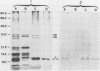
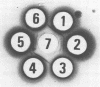
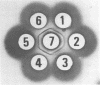
A cell wall antigen of Brucella canis was purified by immunosorbent columns. The antigen contained two proteins of 30 and 28 kilodaltons and a polysaccharide exhibiting a 12-kilodalton band upon 12.5% sodium dodecyl sulfate-polyacrylamide gel electrophoresis. Antibody to the purified antigen, which specifically reacted with the polysaccharide, was used as the first coating antibody in an enzyme-linked immunosorbent assay (ELISA) for serological diagnosis of canine brucellosis. Dogs inoculated orally with live B. canis were positive and dogs from B. canis-free colonies were negative in the ELISA. Of 199 dogs from a brucellosis-contaminated area, 116 with negative titers in the tube agglutination test (TAT), using heat-inactivated whole B. canis cells as the antigen, were also negative in the ELISA. Seventy-eight of the dogs with questionable titers in the TAT were divided into two groups: 20 dogs that were positive in the ELISA and 58 that were negative. Of five dogs with positive titers in the TAT, three were positive in the ELISA and the gel immunodiffusion test (GD) with crude B. canis extract as the antigen and were also culture positive for B. canis. One dog was positive in the ELISA and GD but gave a negative culture result. Serum from the remaining dog, which was positive with high titer in the TAT but negative in the ELISA and in culture for B. canis, formed a spur precipitate with a homologous precipitate in the GD. These results indicate that the ELISA is a specific serological test for B. canis infection in dogs.
Full text
PDF


Images in this article

Selected References
These references are in PubMed. This may not be the complete list of references from this article.
- Badakhsh F. F., Carmichael L. E., Douglass J. A. Improved rapid slide agglutination test for presumptive diagnosis of canine brucellosis. J Clin Microbiol. 1982 Feb;15(2):286–289. doi: 10.1128/jcm.15.2.286-289.1982. [DOI] [PMC free article] [PubMed] [Google Scholar]
- Carmichael L. E., Kenney R. M. Canine abortion caused by Brucella canis. J Am Vet Med Assoc. 1968 Mar 15;152(6):605–616. [PubMed] [Google Scholar]
- Carmichael L. E., Zoha S. J., Flores-Castro R. Problems in the serodiagnosis of canine brucellosis: dog responses to cell wall and internal antigens of Brucella canis. Dev Biol Stand. 1984;56:371–383. [PubMed] [Google Scholar]
- Darnall D. W., Klotz I. M. Protein subunits: a table (revised edition). Arch Biochem Biophys. 1972 Mar;149(1):1–14. doi: 10.1016/0003-9861(72)90293-7. [DOI] [PubMed] [Google Scholar]
- Flores-Castro R., Carmichael L. E. Canine brucellosis. Current status of methods for diagnosis. Cornell Vet. 1978 Jan;68 (Suppl 7):76–88. [PubMed] [Google Scholar]
- George L. W., Carmichael L. E. A plate agglutination test for the rapid diagnosis of canine brucellosis. Am J Vet Res. 1974 Jul;35(7):905–909. [PubMed] [Google Scholar]
- Karkhanis Y. D., Zeltner J. Y., Jackson J. J., Carlo D. J. A new and improved microassay to determine 2-keto-3-deoxyoctonate in lipopolysaccharide of Gram-negative bacteria. Anal Biochem. 1978 Apr;85(2):595–601. doi: 10.1016/0003-2697(78)90260-9. [DOI] [PubMed] [Google Scholar]
- Moreno E., Jones L. M., Berman D. T. Immunochemical characterization of rough Brucella lipopolysaccharides. Infect Immun. 1984 Mar;43(3):779–782. doi: 10.1128/iai.43.3.779-782.1984. [DOI] [PMC free article] [PubMed] [Google Scholar]
- Myers D. M., Jones L. M., Varela-Diaz V. M. Studies of antigens for complement fixation and gel diffusion tests in the diagnosis of infections caused by Brucella ovis and other Brucella. Appl Microbiol. 1972 May;23(5):894–902. doi: 10.1128/am.23.5.894-902.1972. [DOI] [PMC free article] [PubMed] [Google Scholar]
- Serikawa T., Muraguchi T., Nakao N. A survey of dogs from Gifu and Shiga area for Brucella canis. Nihon Juigaku Zasshi. 1977 Dec;39(6):635–642. doi: 10.1292/jvms1939.39.635. [DOI] [PubMed] [Google Scholar]
- Serikawa T., Muraguchi T., Nakao N., Irie Y. Significance of urine-culture for detecting infection with Brucella canis in dogs. Nihon Juigaku Zasshi. 1978 Jun;40(3):353–355. doi: 10.1292/jvms1939.40.353. [DOI] [PubMed] [Google Scholar]
- Zoha S. J., Carmichael L. E. Serological responses of dogs to cell wall and internal antigens of Brucella canis (B. canis). Vet Microbiol. 1982 Mar;7(1):35–50. doi: 10.1016/0378-1135(82)90004-9. [DOI] [PubMed] [Google Scholar]