



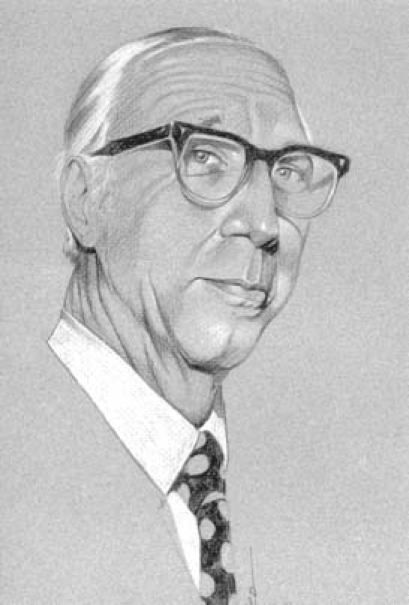
Figure. Willem Johan Kolff, MD, PhD
(Illustration by Rusty Jones)
The biomedical community lost a pioneering, innovative physician upon the passing of Dr. Willem Johan Kolff on 11 February 2009, just 3 days before his 98th birthday. Known as the “Father of Artificial Organs,” Dr. Kolff invented the first artificial heart and kidney using orange-juice cans, used auto parts, and sausage casings. He was noted for saying, “If a man can grow a heart, he can build one.”
Willem Kolff was born in Leyden, The Netherlands, on 14 February 1911. He received his medical degree from the University of Leiden in 1938 and, in 1946, earned a doctorate in internal medicine from the University of Groningen. At the latter institution, Dr. Kolff witnessed the painful death of a young man from kidney failure. That experience aroused his interest in artificial-organ development and inspired him to begin developing an artificial kidney. The original device, which filled an entire room and resembled an oversized hot tub, was the prototype for the contemporary hemodialysis machine, which has saved millions of lives worldwide since 1945. Dr. Kolff also established the first European blood bank. He himself funded all of his basic work in The Netherlands.
During World War II, after Germany invaded The Netherlands, Dr. Kolff actively resisted the occupation. He hid more than 800 persons in his hospital to save them from the Nazis. After the war, despite his dislike for the Nazis, he exemplified the spirit of the Hippocratic Oath by treating Maria Schafstadt, a Nazi sympathizer, with the artificial kidney.
In 1950, Dr. Kolff immigrated to the United States and joined the Cleveland Clinic in Ohio. There, he headed the Department of Artificial Organs and developed the membrane oxygenator, which is still an essential part of the cardiopulmonary bypass circuit during open heart surgery. In 1967, Dr. Kolff joined the University of Utah and led its Division of Artificial Organs as the director of the Institute of Biomedical Engineering. During his tenure at the University of Utah, he worked to create artificial placentas, lungs, and eyes.
In the early 1980s, Dr. Kolff attracted widespread public attention for developing the Jarvik total artificial heart, which is still used as a bridge to transplantation. He was a selfless man, who named his artificial-heart models after his coworkers—in this case, Dr. Robert Jarvik. In 1982, Dr. Barney Clark became the 1st person to receive the Jarvik artificial heart. He died of multiple-organ failure 112 days later, but the Jarvik heart was still functional.
Dr. Kolff was not only an innovative researcher but also an inspiring mentor. In 1961, one of his trainees, Dr. Domingo Liotta, became an investigator at Baylor College of Medicine in Houston. Dr. Liotta later designed the first total artificial heart to be implanted in a human being. My team and I implanted that pump into Haskell Karp in April 1969. I will always remember Dr. Kolff's kind, considerate nature; he was one of the first to congratulate Dr. Liotta and me for that implant.
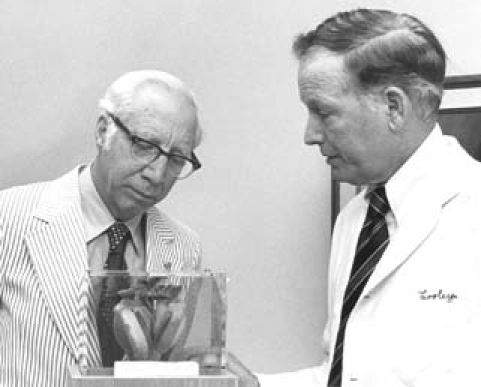
Figure. Dr. Kolff, a teacher of Drs. Domingo Liotta and Tetsuzo Akutsu, examines the Liotta total artificial heart with Dr. Denton Cooley during a visit to the Texas Heart Institute in the late 1970s.
During his illustrious career, Dr. Kolff published more than 600 books and journal articles and received many awards and honors. He was a founding member of the American Society of Artificial Internal Organs. In 1975, he became the 4th recipient of the Ray C. Fish Award from the Texas Heart Institute at St. Luke's Episcopal Hospital. A recipient of more than 12 honorary doctoral degrees, he also received the American Medical Association's prestigious Scientific Achievement Award in 1982 and the Albert Lasker Award for Clinical Medical Research in 2002. Furthermore, he was inducted into the National Inventors Hall of Fame and was named one of the “100 Most Important Americans of the 20th Century” by Life Magazine.
Dr. Kolff is survived by 5 children, 12 grandchildren, and 6 great-grandchildren. I offer my condolences to his family, friends, and colleagues. His pioneering inventions have saved millions of lives, and his legacy will continue to inspire future medical inventors.
Denton A. Cooley, MD
President Emeritus and Surgeon-in-Chief, Texas Heart Institute at St. Luke's Episcopal Hospital, Houston, Texas