



Vicinal diamines appear frequently as structural units in biological and medicinal molecules of interest and as auxiliary groups or ligands for catalytic processes.1 The rich and varied applications for 1,2-diamines belie the rather modest number of general methods for the efficient preparation of such compounds.2 Accordingly, we have attempted to capitalize on the power of sulfamate ester C—H amination to address this problem (Figure 1).
Figure 1.

A two-step protocol for the preparation of 1,2-diamines.
The high performance of sulfamate esters in amination reactions and their propensity to form six-membered oxathiazinane products inspired our investigation of sulfamates fashioned from N-alkylhydroxylamines.3 Catalytic C—H insertion of such substrates affords unique [1,2,3,6]-oxathiadiazinane-2,2-dioxide heterocycles that can, in principle, be reduced to yield differentially protected 1,2-diamines.4 Rhodium-catalyzed intramolecular C—H insertion of ureas and guanidines also gives cyclic products, which may be ringopened to furnish analogous diamine derivatives;5 however, hydrolysis of such heterocycles generally requires forcing conditions incompatible with other attendant functional groups.2i,5,6
Initial attempts to effect intramolecular C—H insertion with O-sulfamoyl-N-alkylhydroxylamine derivatives using a dirhodium catalyst and PhI(OAc)2 led only to rapid substrate decomposition. We ascribed this result to the presence of the nucleophilic hydroxylamine moiety and thus proceeded to examine the effect of an electron-withdrawing substituent on the nitrogen center. While some success was realized with N-Boc- and N-formyl-derived substrates (entries 1 and 2, Table 1), the positive influence of the sulfonyl group on the reaction outcome was pronounced (entries 3 and 4). The stark differences in performance between these substrates may be due to the planar nature of the nitrogen center (sp2-like) in both the Boc and formyl structures, which we believe induces considerable strain in the developing product, thereby disfavoring cyclization. Accordingly, the p-methoxybenzenesulfonyl (Mbs) derivative was selected for further optimization studies.
Table 1.
Evaluating Reaction Conditions for C-H Amination
 | ||||
|---|---|---|---|---|
| Entrya | R Group | Catalyst | Solvent | Yieldb |
| 1 | Boc | Rh2(oct)4 | C6H6 | - (29) |
| 2 | CHO | Rh2(oct)4 | C6H6 | - (23) |
| 3 | MeSO2 | Rh2(oct)4 | C6H6 | - (100) |
| 4 | Mbs | Rh2(oct)4 | C6H6 | 99 (100) |
| 5 | Mbs | Rh2(oct)4 | toluene | 77 |
| 6 | Mbs | Rh2(oct)4 | CH2Cl2 | 74 |
| 7 | Mbs | Rh2(oct)4 | EtOAc | 90 |
| 8 | Mbs | Rh2(OAc)4 | C6H6 | 87 |
| 9 | Mbs | Rh2(O2CCPh3)4 | C6H6 | 43 |
| 10 | Mbs | Rh2(esp)2 | C6H6 | 98 |
Reactions were performed with 2 mol % of catalyst, 2.3 equiv of MgO, and 1.1 equiv of PhI(OAc)2.
Isolated yields; values in parentheses denote percent conversions based on integration of the unpurified 1H NMR spectrum.
The incorporation of an Mbs group in our substrate design has facilitated the preparation of these unique sulfamate starting materials. Such compounds are easily synthesized under Mitsunobu conditions from simple alcohols and MbsNHOSO2NH2, a crystalline reagent available from MbsCl in two steps.7 Oxidative cyclization of this class of sulfamate esters occurs most effectively when catalyzed by either Rh2(oct)4 or Rh2(esp)2 (entries 4 and 10, Table 1).8 The influence of solvent on reaction performance reveals benzene and EtOAc to be optimal (entries 4 and 7), and, as with other C—H amination protocols that we have developed, MgO is a useful additive for this process.
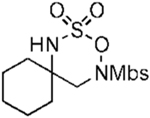
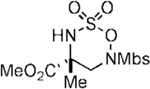
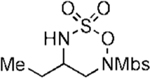
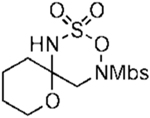
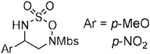
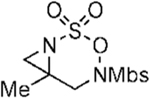
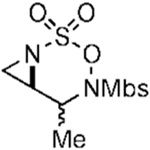
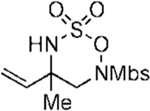
Evaluation of the reaction scope highlights a substrate profile similar to other Rh-catalyzed C—H amination processes (Table 2). Hydroxylamine-derived sulfamates display a strong bias to form six-membered ring products; in addition, oxidation of 3° C—H bonds is generally most effective. One of these examples (entry 2), in which amination is achieved at an α-carbonyl center, affords a product heterocycle that may be transformed into the corresponding α,β-diaminopropionic acid. This type of structure appears with some frequency in both natural and synthetic molecules of import.9 In addition to 3° C—H oxidation, amination of α-ethereal and benzylic C—H bonds is also quite favorable (entries 4 and 5). In these instances, however, direct isolation of the resulting oxathiadiazinanes is impaired due to their instability on silica gel. Fortunately, the yields of the insertion reactions are sufficiently high in most cases to enable subsequent manipulation of the unpurified materials (vide infra). Finally and as noted previously with unsaturated sulfamate derivatives, intramolecular aziridination is quite efficient and often outcompetes the C—H insertion event (entries 6-8).3
Table 2.
Oxidative Cyclization of Novel Sulfamate Esters
| Entrya | Substrate | Product | Conversionb | Yield |
|---|---|---|---|---|
| 1 | 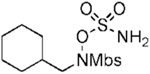 |
 |
100 | 99 |
| 2 | 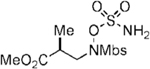 |
 |
82 | 82 |
| 3 | 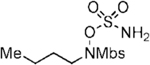 |
 |
26 | 26c |
| 4 | 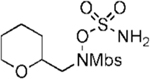 |
 |
100 | 84d |
| 5 | 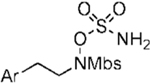 |
 |
100 | 73d |
| 70e | - | |||
| 6 | 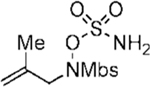 |
 |
100 | 90 |
| 7 | 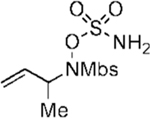 |
 |
100 | 98f |
| 8 | 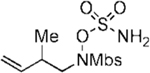 |
 |
100 | 39g |
Reactions were performed in C6H6 with 2 mol % of Rh2(oct)4, 2.3 equiv of MgO, and 1.1 equiv of PhI(OAc)2.
Conversion based on integration of the unpurified 1H NMR spectrum.
Reaction performed with 5 mol % of Rh2(oct)4.
Isolated yield was reduced due to product instability on SiO2.
Product could not be isolated due to instability on SiO2.
Product obtained as a 4:1 diastereomeric mixture.
In addition, the aziridine product was obtained as a 1.3:1 diastereomeric mixture in 56% yield.
The ease with which oxathiadiazinane heterocycles may be converted to the corresponding 1,2-diamine products is a hallmark of this chemistry (Figure 2). Reduction of the N—O bond using Zn(Cu) couple followed by treatment with methanolic HCl affords the monoprotected 1,2-diamine in high yield. The effectiveness of these conditions and the performance of the C—H insertion make possible direct reduction of heterocyclic products that are otherwise difficult to isolate using chromatographic methods. Examples of this two-step protocol are shown in Figure 2. Following the C—H insertion event, filtration of the reaction mixture and subsequent treatment with Zn(Cu) furnishes the desired diamine. These findings also reveal that 1,2-diamine products can be generated with modest to high levels of diastereocontrol from chiral starting materials.
Figure 2.

Reductive N—O cleavage furnishes 1,2-diamine derivatives. Products purified by HPLC using H2O/CH3CN/CF3CO2H.
Rhodium-catalyzed C—H oxidation affords a unique family of oxathiadiazinane structures that serve as intermediates en route to differentially protected 1,2-diamines. The high levels of chemoselectivity and broad substrate scope exemplary of related amination reactions underscore this method.3 This chemistry is further enabled with the advent of straightforward protocols for assembling the requisite hydroxylamine-derived substrates and for the reductive opening of the product heterocycles. The availability of such technologies should elevate Rh-catalyzed C—H amination as a general method for C—N bond formation in synthesis.
Supplementary Material
Acknowledgment
We thank Dr. Benjamin Brodsky and Nichole D. Litvinas for helpful discussions. D.E.O. gratefully acknowledges Eli Lily for a graduate fellowship. This work has been supported by the National Institutes of Health and by generous gifts from Pfizer, Amgen, and GlaxoSmithKline.
Footnotes
Supporting Information Available: Experimental details and analytical data for all new compounds. This material is available free of charge via the Internet at http://pubs.acs.org.
References
- (1).For general applications, see: Kotti SRSS, Timmons C, Li G. Chem. Biol. Drug Des. 2006;67:101–114. doi: 10.1111/j.1747-0285.2006.00347.x.. de Parrodi CA, Juaristi E. Synlett. 2006;17:2699–2715..
- (2).(a) Lucet D, Le Gall T, Mioskowski C. Angew. Chem., Int. Ed. 1998;37:2580–2627. doi: 10.1002/(SICI)1521-3773(19981016)37:19<2580::AID-ANIE2580>3.0.CO;2-L. [DOI] [PubMed] [Google Scholar]; (b) Westermann B. Angew. Chem., Int. Ed. 2003;42:151–153. doi: 10.1002/anie.200390071. [DOI] [PubMed] [Google Scholar]; (c) Savoia D. Top. Organomet. Chem. 2005;15:1–58. [Google Scholar]; (d) Muñiz K. New J. Chem. 2005;29:1371–1385. [Google Scholar]; (e) Mortensen MS, O'Doherty GA. Chemtracts: Org. Chem. 2005;18:555–561. [Google Scholar]; (f) Bar GLJ, Lloyd-Jones GC, Booker-Milburn KI. J. Am. Chem. Soc. 2005;127:7308–7309. doi: 10.1021/ja051181d. [DOI] [PubMed] [Google Scholar]; (g) Ichikawa Y, Egawa H, Ito T, Isobe M, Nakano K, Kotsuki H. Org. Lett. 2006;8:5737–5740. doi: 10.1021/ol0621102. [DOI] [PubMed] [Google Scholar]; (h) Fritz JA, Nakhla JS, Wolfe JP. Org. Lett. 2006;8:2531–2534. doi: 10.1021/ol060707b. [DOI] [PMC free article] [PubMed] [Google Scholar]; (i) Du H, Yuan W, Zhao B, Shi Y. J. Am. Chem. Soc. 2007;129:7496–7497. doi: 10.1021/ja072080d. [DOI] [PubMed] [Google Scholar]; (j) Zhao B, Yuan W, Du H, Shi Y. Org. Lett. 2007;9:4943–4945. doi: 10.1021/ol702061s. [DOI] [PubMed] [Google Scholar]; (k) Zabawa TP, Chemler SR. Org. Lett. 2007;9:2035–2038. doi: 10.1021/ol0706713. [DOI] [PMC free article] [PubMed] [Google Scholar]; (l) Schomaker JM, Boyd WC, Stewart IC, Toste FD, Bergman RG. J. Am. Chem. Soc. 2008;130:3777–3779. doi: 10.1021/ja800738d. [DOI] [PubMed] [Google Scholar]; (m) Singh A, Johnston JN. J. Am. Chem. Soc. 2008;130:5866–5867. doi: 10.1021/ja8011808. [DOI] [PubMed] [Google Scholar]; (n) Muñiz K, Hövelmann CH, Streuff J, Campos-Gómez E. Pure Appl. Chem. 2008;80:1089–1096. and references therein. [Google Scholar]
- (3).Espino CG, Wehn PM, Chow J, Du Bois J. J. Am. Chem. Soc. 2001;123:6935–6936. [Google Scholar]; For recent reviews on C—H amination, see: Müller P, Fruit C. Chem. Rev. 2003;103:2905–2920. doi: 10.1021/cr020043t.. Halfen JA. Curr. Org. Chem. 2005;9:657–669.. Davies HML, Manning JR. Nature. 2008;451:417–424. doi: 10.1038/nature06485.
- (4).We refer to these heterocycles as oxathiadiazinanes for convenience. We are aware of only one prior report of such compounds; see: Arfaei A, Smith S. J. Chem. Soc., Perkin Trans. 1. 1984:1791–1794.
- (5).Kim M, Mulcahy JV, Espino CG, Du Bois J. Org. Lett. 2006;8:1073–1076. doi: 10.1021/ol052920y. [DOI] [PubMed] [Google Scholar]; Zhao B, Du H, Shi Y. Org. Lett. 2008;10:1087–1090. doi: 10.1021/ol702974s. [DOI] [PubMed] [Google Scholar]
- (6).(a) Jones RCF, Schofield J. J. Chem. Soc., Perkin Trans. 1. 1990:375–383. [Google Scholar]; (b) Dunn PJ, Häner R, Rapoport H. J. Org. Chem. 1990;55:5017–5025. [Google Scholar]; (c) Perrin CL, Young DB. J. Am. Chem. Soc. 2001;123:4446–4450. doi: 10.1021/ja003672y. [DOI] [PubMed] [Google Scholar]; (d) Nadir UK, Krishna RV, Singh A. Tetrahedron Lett. 2005;46:479–482. [Google Scholar]
- (7).See Supporting Information for details
- (8).Espino CG, Fiori KW, Kim M, Du Bois J. J. Am. Chem. Soc. 2004;126:15378–15379. doi: 10.1021/ja0446294. [DOI] [PubMed] [Google Scholar]
- (9).(a) For a leading reference, see: Viso A, de la Pradilla RF, García A, Flores A. Chem. Rev. 2005;105:3167–3196. doi: 10.1021/cr0406561.. (b) Also, see: Nakamura Y, Hirai M, Tamotsu K, Yonezawa Y, Shin C. Bull. Chem. Soc. Jpn. 1995;68:1369–1377.. Cutting GA, Stainforth NE, John MP, Kociok-Köhn G, Willis MC. J. Am. Chem. Soc. 2007;129:10632–10633. doi: 10.1021/ja073473f.
Associated Data
This section collects any data citations, data availability statements, or supplementary materials included in this article.