



Abstract
We compared the diagnostic value of an enzyme immunoassay method for detection of gonococcal antigen in genital secretions with culture results and direct Gram stain for Neisseria gonorrhoeae in 1,171 men and 723 women attending a sexually transmitted disease clinic. When compared with culture results in men, the immunoassay provided a sensitivity of 94% and a specificity of 98% and was essentially equivalent to the urethral Gram stain. The predictive value of a positive immunoassay was 97% in men with a urethral discharge in whom the prevalence of gonorrhea was 36%, and 30% in men without urethral discharge, who had a 2% prevalence of gonorrhea (P less than 0.001). The sensitivity of the immunoassay was 95% in men with and 67% in men without urethral discharge (P less than 0.01). In women, the immunoassay resulted in a sensitivity of 78% and a specificity of 98% compared with cervical culture and had a significantly better sensitivity than the cervical Gram stain (78 versus 48%, P less than 0.001). Analysis of patients with discrepant culture and immunoassay results suggested that most culture-negative, immunoassay-positive patients probably did not have gonorrhea. After treatment, all but 1 of 59 originally culture- and immunoassay-positive patients became negative in both tests by 3 days. Results of the immunoassay were not affected by transport or by refrigeration for up to 30 days.
Full text
PDF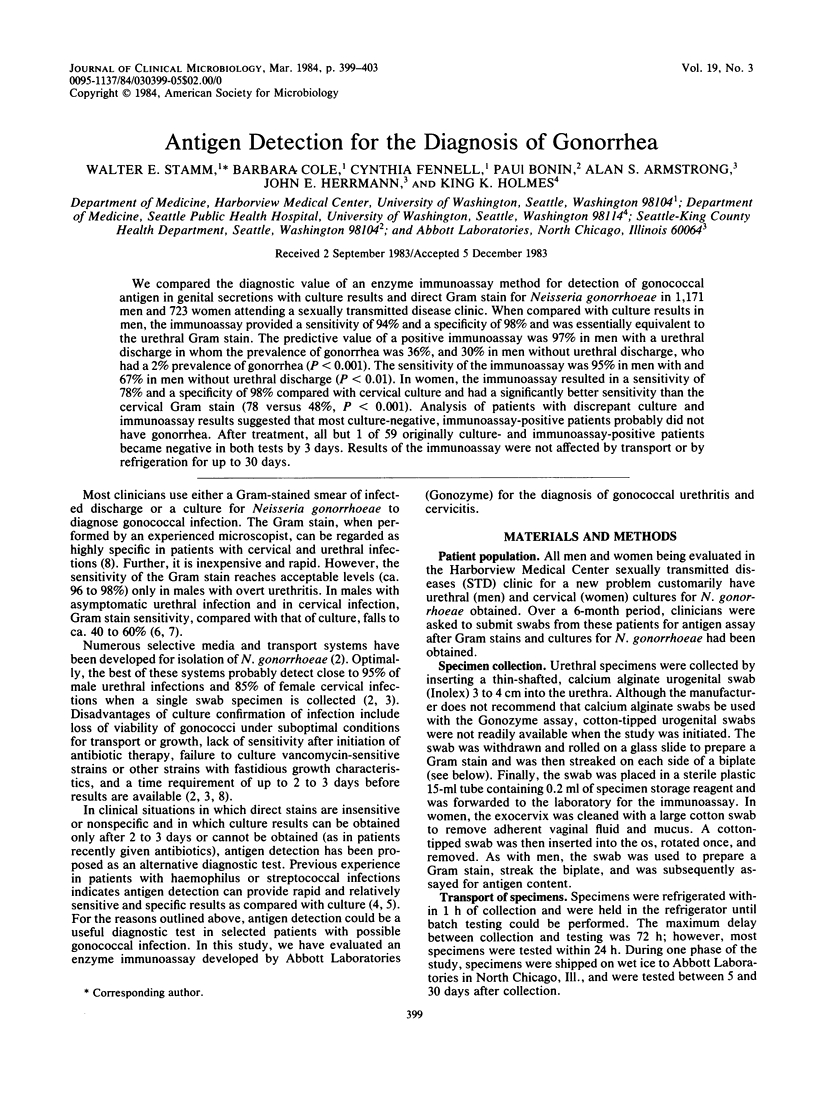


Selected References
These references are in PubMed. This may not be the complete list of references from this article.
- Brown W. J. Modification of the rapid fermentation test for Neisseria gonorrhoeae. Appl Microbiol. 1974 Jun;27(6):1027–1030. doi: 10.1128/am.27.6.1027-1030.1974. [DOI] [PMC free article] [PubMed] [Google Scholar]
- Carlson B. L., Haley M. S., Tisei N. A., McCormack W. M. Evaluation of four methods for isolation of Neisseria gonorrhoeae. J Clin Microbiol. 1980 Sep;12(3):301–303. doi: 10.1128/jcm.12.3.301-303.1980. [DOI] [PMC free article] [PubMed] [Google Scholar]
- Dans P. E., Judson F. The establishment of a venereal disease clinic: II. An appraisal of current diagnostic methods in uncomplicated urogenital and rectal gonorrhea. J Am Vener Dis Assoc. 1975 Mar;1(3):107–112. [PubMed] [Google Scholar]
- Edwards M. S., Kasper D. L., Baker C. J. Rapid diagnosis of type III group B streptococcal meningitis by latex particle agglutination. J Pediatr. 1979 Aug;95(2):202–205. doi: 10.1016/s0022-3476(79)80651-4. [DOI] [PubMed] [Google Scholar]
- Feldman W. E. Relation of concentrations of bacteria and bacterial antigen in cerebrospinal fluid to prognosis in patients with bacterial meningitis. N Engl J Med. 1977 Feb 24;296(8):433–435. doi: 10.1056/NEJM197702242960806. [DOI] [PubMed] [Google Scholar]
- Handsfield H. H., Lipman T. O., Harnisch J. P., Tronca E., Holmes K. K. Asymptomatic gonorrhea in men. Diagnosis, natural course, prevalence and significance. N Engl J Med. 1974 Jan 17;290(3):117–123. doi: 10.1056/NEJM197401172900301. [DOI] [PubMed] [Google Scholar]
- Oxtoby M. J., Arnold A. J., Zaidi A. A., Kleris G. S., Kraus S. J. Potential shortcuts in the laboratory diagnosis of gonorrhea: a single stain for smears and nonremoval of cervical secretions before obtaining test specimens. Sex Transm Dis. 1982 Apr-Jun;9(2):59–62. doi: 10.1097/00007435-198204000-00001. [DOI] [PubMed] [Google Scholar]