


Abstract
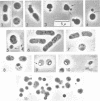
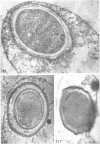
Fitz-James, Philip C. (University of Western Ontario, London, Ontario, Canada). Sporulation in protoplasts and its dependence on prior forespore development. J. Bacteriol. 87:667–675. 1964.—Phase-contrast and electron microscopy were used to decide whether cells from late growth or sporulating cultures could, where converted into protoplasts, complete the process of sporulation. The cell wall was found essential to the development of the forespore. Incomplete forespores formed a satellite protoplast. Completed forespores were enclosed by the sporangial protoplast, and only these or later forms were able to complete sporulation in protoplasts.
Full text
PDF


Images in this article


Selected References
These references are in PubMed. This may not be the complete list of references from this article.
- KELLENBERGER E., RYTER A., SECHAUD J. Electron microscope study of DNA-containing plasms. II. Vegetative and mature phage DNA as compared with normal bacterial nucleoids in different physiological states. J Biophys Biochem Cytol. 1958 Nov 25;4(6):671–678. doi: 10.1083/jcb.4.6.671. [DOI] [PMC free article] [PubMed] [Google Scholar]
- YOUNG I. E., JAMES P. C. Chemical and morphological studies of bacterial spore formation. IV. The development of spore refractility. J Cell Biol. 1962 Jan;12:115–133. doi: 10.1083/jcb.12.1.115. [DOI] [PMC free article] [PubMed] [Google Scholar]