



Abstract
The effects of at least 23-hr deprivation, 5-min presession exposure, and individual preference on the acquisition of mands were investigated in these studies. Two boys who were 2.5 years old and diagnosed with autism participated in the studies. Preference assessments were conducted to identify preference levels of various toys. Toys of various preferences were then assigned to either a 23-hr deprivation or 5-min presession exposure condition for mand training. Both deprivation and preference level affected acquisition of mands. Implications for teaching children to mand are discussed.
Keywords: establishing operations, preferences, manding, autism
Autism is typically diagnosed when a child has impairments in verbal behavior, social interaction skills, play skills, and a presence of repetitive and stereotyped patterns of behavior (DSM-IV; American Psychiatric Association, 1994). Although children with autism show these characteristics in various ways, the impairment in verbal behavior is perhaps the most crucial for young children because it affects many other areas, including social and play skills. Many individuals with autism, in fact, do not learn vocal verbal behavior skills and, in some cases, do not learn any functional language. This often results in children engaging in problem behavior as a form of verbal behavior.
Deficits in verbal behavior, however, have in some cases been remediated with behavioral intervention. For example, children with disabilities have been taught alternative communicative responses to replace stereotypical behavior (Kennedy, Meyer, Knowles, & Shukla, 2000) and new communicative responses such as sign language (Partington, Sundberg, Newhouse, & Spengler, 1994). In addition, children with autism have been taught to mand (Drash, High, & Tudor, 1999). The mand is a type of verbal behavior that specifies its reinforcement (Skinner, 1957). In other words, a mand is verbal behavior that results in obtaining a specific reinforcer (rather than generalized conditioned reinforcement such as social approval). A mand could include making a request (e.g., child asks for juice) or a command (e.g., child says, “Please wait for me.”) It has been suggested that teaching children with autism to mand is the best way to begin verbal behavior training, because the verbal behavior results in the child obtaining a desired item (Sundberg & Partington, 1998). This immediately reinforces the child's verbal behavior and thereby increases the frequency of verbal behavior between the child and another person.
The goal for teaching children with autism to mand is to bring an appropriate response form under the control of a relevant establishing (motivating) operation. This is demonstrated when a child can mand for something that is not visibly (or auditorily, or tactually, etc.) present, for example requesting juice while riding in a car. Initial steps in teaching manding to children with no or limited vocal skills usually includes teaching them to echo auditory stimuli. After they have an appropriate echoic response, they can be taught to tact a preferred item in the presence of the item. This procedure usually entails giving the preferred item to the child when it is correctly tacted, which makes this procedure also a form of mand training. But, when the child begins to mand for an item in visual sight, the response is also part tact if it is jointly evoked by the visual stimulus as well as the establishing operation. For children with autism, mands taught in the presence of such stimuli often fail to occur in their absence (when they would be most useful). For this reason, children diagnosed with autism may need specific mand instruction in the absence of the relevant stimulus.
Mands are sensitive to “motivation” or, more precisely, to establishing operations (Keller & Schoenfeld, 1950; Michael, 1982, 1993). An establishing operation is a term that describes environmental changes that momentarily change the effectiveness of a stimulus as a reinforcer. The most commonly described establishing operations include deprivation and satiation (although see Murphy, McSweeney, Smith, & McComas, 2003). To illustrate, requesting a reinforcer such as a glass of juice is more likely when the child has not consumed liquids for a period of time (deprivation) and less likely after consuming the juice (satiation). The effects of establishing operations have been demonstrated on social praise (Gewirtz & Baer, 1958), motor tasks (Vollmer & Iwata, 1991), food preferences (Gottchalk, Libby, & Graff, 2000), and functional communication (Brown et al., 2000).
In addition to the effects of establishing operations such as deprivation and satiation, the level of preference for items such as toys would be expected to be related to children's learning to mand for such items. More specifically, using highly preferred rather than lesser preferred stimuli may be more effective in teaching mands, because of the greater reinforcing effectiveness of the highly preferred stimuli. The effect of delivering reinforcers of differing strength has been shown, for example, when adults diagnosed with developmental disabilities engaged more with high than with low preferred activities when given the opportunity during a typically low engaging time period (Klatt, Sherman, & Sheldon, 2000).
The purpose of the present studies was to investigate the effects of deprivation/satiation and varying levels of preference on learning to mand for toys for two children with autism. Deprivation was defined as 23 hrs without contacting a toy, and satiation was defined as a 5-min presession exposure to a toy. In the first phases of both studies, participant preferences were assessed. The second phase of Study 1 investigated the effects of establishing operations and preferences on learning to mand (i.e., the first steps to mand training). The second phase of Study 2 investigated whether the effects of establishing operations and preferences would be replicated with one boy when teaching a step closer to a “pure” mand for a different subset of toys.
GENERAL METHOD
Participants, Setting, and Materials
Two male children diagnosed with autism, who were enrolled in an on-campus autism program, participated in the studies. The participants, Sean and Billy, were both 2.5 years old. Both boys could echo a few words but did not mand to obtain tangible objects. The boys could not tact nor receptively identify the toys used in the study before mand training was implemented. Sean participated in Studies 1 and 2 and Billy participated in Study 1.
The studies were conducted in a 3.5 m × 3.5 m therapy room containing a table and chairs for the participant and researcher. The room contained a one-way mirror, so sessions could be observed from an adjoining room.
Age appropriate toys identified through preference assessments were used throughout the studies.
STUDY 1: MAND TRAINING PART I
The purpose of Study 1 was to assess the effects of 23-hr deprivation/5-min presession exposure and various levels of preference (high to low) on the acquisition of mands. Toys identified from preference assessments as high, medium, or low for Sean and high or low for Billy were used in Study 1. For both boys, one toy from each of the preference categories (high/medium/low for Sean and high/low for Billy) was placed in the 23-hr deprivation condition and one toy from each of the preference categories in the 5-min presession exposure condition.
To keep the 23-hr deprivation and the 5-min presession exposure conditions equivalent, an attempt was made to select toys with a comparable number of syllables (e.g., train and dough). In addition, when a toy was selected slightly more often within a preference category that toy was placed in the 5-min presession exposure condition so that any potential bias would favor that condition. This was done because of the plausible hypothesis that manding would not be learned as effectively in the 5-min presession exposure condition.
Phase 1: Preference Assessment
The purpose of the first phase of Study 1 was to identify a preference hierarchy of toys for each boy. Toys identified for the preference assessments were selected by observing the child play in the autism program and from parent interviews. Different preference assessments were used for each boy because of challenging behaviors that occurred during pilot testing. A paired-stimulus preference assessment (Mithaug & Hanawalt, 1978; Fisher, Piazza, Bowman, Hagopian, & Slevin, 1992) was conducted for Sean. A variation of the multiple stimulus without replacement preference assessment (Deleon & Iwata, 1996) was conducted for Billy.
Paired-stimulus (PS). Each session began by presenting two toys (out of eight) on a table in front of Sean. With Sean seated at the table, the experimenter told Sean to “pick” a toy. After Sean selected a toy he was allowed to play with the toy for 5 s before it was removed and another trial initiated. The session was continued until every toy was paired with every other toy using a random presentation format. This procedure was replicated the following day. The dependent variable for the PS preference assessment was the number of times Sean selected each toy.
A variation of multiple stimulus without replacement (MSWO). This assessment procedure began with four toys in a line on the table in the middle of the room. Billy was given the instruction “pick.” After he selected a toy he was allowed to play with the toy on the table or floor until either he stopped playing with it or 5 min elapsed, whichever came first. At that point the toy was removed and the procedure was repeated with the remaining toys. The dependent variable for the variation of the MSWO preference assessment was the duration of engagement with each toy for Billy.
Interobserver agreement. Interobserver agreement was obtained by the program director and students observing from an adjacent observation room. The number of times a toy was selected for Sean and the number of seconds of engagement for Billy were recorded and verified via videotape. In both cases there was 100% agreement.
Results phase 1: Preference assessment. The results for Sean, depicted in the top panel of Figure 1, show the hierarchy of most-to-least selected toys in the PS preference assessment. Sean could have selected a specific toy a maximum 14 times if he had shown exclusive preference. The number of times Sean selected each toy was: doll 12, train 11, slinky 8, drum 7, pen 6, the Barney® figure 5, truck 5, and beads 2. The doll and train thus were identified as “high” preferred toys, the drum and pen as “medium” preferred toys and the Barney® figure and truck as “low” preferred toys.
Figure 1.
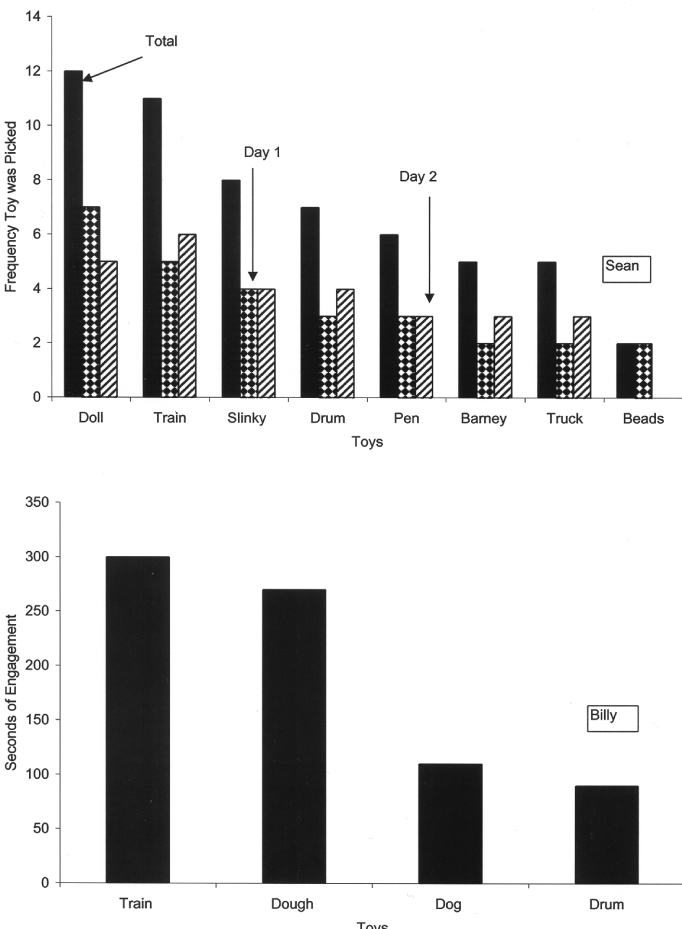
Study 1 Preference Assessments: The top panel displays the frequency of Sean's individual toy selection for day one, day two, and the total of these two days. The bottom panel displays the duration (in seconds) of Billy's engagement with each toy.
The results for Billy, depicted in the bottom panel of Figure 1, show the number of seconds of engagement with each toy. (The items selected have been graphed from most-to-least engaged and not necessarily the order in which he selected them). Billy engaged with the train 300 s, play dough 270 s, toy dog 110 s, and drum 90 s. The train and dough were identified as “high” preferred and the dog and drum as “low” preferred toys.
Phase 2: Mand Training
Procedure. Teaching manding for the toys was conducted with the experimenter and boy seated at a table in the therapy room. The experimenter sat across the table from the boy and presented toys sequentially in a counterbalanced order. The experimenter placed the toy in front of the child and asked, “What do you want?” or, “What would you like?” A 3-s constant prompt delay procedure was used to transfer stimulus control from the echoic prompt to the sight of the toy. In the first trial the experimenter provided an immediate echoic prompt, “say [name of toy].” After the first trial the echoic prompt was delayed 3-s. If the child gave a correct response (with or without a prompt) the child received both verbal praise and access to the toy for 10-s. If the child made an error during a trial or did not respond before the echoic prompt for two consecutive trials, the experimenter returned to one trial of a 0-s prompt delay. The following trial the experimenter again waited 3-s before giving the echoic prompt. Although the questions “What do you want?” and “What would you like?” are not relevant sources of control for a mand, they were not treated as prompts in this study. If the child responded before or after the question the response was recorded as a correct mand.
Five consecutive trials for each toy were presented each session. One session was conducted each weekday. If the child turned away from the toy or asked for a different item after the experimenter asked, “What do you want?” the experimenter stopped the trial. If two consecutive trials were stopped, the trials for that toy were ended for that session. A toy was terminated from the study if the child reached criterion for all the other toys or if the child did not have any correct mands for three consecutive days.
The dependent variable in Phase 2 was the frequency of correct mands (although technically this was an impure mand). A correct mand was defined as the child requesting the toy presented by the experimenter without echoic prompts. The boys met criterion when they manded correctly without an echoic prompt during all trials for three consecutive sessions.
Independent variables. One independent variable was the deprivation level, with the two values being 23-hr deprivation and 5-min presession exposure. Toys in the 23-hr deprivation condition and in the 5-min presession exposure condition were neither available to the child at home nor at the campus program for at least 23 hrs prior to each session. In the 5-min presession exposure condition, the boy was allowed to play with the toy for 5 min or until he stopped playing (whichever occurred first) prior to conducting the five trials. The order of the two conditions was counterbalanced each day to control for order effects.
The other independent variable was the preference level of the toy that was manded, as determined by the preference assessment. For Sean the toys were of high, medium, and low preference value; for Billy they were of high and low preference value.
Interobserver agreement. Interobserver agreement was conducted during 100% of the sessions for Sean and 46% for Billy. To obtain interobserver agreement, a secondary observer recorded behind a one-way mirror in an adjoining observation room. Interobserver agreement was calculated by dividing the number of agreements of correct mands by the total number of responses and multiplying by 100%. Interobserver agreement was 95% for Sean and 100% for Billy.
Results phase 2: Mand training. The cumulative number of correct mands (without echoic prompts) across sessions for Sean is shown in Figure 2. To show the effects of different preferences (high, medium, low) on the acquisition of mands, data for the toys in 23-hr deprivation and 5-min presession exposure were collapsed within each preference category and shown in the top panel. Sean reached criterion for manding the two high preferred toys in 6 and 11 sessions, one medium preferred toy in 7 sessions (the other medium toy was terminated), and the two low preferred toys in 7 and 12 sessions.
Figure 2.
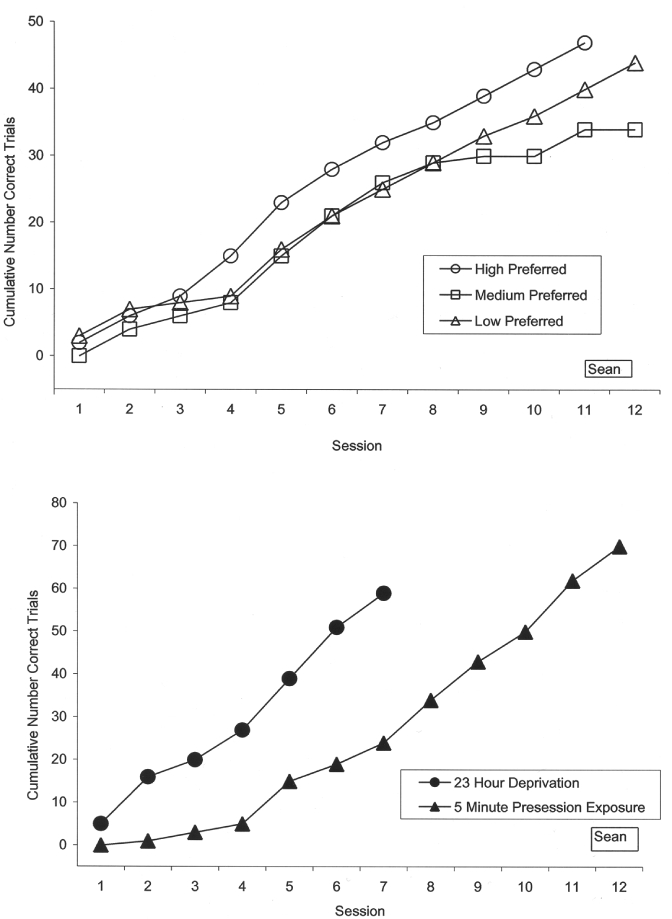
Study 1 Mand Training for Sean: The top panel displays the cumulative number of correct mands across sessions (high vs. medium vs. low preferences). The bottom panel displays the cumulative number of correct mands across sessions (23-hr deprivation vs. 5-min presession exposure). The session that Sean reached criterion for each toy is also shown in the bottom panel.
To show the effect of deprivation level, the same data were collapsed across the preference levels and presented in the bottom panel of Figure 2. Sean reached the criterion for manding the three toys in the 23-hr deprivation condition in seven sessions. In the 5-min presession exposure condition he reached criterion in 12 sessions for two of the three toys. The medium preferred toy was terminated from the study at this point.
The cumulative number of correct mands (without echoic prompts) across sessions for Billy is shown in Figure 3. The top panel shows the effects of preferences on manding. Billy reached criterion for manding one high preferred toy in nine sessions. The other high preferred toy and both low preferred toys were terminated after 13 sessions. The bottom panel shows the effect of deprivation and presession exposure, with the data showing little difference between the two conditions.
Figure 3.

Study 1 Mand Training for Billy: The top panel displays the cumulative number of correct mands across sessions (high vs. low preferences). The bottom panel displays the cumulative number of correct mands across sessions (23-hr deprivation vs. 5-min presession exposure). The session that Billy reached criterion for each toy is also shown in the bottom panel.
STUDY 2: MAND TRAINING PART 2
The purpose of Study 2 was to replicate the results found in Study 1 with different toys and to teach Sean a response closer to a “pure” mand (Billy was initially included but dropped due to termination of toys and program time constraints). The procedures were the same as in Study 1. A new PS preference assessment was conducted to identify different toys for this study and only two preference categories were investigated (high and low). Three of the toys (go-cart, Ernie®, and cycle) were chosen about the same number of times during the first two assessments, and thus a third preference assessment was conducted with only these toys.
To teach a response closer to a pure mand, the toys were hidden under the table. In each trial the experimenter placed the toy in front of Sean for one second and then hid the toy under the table. Once the toy was hidden, the experimenter would start a trial by asking Sean, “What would you like?” A correct mand was recorded if Sean said the name of the item without an echoic prompt after the toy was hidden under the table and either before or after the question was asked. If Sean did not respond or responded incorrectly, an echoic prompt was provided as described in study one.
Results phase 1: Preference assessment. The results for the PS preference assessment are shown in the top panel of Figure 4. In this assessment, a phone, boat, hammer, go-cart, Ernie® doll, and cycle were tested. The number of times Sean selected each toy was phone 9, boat 8, hammer 6, go-cart 3, and Ernie® and the cycle 2. The phone and boat were identified as “high” preferred toys and go-cart and Ernie® were identified as “low” preferred toys.
Figure 4.
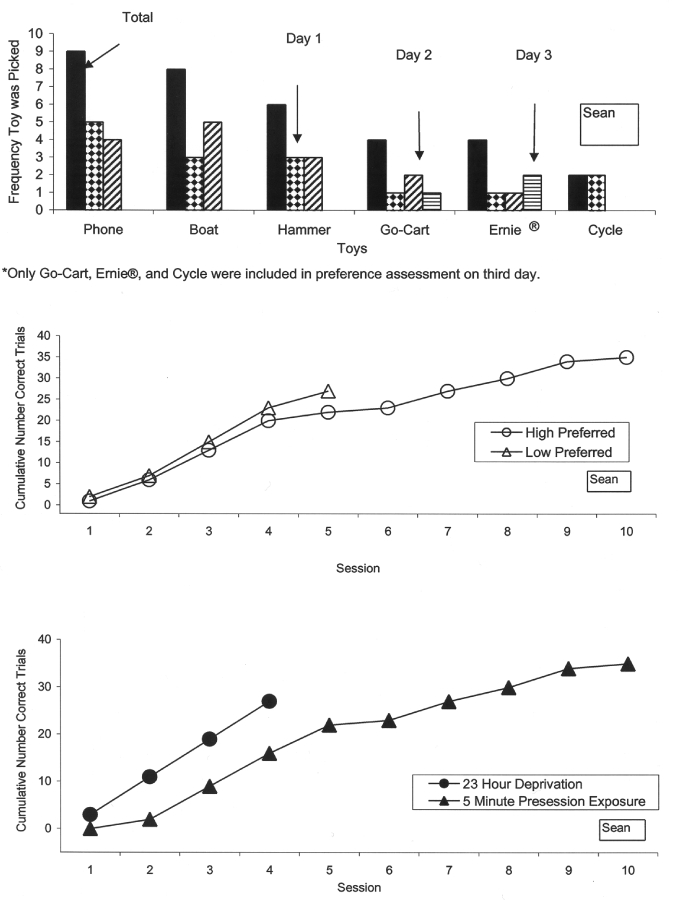
Study 2 Preference Assessment and Mand Training for Sean: The top panel displays the frequency each toy was picked for day one, two, and three, and the total frequencies. Only go-cart, Ernie®, and cycle were included in the preference assessment on the third day. The middle panel displays the cumulative number of correct mands across sessions (high vs. low preferences). The bottom panel displays the cumulative number of correct mands across sessions (23-hr deprivation vs. 5-min presession exposure) and the session that Sean reached criterion for each toy.
Results phase 2: Mand training part 2. The cumulative number of correct mands (without echoic prompts) across sessions for Sean is shown in the middle and bottom panels of Figure 4. To show the effects of high vs. low preferences on “pure” manding, data for the toys were collapsed across 23-hr deprivation and 5-min presession exposure conditions and shown in the middle panel. Sean reached criterion for manding one preferred toy in four sessions and the other preferred toy was terminated after 10 sessions. Sean reached criterion for manding the two low preferred toys in four and five sessions.
The same data were collapsed across preference levels and presented in the bottom panel of Figure 4. These data show that Sean reached criterion for manding both toys in the deprivation condition in four sessions and one toy in the presession exposure condition in five sessions (the other was terminated).
GENERAL DISCUSSION
The results of these studies suggest that establishing operations and/or levels of preference can affect learning to mand for children with autism, although the two subjects differed considerably in their response to these variables. For example, in both studies Sean learned to mand in fewer sessions in the 23-hr deprivation compared to 5-min presession exposure conditions. In contrast, when comparing the preference conditions, he acquired mands in only slightly fewer sessions for the high preferred toys than for the medium or low preferred toys. On the other hand, Billy's acquisition of mands in Study 1 was affected more by preference than by 23-hr deprivation/5 min presession exposure. This conclusion, however, is a bit premature given that Billy met criterion for only one toy.
In these two studies Sean learned to mand for toys in both the 5-min presession exposure and the low preferred conditions, albeit slower than in the deprivation or the high preferred condition. In this case learning might have occurred due to generalization across conditions. That is, Sean might have manded for a low preferred toy in 5-min presession exposure because he was reinforced in the condition with a high preferred toy in 23-hr deprivation. This is not likely, however, given that Sean needed more trials to reach criterion with toys in the low preferred and 5-min presession exposure conditions and, in Billy's case, acquisition was not reached with toys in either low preferred or 5-min presession exposure conditions.
These results imply the importance of considering establishing operations and individual preference when teaching manding to children with autism. Given the deficits in verbal behavior for children with autism and the difficulty often reported in teaching verbal behavior skills, these factors are likely to be important. Attention to establishing operations and individual preference is recommended during both discrete trial and incidental teaching. These data suggest that in both teaching situations, when teaching a child to mand, one should select a high preferred item that a child has not engaged with for some time. Furthermore, teaching a child to mand for a less preferred item (i.e., the toilet) may result in slower acquisition of mands.
The results from these studies should be interpreted with caution due to several limitations. First, the studies only included two participants. Second, the first study involved only one to two preference assessments across the two boys. This might not have been enough assessment to determine high to low preference. Third, and related, a reinforcer assessment was not conducted to verify the reinforcing efficacy of the toys. A fourth limitation was that the toys were not equivalent within each preference category. For example, small differences existed between the two toys in the high preference category, etc. To account for these differences, the higher ranked toy was always placed in the 5-min presession exposure condition. Thus, if any bias existed, it should have favored the toys in the 5-min presession exposure condition. The data suggests that little bias existed given the higher performance in the 23-hr deprivation condition for both boys.
Future research should continue to investigate variables that affect verbal behavior skills for young children with autism. For example, studies could be conducted to determine other variables that affect learning to mand. Since manding is an important start for children in learning verbal behavior, variables that affect learning and procedures that promote manding will likely prove to be valuable to clinicians working with children with autism.
Footnotes
Ellie C. Hartman is now in graduate school at the University of Minnesota. We thank the children and families who participated in the studies. We also thank the University of Wisconsin-Eau Claire Office of Research and Sponsored Programs for funding this research.
REFERENCES
- American Psychiatric Association. Diagnostic and statistical manual of mental disorders. (4th ed.) Washington, DC: 1994. [Google Scholar]
- Brown K. A, Wacker D. P, Derby K. M, Peck S. M, Richman D. M, Sasso G. M, Knutson C. L, Harding J. W. Evaluating the effects of functional communication training in the presence and absence of establishing operations. Journal of Applied Behavior Analysis. 2000;33:53–71. doi: 10.1901/jaba.2000.33-53. [DOI] [PMC free article] [PubMed] [Google Scholar]
- DeLeon I. G, Iwata B. A. Evaluation of a multiple-stimulus presentation format for assessing reinforcer preferences. Journal of Applied Behavior Analysis. 1996;29:519–532. doi: 10.1901/jaba.1996.29-519. [DOI] [PMC free article] [PubMed] [Google Scholar]
- Drash P. H, High R. L, Tudor R. M. Using mand training to establish an echoic repertoire in young children with autism. Analysis of Verbal Behavior. 1999;16:29–44. doi: 10.1007/BF03392945. [DOI] [PMC free article] [PubMed] [Google Scholar]
- Fisher W, Piazza C. C, Bowman L. G, Hagopian L. P, Owens J. C, Slevin I. A comparison of two approaches for identifying reinforcers for persons with severe and profound disabilities. Journal of Applied Behavior Analysis. 1992;25:491–498. doi: 10.1901/jaba.1992.25-491. [DOI] [PMC free article] [PubMed] [Google Scholar]
- Gewirtz J. L, Baer D. M. The effect of brief social deprivation on behaviors for a social reinforcer. Journal of Abnormal Social Psychology. 1958;56:49–56. doi: 10.1037/h0047188. [DOI] [PubMed] [Google Scholar]
- Gottschalk J. M, Libby M. E, Graff R. B. The effects of establishing operations on preference assessment outcomes. Journal of Applied Behavior Analysis. 2000;33:85–88. doi: 10.1901/jaba.2000.33-85. [DOI] [PMC free article] [PubMed] [Google Scholar]
- Keller F. S, Schoenfeld W. N. Principles of Psychology: A Systematic Text in the Science of Behavior. New York: Appleton-Century-Crofts, Inc; 1950. [Google Scholar]
- Kennedy C. H, Meyer K. A, Knowles T, Shukla S. Analyzing the multiple functions of stereotypical behavior for students with autism: Implications for assessment and treatment. Journal of Applied Behavior Analysis. 2000;33:559–571. doi: 10.1901/jaba.2000.33-559. [DOI] [PMC free article] [PubMed] [Google Scholar]
- Klatt K. P, Sherman J. A, Sheldon J. B. Effects of deprivation on engagement in preferred activities by persons with developmental disabilities. Journal of Applied Behavior Analysis. 2000;33:495–506. doi: 10.1901/jaba.2000.33-495. [DOI] [PMC free article] [PubMed] [Google Scholar]
- Mithaug D. E, Hanawalt D. A. The validation of procedures to assess prevocational task preferences in retarded adults. Journal of Applied Behavior Analysis. 1978;11:153–162. doi: 10.1901/jaba.1978.11-153. [DOI] [PMC free article] [PubMed] [Google Scholar]
- Michael J. Distinguishing between discriminative and motivational functions of stimuli. Journal of the Experimental Analysis of Behavior. 1982;37:149–155. doi: 10.1901/jeab.1982.37-149. [DOI] [PMC free article] [PubMed] [Google Scholar]
- Michael J. Establishing operations. The Behavior Analyst. 1993;16:191–206. doi: 10.1007/BF03392623. [DOI] [PMC free article] [PubMed] [Google Scholar]
- Murphy E. S, McSweeney F. K, Smith R. G, McComas J. J. Dynamic changes in reinforcer effectiveness: Theoretical, methodological, and practical implications for applied research. Journal of Applied Behavior Analysis. 2003;36:421–438. doi: 10.1901/jaba.2003.36-421. [DOI] [PMC free article] [PubMed] [Google Scholar]
- Partington J. W, Sundberg M. L, Newhouse L, Spengler S. M. Overcoming an autistic child's failure to acquire a tact repertoire. Journal of Applied Behavior Analysis. 1994;37:149–155. doi: 10.1901/jaba.1994.27-733. [DOI] [PMC free article] [PubMed] [Google Scholar]
- Skinner B. F. Verbal Behavior. New York: Appleton-Century-Crofts, Inc; 1957. [Google Scholar]
- Sundberg M. L, Partington J. W. Teaching Language to Children with Autism or Other Developmental Disabilities. Pleasant Hill: Behavior Analysts, Inc; 1998. [DOI] [PMC free article] [PubMed] [Google Scholar]
- Vollmer T. R, Iwata B. A. Establishing operations and reinforcement effects. Journal of Applied Behavior Analysis. 1991;24:279–291. doi: 10.1901/jaba.1991.24-279. [DOI] [PMC free article] [PubMed] [Google Scholar]