



Abstract
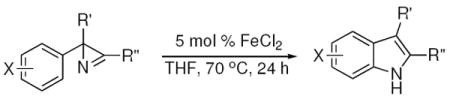
A general method for the synthesis of 2,3-disubstituted indoles is described. The key feature of this method is amination of aromatic C-H bonds via FeCl2-catalyzed ring opening of 2H-azirines. The method tolerates a variety of functional groups such as Br, F, NO2, OMe, CF3, OTBS, alkenes, and OPiv. The method can be also extended to synthesize azaindoles.
The widespread occurrence of the indole motif in bioactive natural products and pharmaceuticals has drawn synthetic chemists’ long lasting interest in developing general methods to prepare them.1a,b In fact, almost all the conceivable bond disconnections for the indole nucleus have been explored.1c,d Yet the efficiency and the substrate scope for most of these approaches still leave much to be desired. For example, very few of them employ direct amination of aromatic C-H bonds,2 which obviates the need for pre-functionalizing the substrate. Furthermore, simultaneous introduction of substituents at C2 and C3 of the indole nucleus remains a continual challenge for organic chemists.3 Additionally, most of the existing methods are not particularly effective for preparing azaindoles that are of great interest to medicinal chemists.4
We were interested in developing a general and catalytic method for the synthesis of 2,3-disubstituted indoles based on the direct amination of aromatic C-H bonds. To implement this strategy, a suitable vinyl nitrene precursor would be needed. Vinyl azides are typically used as precursors to generate the vinyl nitrenes.5a,b However, their use as the vinyl nitrene precursor is often limited by their narrow substrate scope as they are generally prepared by the condensation of methyl azidoacetate and aromatic aldehydes.5c Thermal rearrangement of 2-aryl-2H-azirines via vinyl nitrene intermediates6a provides an efficient route to indoles, although it remains in scattered use in indole syntheses (Scheme 1).6 This rearrangement could be catalyzed by Pd(PhCN)2Cl2 7a or Rh2[OC(O)CF3]4 7b. The catalytic variant of the rearrangement has also received little attention from the chemistry community and only two reports have been published to date.7 Although a vinyl nitrene metal complex was speculated to be involved in one of the catalyzed rearrangements, no mechanistic studies were performed.7b Only one example of azaindoles prepared by the thermal rearrangement has been reported4a while the catalyzed process has not been applied to azaindole synthesis. Since a wide variety of 2H-azirines have been reported in the literature,8 they could be potentially a much better vinyl nitrene precursor than the vinyl azides. We also sought alternative catalysts that could intercept the vinyl nitrene intermediates. Fe stands out among commonly used metals because it is far cheaper than Pd or Rh, abundant, and generally non-toxic. FeCl2 has been reported to catalyze cleavage of azirines to form N-N bonds9a,b or open azirine rings as a stoichiometric one-electron donor.9c To the best of our knowledge, the rearrangement of azirines to indoles is not known to be catalyzed by FeCl2. Herein we report a general method for the synthesis of 2,3-disubstituted indoles and azaindole via ring opening of 2H-azirines catalyzed by inexpensive FeCl2, offering a solution to the unmet needs in indole synthesis mentioned above and probes towards the mechanism.
Scheme 1.
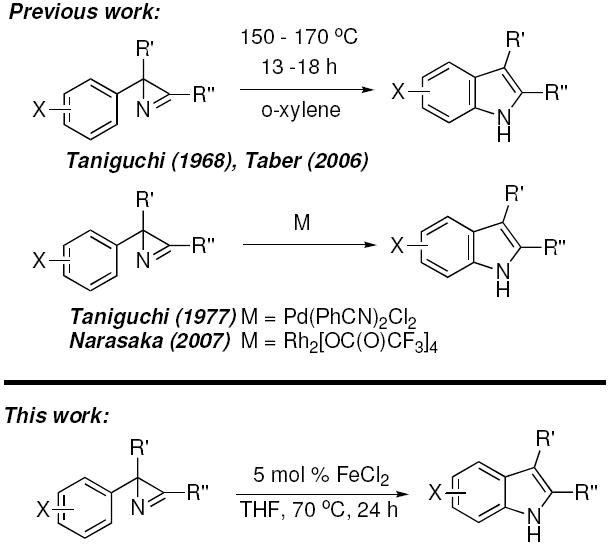
Rearrangement of 2H-Azirines to Indoles
2H-Azirines can be readily prepared from ketones using modified Neber rearrangement processes via hydrazones in three steps developed by Padwa7b,10 or oximes in two steps developed by Taber6b (Scheme 2). Azirine 1a6b,7 was chosen as the model substrate to study the rearrangement of 2-aryl-2H-azirines to indoles. Among the catalysts screened, FeCl2 was found to be particularly effective to catalyze the rearrangement (Table 1). With 5 mol% FeCl2 in THF at rt, the rearrangement was complete after 12 h to provide indole 2a in 75% yield (Entry 1). The rearrangement was cleaner at 70 °C (Entry 2). In the absence of FeCl2, no indole (2a) was formed and azirine 1a was completely recovered (Entry 3). Other Fe(II) halide salts such as Br and I also catalyzed the reaction although they were not as effective as FeCl2 (Entries 4 and 5). Fe(OAc)2 and FeCl3 show no catalytic activity (Entries 6 and 7). CuCl was only moderately effective for catalyzing the rearrangement while CuCl2 led to a mixture of unidentified products with trace amount of indole 2a (Entries 8 and 9). Treatment of 1a with common Lewis acids (AlCl3 and BF3•Et2O) or Bronsted acids (HCl) led to complete conversion to unidentified products (Entries 10-12). The rearrangement was very sensitive to the solvent used. Among the solvents screened at rt (THF, DME, CH2Cl2, 1,2-dichloroethane, and toluene), the rearrangement occurred in only THF. At 70 °C, in addition to THF, 1,2-dichloroethane was also suitable yet less effective (See SI).
Scheme 2.
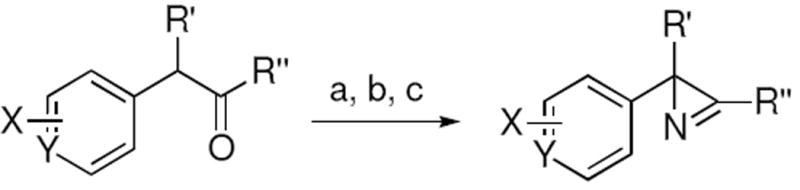
Synthesis of 2H-Azirines
Y = CH: (a) NH2NMe2, NaOAc, AcOH; (b) MeI; (c) NaH. Y = N: (a) NH2OH•HCl, NaOAc; (b) MsCl, Et3N; (c) DBU (one pot).
Table 1.
Optimization of Catalytic Conditions
 | |||
|---|---|---|---|
| entry | catalyst (mol %) | temp (°C), time | 2a, yield (% |
| 1 | FeCl2 (5) | rt, 12 h | 75a |
| 2 | FeCl2 (5) | 70, 24 h | 77a |
| 3 | none | 70, 24 h | 0 |
| 4 | FeBr2 (5) | rt, 12 h | 69a |
| 5 | FeI2 (5) | rt, 12 h | 60a |
| 6 | Fe(OAc)2 (5) | rt, 12 h | 0 |
| 7 | FeCl3 (5) | rt, 12 h | 0 |
| 8 | CuCl (5) | rt, 12 h | 27b,c |
| 9 | CuCl2 (5) | rt, 12 h | traceb,d |
| 10 | AlCl3 (100) | 70, 24 h | 0d |
| 11 | BF3•Et2O (100) | 70, 24 h | 0d |
| 12 | HCl/Et2O (100) | 70, 24 h | 0d |
Yield after chromatography.
NMR yield using hexamethyl benzene as an internal standard.
1a (40%) was recovered.
None of 1a was recovered.
With these screening results in hand, we sought to examine the scope and the generality of the method under the optimized condition (5 mol% of FeCl2, 70 °C, 24 h in THF). As shown in Scheme 3, functional groups are generally well tolerated as a variety of groups such as amides, aryl, cyclopropyl, CF3, halides, OTBS, and OPiv can be incorporated into the indoles. Particularly, the method tolerates substitution on the aromaticring undergoing functionalization and substituents with a wide range of electronic properties from electron-donating (OMe) to electron-withdrawing groups (NO2) can be accommodated. The rearrangement is also quite tolerant of the C2 and C3 substituents of 2H-azirine 1 as aryl and alkyl groups with various steric sizes are generally compatible. In the cases where two regioisomeric products could be obtained, cyclization onto more electron-rich aromatic rings is generally favored. Modest to excellent regioselectivities were observed depending on the substituent. It is worth noting that thermal rearrangement of 1h provided indole 2h with modest selectivity (3.4:1)6b while this method provided 2h as the only product. The method also proves particularly effective for preparing electron-rich indoles. The low yields of 2g and 2j were due to their isolation since they were notoriously prone to air oxidation. The method can be also extended to synthesize 6-azaindoles but a higher catalyst loading (50 mol%) was required to obtain an acceptable yield of 2n.11 The method has one limitation about its substrate scope: the C2 carbon of 1a-n needs to be disubstituted (R’ ≠ H) and R’ can be alkyl, cyclopropyl, aryl, or amide groups.
Scheme 3.

Substrate Scopea,b
aIsolated yield. bYields in parentheses refer to overall yields from the corresponding ketones. The synthesis of 2H-azirines was not optimized. cTwo steps (a 2:1 mixture of two isomers). Indole 2g was reduced to 2g’ by NaBH3(CN). d2i:2i’ = 1:1.8. eTwo steps. Indole 2j was oxidized to 2j’ by O2. f50 mol % FeCl2. gNaHMDS then ClCO2Et.
Scheme 4 shows our proposed catalytic cycle: initial coordination of Fe(II) to the imine nitrogen atom of 2H-azirine 1 would form iron azirine complex 6; subsequent cleavage of the C-N bond would provide iron vinyl nitrene complex 7; finally, indole 2 could be formed by a five-centered 6-π electrocyclization12 of 7 via intermediate 8.
Scheme 4.
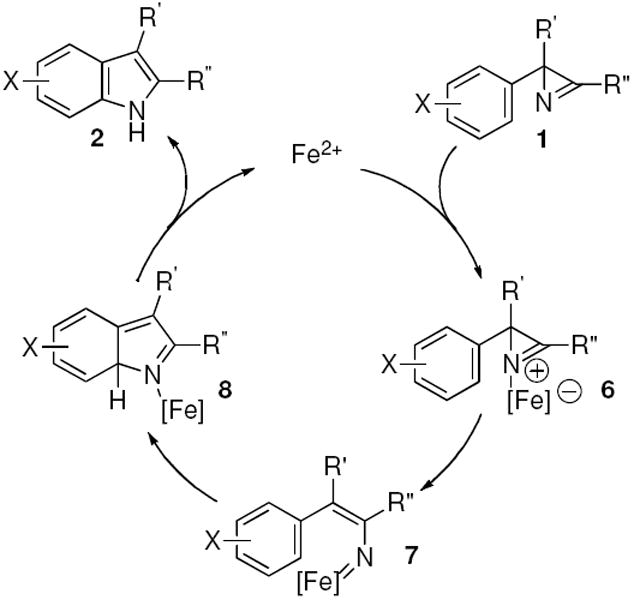
Proposed Catalytic Cycle
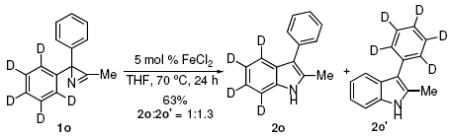
We think that the rearrangement likely involves an iron nitrene complex such as 7. This hypothesis was consistent with the following observations. FeCl2 was unique and effective for the rearrangement while other salts such as FeCl3 and common Lewis and Brønsted acids were completely ineffective. Pyridines that are generally inert in electrophilic substitution reactions participated in the rearrangement. Other potential pathways such as opening the azirine ring via a radical pathway9c was ruled out based on formation of indole 2g with the cyclopropyl group intact. Submission of penta-deuterated substrate 1o to the optimized condition revealed a kinetic isotope effect of 1.3 (eq 1). The magnitude of the kinetic isotope effect is more consistent with the 6-π electrocyclization where the C-H bond breaking event is not the rate-determining step.2c,6b
 |
(1) |
In conclusion, we have developed a catalytic and general method for the synthesis of 2,3-disubstituted indoles whose syntheses still lack a general solution. The method employing inexpensive and nontoxic FeCl2 has a broader substrate scope than the similar processes catalyzed by Pd(PhCN)2Cl2 or Rh2[OC(O)CF3]4.
Supplementary Material
Acknowledgments
We thank the University of Arkansas, the Arkansas Bioscience Institute, and the NIH NCRR COBRE grant (P20 RR15569) for generous support of this research. Core facilities were funded by the NIH NCRR COBRE grant (P20 RR15569) and the Arkansas Bioscience Institute.
Footnotes
Supporting Information Available Experimental procedures and spectral data for all new compounds. This material is available free of charge via the Internet at http://pubs.acs.org.
References
- 1.For recent reviews on biological activities and synthesis of indoles: Kawasaki T, Higuchi K. Nat Prod Rep. 2007;24:843–868. doi: 10.1039/b516351j.Brancale A, Silvestri R. Med Res Rev. 2007;27:209–238. doi: 10.1002/med.20080.Humphrey GR, Kuethe JT. Chem Rev. 2006;106:2875–2911. doi: 10.1021/cr0505270.Sundberg RJ. Indoles. Academic Press; London: 1996.
- 2.(a) Hsieh TH, Dong VM. Tetrahedron. 2009;65:3062–3068. [Google Scholar]; (b) Li J-J, Mei T-S, Yu J-Q. Angew Chem Int Ed. 2008;47:6452–6455. doi: 10.1002/anie.200802187. [DOI] [PubMed] [Google Scholar]; (c) Stokes BJ, Dong H, Leslie BE, Pumphrey AL, Driver TG. J Am Chem Soc. 2007;129:7500–7501. doi: 10.1021/ja072219k. [DOI] [PubMed] [Google Scholar]; (d) Du Y, Liu R, Linn G, Zhao K. Org Lett. 2006;8:5919–5922. doi: 10.1021/ol062288o. [DOI] [PubMed] [Google Scholar]; (e) Carpenter JF. J Org Chem. 1993;58:1607–1609. [Google Scholar]; (f) Tan Y, Hartwig JF. J Am Chem Soc. 2010;132:3676–3677. doi: 10.1021/ja100676r. [DOI] [PubMed] [Google Scholar]
- 3.For some recent examples: Shi Z, Zhang C, Li S, Pan D, Ding S, Cui Y, Jiao N. Angew Chem Int Ed. 2009;48:4572–4576. doi: 10.1002/anie.200901484.Cariou K, Ronan B, Mignani S, Fensterbank L, Malacria M. Angew Chem Int Ed. 2007;46:1881–1884. doi: 10.1002/anie.200604026.Liu KG, Robichaud AJ, Lo JR, Mattes JF, Cai Y. Org Lett. 2006;8:5769–5771. doi: 10.1021/ol0623567.Barluenga J, Jiménez-Aquino A, Aznar F, Valdés C. J Am Chem Soc. 2009;131:4031–4041. doi: 10.1021/ja808652a.Cui S-L, Wang J, Wang Y-G. J Am Chem Soc. 2008;130:13526–13527. doi: 10.1021/ja805706r.
- 4.(a) Roy PJ, Dufresne C, Lachance N, Leclerc J-P, Boisvert M, Wang Z, Leblanc Y. Synthesis. 2005:2751–2757. [Google Scholar]; (b) Wang T, Yin Z, Zhong Z, Bender JA, Yang Z, Johnson G, Yang Z, Zadjura LM, D’Arienzo CJ, Parker DD, Gesenberg C, Yamanaka GA, Gong Y-F, Ho H-T, Fang H, Zhou N, McAuliffe BV, Eggers BJ, Fan L, Nowicka-Sans B, Dicker IB, Gao Q, Colonno RJ, Lin P-F, Meanwell NA, Kadow JF. J Med Chem. 2009;52:7778–7787. doi: 10.1021/jm900843g. [DOI] [PubMed] [Google Scholar]
- 5.(a) Söderberg BCG. Curr Org Chem. 2004;6:743–746. [Google Scholar]; (b) L’abbé G. Angew Chem Int Ed. 1975;14:775–782. [Google Scholar]; (c) Henn L, Hickey DMB, Moody CJ, Rees CW. J Chem Soc Perkin Trans I. 1984:2189–2196. [Google Scholar]
- 6.(a) Isomura K, Ayabe G-I, Hatano S, Taniguchi H. J Chem Soc Chem Commun. 1980:1252–1253. [Google Scholar]; (b) Taber DF, Tian W. J Am Chem Soc. 2006;128:1058–1059. doi: 10.1021/ja058026j. [DOI] [PMC free article] [PubMed] [Google Scholar]; (c) Isomura K, Kobayashi S, Taniguchi H. Tetrahedron Lett. 1968;9:3499–3502. [Google Scholar]; (d) Padwa A, Carlsen PHJ. J Org Chem. 1978;43:2029–2037. [Google Scholar]; (e) Li X, Du Y, Liang Z, Li X, Pan Y, Zhao K. Org Lett. 2009;11:2643–2646. doi: 10.1021/ol9006663. [DOI] [PubMed] [Google Scholar]
- 7.(a) Isomura K, Uto K, Taniguchi H. J Chem Soc Chem Commun. 1977:664–665. [Google Scholar]; (b) Chiba S, Hattoti G, Narasaka K. Chem Lett. 2007;36:52–53. [Google Scholar]
- 8.(a) Palacìos F, de Retana AMO, de Marigorta EM, de los Santos JM. Org Prep Proced Int. 2002;34:219–269. [Google Scholar]; (b) Palacìos F, de Retana AMO, de Marigorta EM, de los Santos JM. Eur J Org Chem. 2001:2401–2414. [Google Scholar]
- 9.(a) Stevens KL, Jung DK, Alberti MJ, Badiang JG, Peckham GE, Veal JM, Cheung M, Harris PA, Chamberlin SD, Peel MR. Org Lett. 2005;7:4753–4756. doi: 10.1021/ol0519745. [DOI] [PubMed] [Google Scholar]; (b) Fitzgerald RN, Jung DK, Eaddy JF. PCT Int Appl. 2001 WO0183479A2. [Google Scholar]; (c) Auricchio S, Grassi S, Malpezzi L, Sartori AS, Truscello AM. Eur J Org Chem. 2001:1183–1187. [Google Scholar]
- 10.Padwa A, Rosenthal RJ, Dent W, Filho P. J Org Chem. 1984;49:3174–3180. [Google Scholar]
- 11.2n was converted to 2n’ because we were unable to purify 2n to the degree required for publication.
- 12.Davies IW, Guner VA, Houk KN. Org Lett. 2004;6:743–746. doi: 10.1021/ol0364273. [DOI] [PubMed] [Google Scholar]
Associated Data
This section collects any data citations, data availability statements, or supplementary materials included in this article.