



“The first 20–40 cases of robotic coronary artery bypass grafting are inevitably associated with longer operative times or an early cluster of surgical failures … the ‘learning curve’.”
Coronary artery bypass grafting (CABG) is one of the most common surgical procedures performed in the USA, with expenditures exceeding US$5 billion annually. The risks and highly invasive nature of CABG have driven the development of alternatives, such as percutaneous coronary intervention (PCI). Despite well-known limitations, PCI has grown steadily over the past decade while CABG volume has declined 40%, a success driven almost entirely by a dramatic difference in recovery time.
The Da Vinci robot is a US FDA approved device and is used in cardiac surgery to permit access of surgical instruments into the thorax through limited incisions. Proponents of robotics point to patients’ demand for better short-term outcomes and quicker recovery. Detractors suggest that the procedure compromises the long-term benefits of CABG and has benefits limited to cosmetics. There are two primary components: the surgeon’s console and the surgical arm unit that maneuvers the surgical instruments. The system is used for internal mammary artery (IMA) harvest, with subsequent coronary grafting performed by a hand-sewn technique via small thoracotomy (Figure 1), or with a totally endoscopic approach [1–3]. Hybrid revascularization utilizes PCI to extend minimally invasive CABG to a broader population of patients with multivessel disease. While there are a number of issues that remain to be clarified, the hybrid procedure has been proven to be feasible, safe and to provide equivalent clinical outcomes to conventional CABG [4]. Adding IMA grafting to PCI is likely to reduce the need for reintervention compared with multivessel PCI alone.
Figure 1. Postoperative image of a morbidly obese patient who underwent robot-assisted coronary artery bypass grafting using bilateral internal mammary artery grafts.
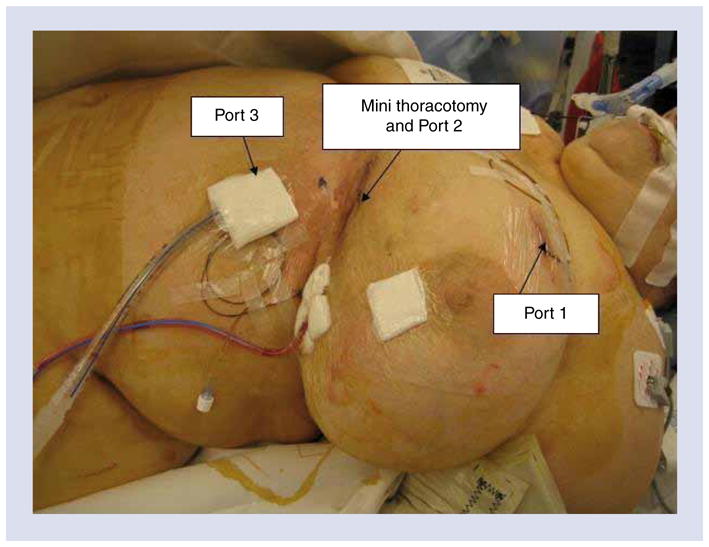
The left and right robotic port site incisions are illustrated along with the 2-inch minithoracotomy incision, which is used to facilitate a direct, hand-sewn anastomosis to the distal coronary artery target.
The robot is available in over 800 hospitals in the USA but is utilized for CABG in less than 20 medical centers. This stark fact underscores significant challenges blocking the adoption of robotics in cardiac surgery, which will be outlined in this report.
Challenge 1: develop the team
An often underestimated step in starting a robotic program is building a team. The transition to robotic CABG requires that carefully choreographed routines of the traditional procedure are replaced with a set of new and unfamiliar behaviors. The first 20–40 cases of robotic CABG are inevitably associated with longer operative times or an early cluster of surgical failures, a process referred to as the ‘learning curve’ [5]. The impact of this learning curve on staff morale and patient safety can compromise the ultimate success of robotic CABG. An analytic technique called cumulative sum (CUSUM) failure analysis provides a sensitive way to monitor this process, provide feedback regarding team learning and direct quality improvement efforts [6,7]. Staff morale can also be closely monitored using a validated ‘culture of safety’ survey, which has shown a strong relationship to length of stay and mortality after cardiac surgery [8]. These tools provide key metrics regarding team development.
We analyzed the impact of the learning curve on staff morale after the introduction of robotic CABG at our institution. Six major adverse events (death, stroke, mediastinitis, reoperation for bleeding, renal failure and prolonged intubation) were plotted in a CUSUM model against their expected rates obtained from the Society of Thoracic Surgery database (Figure 2). At 8-month intervals during the study, surgical intensive care unit nurses (n = 57, 93% staff participation) were surveyed using the culture of safety tool with a 1–5 scale (1: strongly disagree to 5: strongly agree with safety of the program). Although the composite rates of adverse events did not significantly change during the first versus the second half of the study (p = 0.37), CUSUM analysis clearly illustrated a steep cumulative failure rate for the first 40 (out of 160) patients. The first survey, obtained after the completion of the learning curve, showed an average response of 2.55 out of 5 (ranked in the 35th percentile according to database hospitals). By the completion of the 150th case, the scores improved to 3.53 (56th percentile, p < 0.05).
Figure 2. Cumulative sum analysis of the first 160 cases of robotic surgery performed at the authors’ institution.

The x-axis denotes consecutive patients undergoing robotic coronary artery bypass grafting from March 2008 until September 2009. The y-axis denotes the number of cumulative failures, assuming a total ‘acceptable failure rate’ of 13% for a perioperative complication and/or death based on the predicted risk from the Society of Thoracic Surgeons National Database.
These findings highlight the need to complete the learning curve as quickly as possible. Case volume (i.e., ‘learning by doing’) is necessary but not sufficient to create rapid learning. A comparison of 16 different institutions adopting minimally invasive cardiac surgery found that some organizations seem to capitalize on their experience more effectively than others [9]. These investigators found that team learning did not correlate with standard predictors, such as volume of cases or prior experience of the surgeon. Instead, interviews with staff at the 16 programs elucidated that the most consistent characteristic of a successful team was a high level of motivation to learn. This motivation stemmed from leaders judged by staff to be willing to admit mistakes and elicit feedback. In addition, members of successful teams were deliberately selected based on competence and personality characteristics that suggest openness to change. These factors were absent at programs with prolonged learning curves.
Challenge 2: develop a vision about why robotic CABG is being pursued
Traditional CABG is a mature surgical product that yields lasting results at low rates of mortality and morbidity. Adverse outcomes associated with the robotic CABG learning curve mandate a clear vision about the rationale for the program. From the perspective of the patient, a primary reason is the potential to improve quality of life during the recovery period. Other than the demonstration of shorter hospital stays and time to return to work [2,10], recovery time after robotic CABG has not been compared with traditional CABG using objective measures (e.g., exercise testing or validated health surveys, such as the Duke Activity Status Index or Short Form Health Survey). Outcomes after an intervention using modern technology are influenced by the placebo effect. Therefore, a credible mechanism that explains how recovery is accelerated beyond merely the placebo effect is required to validate robotic CABG as an evidence-based practice.
Neurocognitive dysfunction occurs in 10–70% of patients after cardiac surgery and adversely affects postoperative recovery and return to work. Robotic CABG avoids risk factors for cognitive dysfunction by reducing the need for cardiopulmonary bypass, aortic cross-clamping and cardiac manipulation. Abnormal cerebral tissue oxygenation, measured intraoperatively using near infrared spectroscopy, has been shown to predict postoperative cognitive decline [11]. We monitored intraoperative cerebral oxygenation in a matched group of patients undergoing robotic and sternotomy CABG, and found significantly better results with robotic cases. Ongoing testing of cognitive function in these patients will help determine if this issue helps to explain the quicker recovery of this patient cohort.
Challenge 3: prove that the longevity of traditional CABG is not compromised
Patency of bypass graft is the primary determinant of long-term success after CABG [12]. Critics of minimally invasive techniques question the ability to perform coronary anastomoses of equal quality compared with those performed on an arrested heart via a full sternotomy. Anastomotic quality influences patency, particularly during the learning curve; however, most studies suggest that the type of conduit (e.g., mammary artery vs vein) has a much greater impact [12–14]. Saphenous vein grafts have a high failure rate (20–30% at 1 year), yet are chosen over a second IMA owing to concerns about sternal devascularization [15]. As a sternal sparing procedure, robotic CABG can provide the advantages of bilateral IMA conduits (i.e., freedom from major adverse cardio- and cerebro-vascular events) without concerns about healing/infection (Figure 1) [16]. In part because of a higher frequency of IMA grafting, robotic CABG was associated with significant reductions in major adverse cardio- and cerebro-vascular event rates, compared with sternotomy CABG at 1 year (4 vs 25%; p = 0.01) [2]. However, these studies are preliminary. Further investigation of long-term outcomes after robotic CABG has been called for by professional societies (e.g., American College of Cardiology and American Heart Association), regulatory bodies (e.g., NICE) and insurance carriers (e.g., Blue Cross/Blue Shield, United Healthcare/Oxford Health Plans). The stigma of robotic CABG as an ‘experimental’ procedure by these organizations will remain until the long-term efficacy and reproducibility is clearly demonstrated.
Challenge 4: establish that robotic CABG is financially ‘viable’
From the perspective of the hospital, a major obstacle for pursuing robotics is the cost. The acquisition costs of the robot and higher procedural costs, particularly during the learning curve, can be prohibitive for many organizations [2]. After the learning curve, robotic CABG consistently reduces hospital stay, need for blood transfusions and frequency of complications, all highly effective strategies for reducing costs [17]. These advantages prove greatest for patients at high risk for a prolonged hospital stay (e.g., the elderlyot those who have an ejection fraction of 20%, poorly controlled diabetes and severe chronic obstructive pulmonary disease) [2]. The opportunity to market robotic CABG to low-risk patients further shortens average hospital stay for CABG and can produce a shift in the payer mix for the hospital, with a favorable impact on revenue and receivables. On balance, for most patients robotic CABG proved to be cost-neutral if the acquisition costs of the robot are excluded.
Robotic CABG has intangible advantages, not accounted for in standard cost–benefit analyses. Faster return to work after robotic CABG (44 vs 91 days; p = 0.016) has a significant economic impact on loss of wages and productivity. Also, recent changes in healthcare financing designate mediastinital infection as a ‘never event’ that is not reimbursable by Medicare [101]. Robotic CABG eliminates the risk of mediastinal infection, even in those at extreme risk (Figure 1). This is in contrast to a 1–5% risk after traditional CABG, which can be associated hospital costs in excess of US$50,000 per case.
Future
Familiarity, concerns about the safety and efficacy of alternatives, and acceptable intermediate-term results have led to established practice patterns for CABG, such as the routine use of a full sternotomy, even for patients otherwise suitable for a less invasive approach. There is a clear clinical and economic mandate to find the most effective and durable method for coronary artery revascularization. Numerous clinical trials have compared surgery versus PCI, yet none have considered the hybrid method that combines both techniques. The growing adoption of less invasive methods for CABG makes it increasingly apparent that the best revascularization technique should draw upon the strengths of both. The National Heart Lung and Blood Institute recently funded a pathway to help establish hybrid coronary revascularization as a new, scientifically validated approach for coronary artery disease. Success with this promising collaborative effort would be a major advance in cardiovascular medicine and would probably have a profound impact on patient care in the future.
Footnotes
Financial & competing interests disclosure
The authors have no relevant affiliations or financial involvement with any organization or entity with a financial interest in or financial conflict with the subject matter or materials discussed in the manuscript. This includes employment, consultancies, honoraria, stock ownership or options, expert testimony, grants or patents received or pending, or royalties.
No writing assistance was utilized in the production of this manuscript.
Contributor Information
Pranjal H Desai, Department of Cardiothoracic Surgery, Boston University School of Medicine, Boston, MA, USA.
Richard Tran, Department of Cardiothoracic Surgery, Boston University School of Medicine, Boston, MA, USA.
Todd Steinwagner, Department of Cardiothoracic Surgery, Boston University School of Medicine, Boston, MA, USA.
Robert S Poston, Email: Robert.Poston@bmc.org, Chief of Cardiac Surgery, Department of Cardiothoracic Surgery, Associate Professor of Surgery, Boston University and School of Medicine and Boston Medical Centre, 88 East Newton Street, Robinson Building suite B-402, Boston, MA 02118, USA, Tel.: +1 617 638 7350, Fax: +1 617 638 7228.
References
- 1.Srivastava S, Gadasalli S, Agusala M, et al. Use of bilateral internal thoracic arteries in CABG through lateral thoracotomy with robotic assistance in 150 patients. Ann Thorac Surg. 2006;81(3):800–806. doi: 10.1016/j.athoracsur.2005.08.044. [DOI] [PubMed] [Google Scholar]
- 2.Poston RS, Tran R, Collins M, et al. Comparison of economic and patient outcomes with minimally invasive vs. traditional off-pump CABG techniques. Ann Surg. 2008;248:638–646. doi: 10.1097/SLA.0b013e31818a15b5. [DOI] [PMC free article] [PubMed] [Google Scholar]
- 3.Bonatti J, Schachner T, Bonaros N, et al. How to improve performance of robotic totally endoscopic coronary artery bypass grafting. Am J Surg. 2008;195(5):711–716. doi: 10.1016/j.amjsurg.2007.11.010. [DOI] [PubMed] [Google Scholar]
- 4.Reicher B, Poston RS, Mehra MR, et al. Simultaneous ‘hybrid’ percutaneous coronary intervention and minimally invasive surgical bypass grafting: feasibility, safety, and clinical outcomes. Am Heart J. 2008;155(4):661–667. doi: 10.1016/j.ahj.2007.12.032. [DOI] [PMC free article] [PubMed] [Google Scholar]
- 5.Novick RJ, Fox SA, Kiaii BB, et al. Analysis of the learning curve in telerobotic, beating heart coronary artery bypass grafting: a 90 patient experience. Ann Thorac Surg. 2003;76(3):749–755. doi: 10.1016/s0003-4975(03)00680-5. [DOI] [PubMed] [Google Scholar]
- 6.Altman DG, Royston JP. The hidden effect of time. Stat Med. 1988;7:629–637. doi: 10.1002/sim.4780070602. [DOI] [PubMed] [Google Scholar]
- 7.McPherson K. Statistics: the problem of examining accumulating data more than once. N Engl J Med. 1974;290:501–502. doi: 10.1056/NEJM197402282900907. [DOI] [PubMed] [Google Scholar]
- 8.Bognár A, Barach P, Johnson JK, et al. Errors and the burden of errors: attitudes, perceptions, and the culture of safety in pediatric cardiac surgical teams. Ann Thorac Surg. 2008;85(4):1374–1378. doi: 10.1016/j.athoracsur.2007.11.024. [DOI] [PubMed] [Google Scholar]
- 9.Edmondson AC, Bohmer R, Pisano GP. Speeding up team learning. Harv Bus Rev. 2001;79(9):125–134. [Google Scholar]
- 10.Bonaros N, Schachner T, Wiedemann D, et al. Quality of life improvement after robotically assisted coronary artery bypass grafting. Cardiology. 2009;114(1):56–66. doi: 10.1159/000212115. [DOI] [PubMed] [Google Scholar]
- 11.Slater JP, Guarino T, Stack J, et al. Cerebral oxygen desaturation predicts cognitive decline and longer hospital stay after cardiac surgery. Ann Thorac Surg. 2009;87(1):36–44. doi: 10.1016/j.athoracsur.2008.08.070. [DOI] [PubMed] [Google Scholar]
- 12.Goldman S, Zadina K, Moritz T, et al. Long-term patency of saphenous vein and left internal mammary artery grafts after coronary artery bypass surgery: results from a Department of Veterans Affairs Cooperative Study. J Am Coll Cardiol. 2004;44(11):2149–2156. doi: 10.1016/j.jacc.2004.08.064. [DOI] [PubMed] [Google Scholar]
- 13.Grondin CM, Campeau L, Lesperance J, et al. Comparison of late changes in internal mammary artery and saphenous vein grafts in two consecutive series of patients 10 years after operation. Circulation. 1984;70:208–212. [PubMed] [Google Scholar]
- 14.Cameron A, Kemp HG, Green GE. Bypass surgery with the internal mammary artery graft: 15-year follow-up. Circulation. 1986;74:30–36. [PubMed] [Google Scholar]
- 15.Tabata M, Grab JD, Khalpey Z, et al. Prevalence and variability of internal mammary artery graft use in contemporary multivessel coronary artery bypass graft surgery. Circulation. 2009;120:935–940. doi: 10.1161/CIRCULATIONAHA.108.832444. [DOI] [PubMed] [Google Scholar]
- 16.Lytle BW, Blackstone EH, Loop FD, et al. Two internal thoracic artery grafts are better than one. J Thorac Cardiovasc Surg. 1999;117:855–872. doi: 10.1016/S0022-5223(99)70365-X. [DOI] [PubMed] [Google Scholar]
- 17.Brown P, Kugelmass A, Cohen D, et al. The frequency and cost of complications associated with coronary artery bypass grafting surgery: results from the United States Medicare program. Ann Thorac Surg. 2008;85(6):1980–1986. doi: 10.1016/j.athoracsur.2008.01.053. [DOI] [PubMed] [Google Scholar]
Website
- 101.CMS improves patient safety for Medicare and Medicaid by addressing never events. www.cms.hhs.gov/apps/media/fact_sheets.asp.