



Abstract
Objective
To articulate the need for a new approach to primary ovarian insufficiency. The condition, also known as premature menopause or premature ovarian failure, is defined by the presence of menopausal-level serum gonad otropins in association with irregular menses in adolescent girls or women younger than 40 years. It can be iatrogenic as related to cancer therapy or may arise spontaneously, either alone or as part of a host of ultrarare syndromes. In a large percentage of spontaneous cases no pathogenic mechanism can be identified.
Design
Literature review and consensus building at a multidisciplinary scientific workshop.
Conclusion(s)
There are major gaps in knowledge regarding the etiologic mechanisms, psychosocial effects, natural history, and medical and psychosocial management of primary ovarian insufficiency. An international research consortium and disease registry formed under the guidance of an umbrella organization would provide a pathway to comprehensively increase basic and clinical knowledge about the condition. Such a consortium and patient registry also would provide clinical samples and clinical data with a goal toward defining the specific pathogenic mechanisms. An international collaborative approach that combines the structure of a patient registry with the principles of integrative care and community-based participatory research is needed to advance the field of primary ovarian insufficiency.
Keywords: Primary ovarian insufficiency (POI), premature ovarian failure (POF), premature menopause, diminished ovarian reserve, sex steroid deficiency, infertility, menstrual cycle, patient registry, research consortia, participatory research, integrative medicine
Primary ovarian insufficiency, also known as premature menopause or premature ovarian failure, is defined by the presence of menopausal-level serum gonadotropins in association with irregular menses in a woman younger than 40 years (1–3). The syndrome is associated with the symptoms and metabolic effects of sex steroid deficiency, as well as the emotional sequelae experienced by couples who have difficulty in conceiving a pregnancy.
In 1942 Fuller Albright, whom many consider to be the father of modern endocrinology, was the lead author to report on a newly recognized syndrome in young women. The disorder is characterized by amenorrhea and estrogen deficiency in association with menopausal serum FSH levels (4). He termed the condition “primary ovarian insufficiency” to emphasize that it was ovarian function that was the primary defect rather than a central defect in gonadotropin secretion by the pituitary (secondary ovarian insufficiency).Table 1 outlines the various terms that have been used to describe this condition. Primary ovarian insufficiency has diverse etiologies(1, 2). It may be induced by radiation or chemotherapy related to treatment of cancer (5–9). It also may occur spontaneously. Spontaneous cases may be related to an abnormal karyotype involving the X chromosome (10, 11) or, in women with a normal 46,XX karyotype, possibly related to a premutation in the FMR1 gene (12), steroidogenic cell autoimmunity (13, 14), or one of a host of rare syndromes (2).
TABLE 1.
Terms used in the medical literature to equate with “primary ovarian insufficiency” as originally described by Fuller Albright in 1942 (4).
| Term | Count in PubMed |
|---|---|
| Gonadal dysgenesis | 2675 |
| Premature ovarian failure | 1461 |
| Premature menopause | 799 |
| Early menopause | 468 |
| Hypergonadotropic hypogonadism | 268 |
| Ovarian dysgenesis | 181 |
| Primary ovarian failure | 130 |
| Hypergonadotropic amenorrhea | 44 |
| Primary ovarian insufficiency | 33 |
| Climacterium praecox or menopause praecox |
5 |
Note: The table indicates how many times each phrase appeared in the PubMed database from 1949 to the time of this writing using the INDEX search feature including [All FIELDS].
Cooper. Primary ovarian insufficiency. Fertil Steril 2010.
Many women with the spontaneous form of primary ovarian insufficiency experience a delay in diagnosis and express dissatis faction with their medical care (15). Recent evidence demonstrates that delay in diagnosis is a significant factor in the reduced bone mineral density these patients have as a group (16). The diagnosis and the associated reduced likelihood of conception are a major source of emotional distress for most of these patients (17, 18). In most cases of 46,XX spontaneous primary ovarian insufficiency the mechanism of the disorder remains a mystery even after a thorough evaluation. Furthermore, the magnitude of long-term risks associated with the disorder (including cardiovascular disease and osteoporosis) and the optimal means of reducing these risks are uncertain (2).
Change is needed in the areas of primary ovarian insufficiency research and patient care. There is a need for a coordinated and integrated approach to this problem. As patients, clinicians, and investigators we can sit back and let change happen to us, or we can be leaders of change (19). Darwin observed that it is not necessarily the strongest or the most intelligent species that survive, but rather the ones most adaptable to change. Sir William Osler called on clinicians to “Care more particularly for the individual patient than for the special features of the disease” (20). Together, these thoughts suggest that we should lead and embrace change that will improve care for the individual patient while in the process advancing disease research.
With this in mind, on October 2–3, 2008, representative stake holders convened at the William F. Bolger Center for Leadership and Development in Potomac, Maryland. The purpose was to begin building a self-sustaining community of practice in the field of primary ovarian insufficiency. The resulting conference, Orphan Mechanisms of Primary Ovarian Insufficiency: Passion for Participatory Research, was a product of collaboration between a research oriented patient advocacy group (Rachel’s Well, Inc.), a professional organization representing clinicians and investigators who care for these patients (American Society for Reproductive Medicine), and representatives from the U.S. Department of Health and Human Services (DHHS) (National Institutes of Health [NIH] Eunice Kennedy Shriver National Institute of Child Health and Human Development, Office of Research on Women’s Health, Office of Rare Diseases, National Human Genome Research Institute, National Institute of Environmental Health Sciences, and the DHHS Office on Women’s Health).
From this meeting a “community of practice” emerged, bound together and sustained by common interests and shared goals (21, 22). Communities of practice focus on creating value and provide the structure and governance that can build mutual trust and generate commitment to common goals. Trust and commitment in turn improve communication and permit specialists to venture out of their comfort zones to interact with other specialists. Communities of practice share knowledge, they do not operate by a fixed agenda, and they survive through the efforts of leaders who can remain relatively free of the gravitational pull of their own biases and agendas (23).
The purpose of this article is to articulate the need for an international collaborative approach to primary ovarian insufficiency and suggest a model that brings together scientists, clinicians, patients, academia, industry, government, and philanthropy under one umbrella. Primary ovarian insufficiency is a rare disease. Rare diseases by their nature tend to induce fragmented research and fragmented patient care. A diagnosis of primary ovarian insufficiency has a tremendous impact on many aspects of a young woman’s health beyond the traditional patient care paradigms of an obstetrician gynecologist or reproductive health professional. A woman with primary ovarian insufficiency requires integrated care for her physical, psychosocial, and reproductive health, as well as preventative strategies to maintain her long-term fitness. Treatment strategies could have far-reaching implications that may be unrecognized in smallscale studies with limited resources. Without definitive research, we are left to advise women with primary ovarian insufficiency using inappropriate postmenopausal practice guidelines that are based on a different patient population. United, collaborative, medical research consortia can overcome these limitations.
THE POWER OF AN INTEGRATED APPROACH ON A GRANDER SCALE
A recent perspective in the New England Journal of Medicine stated, “We will create a high-performing health care system only if integrated delivery systems become the mainstay of organizational design” (19). Clinical and research systems need to be coordinated in a manner that makes them accountable to the full continuum of patient care and research. This integration need not be disruptive and in fact can be quite constructive. We need to view this from the patient perspective as shown in Figure 1, which compares an integrative with a traditional system of research and health care. An integrative system brings care and research domains to the patient. In the traditional system the patient resides in one domain at a time. Table 2 outlines the characteristics of an integrative approach to primary ovarian insufficiency. A consortium is a group of diverse stakeholders organized to undertake an enterprise beyond the resources of any one member (24). Figure 2 depicts graphically the stakeholders involved. Integration and collaboration among all those invested in improving research and patient care in primary ovarian insufficiency remain the core component of the consortium model we are proposing to move patient care and research forward.
FIGURE 1.
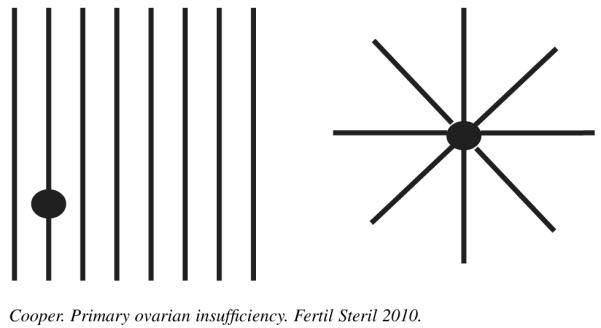
Models of integrative and traditional systems of research and health care, viewed from the patient perspective. In each panel the solid black circle represents the patient. Each straight line represents a specialized area of research or health care, for example, bone health, reproductive health, emotional health, genetic health. In the traditional model for research and health care depicted on the left, the patient resides in one domain at a time, and frequently the data collection and relevant health care are carried out in one domain. In an integrative model for research and health care, depicted on the right, various domains come to meet the patient, and the result can be data and relevant health care coming together in one system and in one database.
TABLE 2.
Characteristics of an integrative approach to primary ovarian insufficiency (42).
| Promotes partnerships. |
| Promotes sharing of resources. |
| Uses evidence-based protocols and guidelines. |
| Uses registries in planning and population management. |
| Plans proactively, as opposed to reactively. |
| Emphasizes individual empowerment. |
| Promotes sharing of responsibility–patient, health care system, supporting systems. |
| Provides for coordination of care across a spectrum of health professions. |
| Emphasizes personalized health planning. |
| Extends across a spectrum of intervention modalities and health professions. |
| Values utilization of nonphysician health team members. |
| Promotes preventive care and planning. |
| Represents the embodiment of “patient-centered”care. |
| Covers the physical, mental, emotional, and spiritual dimensions of health. |
| Receptive to multiple modalities of care, both conventional and alternative, as long as they work. |
Cooper. Primary ovarian insufficiency. Fertil Steril 2010.
FIGURE 2.
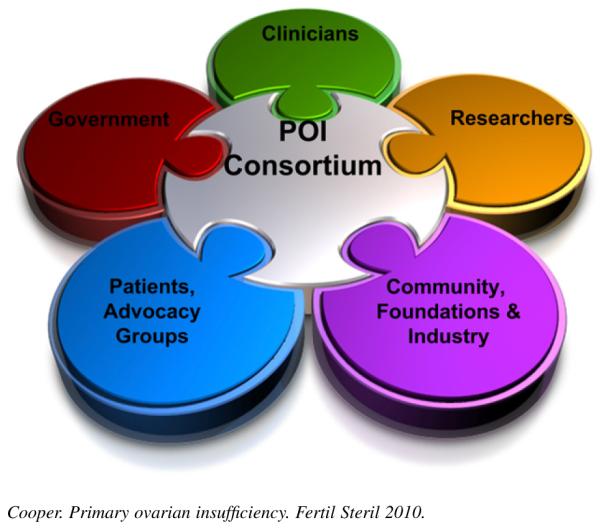
Diverse stakeholders organized as a consortium can undertake an enterprise beyond the resources of any one member. Such an approach can create synergistic solutions for women with primary ovarian insufficiency (POI), a complex and multifaceted chronic disease.
THE POWER OF A DISEASE REGISTRY
Rare diseases present special challenges to research and patient care. The small number of patients limits the experience of any one center. This limits complete understanding of the natural history of the disease. Furthermore, the conduct of randomized controlled trials is extremely difficult in this setting. For rare diseases that are chronic in nature, such as primary ovarian insufficiency, long-term follow up is particularly important. Rare diseases commonly are incompletely characterized, and there is a paucity of published data on long-term treatment outcomes (25).
Primary ovarian insufficiency is itself a rare disease that spans a broad constellation of other rare diseases. Some examples of other rare diseases that have primary ovarian insufficiency as part of their clinical constellation include fragile X–associated primary ovarian insufficiency; galactosemia; polyglandular autoimmune syndrome types 1 and 2; Addison disease as related to steroidogenic cell autoimmunity and autoimmune lymphocytic oophoritis; Turner syndrome; blepharosis, ptosis, epicanthus inversus syndrome; Fanconi anemia; progressive external ophthalmoplegia with mitochondrial DNA deletions; and ataxia telangiectasia, to name a few (2).
Patient registries offer numerous advantages, especially for rare disorders. Characteristics of patient registries are summarized in Table 3. Registries can track patterns in disease diagnosis, progression, treatment, and outcomes. They can determine the clinical effectiveness, safety, and adherence to therapies. Furthermore, they may aid in the improvement of the quality of care and practice guidelines, as well as providing an evidence-based alternative when randomized controlled trials are not practical or ethically acceptable. For the rare and ultrarare conditions that form the constellation of primary ovarian insufficiency, an international, longitudinal disease registry may be the best or only feasible approach (25). A disease registry could provide the pathway to a comprehensive in crease in knowledge about the clinical characteristics and natural history of the disorder and provide the basis for assessment of long-term outcomes of treatment. Such a patient registry could also provide clinical samples and clinical data with a goal toward defining the specific pathogenic mechanisms involved in the development of primary ovarian insufficiency.
TABLE 3.
Establishing a disease registry for primary ovarian insufficiency (25).
| Value/advantages |
| Track patterns in disease diagnosis, treatment, and outcomes. |
| Provide knowledge of disease progression and management. |
| Determine clinical effectiveness and safety of new therapies. |
| Measure quality of care and adherence to evidence based guidelines. |
| Promote proactive patient practice and communication with patients. |
| Describe health care patterns, including appropriateness of and disparities in delivery. |
| Monitor safety and effectiveness of products and technologies. |
| Compare variations in treatments and outcomes. |
| Provide an evidence-based alternative when randomized controlled trials are not practical or ethically acceptable. |
| Examine factors that impact health, quality of life, and disease. |
| Utilize data to provide feedback and modify behavior. |
| Problems/pitfalls |
| Lack of established standards for registries. |
| Potential for bias or systematic error in registry design. |
| Quality assurance issues, such as missing, inaccurate, or inconsistent data. |
| Determination of ownership of collected data. |
| Maintaining consistency in recruitment and data collection in a multiple-site registry. |
| Bias in recruitment and retention of registry participants. |
| Failure to obtain a representative sampling of target population. |
| Failure to obtain adequate sample size or oversampling within a population. |
| Confusing terminology, particularly in international or multisite registries. |
Cooper. Primary ovarian insufficiency. Fertil Steril 2010.
THE POWER OF COMMUNITY-BASED PARTICIPATORY RESEARCH
The conference started with a panel of patients who told their stories. We learned that the diagnosis of primary ovarian insufficiency with its attendant sequelae can lead to loss of employment; can play a role in severing valued interpersonal relationships; and can contribute to social isolation. The patients described deep emotional pain as a result of the diagnosis of primary ovarian insufficiency. They expressed frustration about delay in diagnosis and the difficulty of finding practitioners who are knowledgeable about the disorder. Some women with this condition turn their pain into a passion to help others in similar circumstances (26). They become what has been referred to as “wounded healers,” who can help others heal, and help heal themselves in the process (27–29). It is clear that patients are a critical component of this community of practice.
Community-based participatory research is an approach that equitably partners investigators with those knowledgeable of the local circumstances that impact the area of investigation. This includes co-learning and reciprocal transfer of expertise by all research partners; shared decision-making power; and mutual ownership of the processes and products of the research (30). Community is best defined broadly as including all that would be affected by the research. The approach provides opportunities for novel partnerships, a chance to build trust and generate new ideas, and a chance to obtain insider perspectives that otherwise would go lacking (31).
Traditional research approaches have been characterized as an imbalance of power, wherein funding agencies and investigators have much more power and control over the resources and decision making than the affected community (32). Just as it is difficult to conceive how one could conduct effective research without those knowledgeable in study design, it is difficult to conceive how research aimed at improving health could do so effectively without substantive and sustained input from the affected community. As partnered research advances, boundaries blur. It becomes possible for patients, clinicians, professional organizations, academia, industry, not for profits, and government to join together in one camp to become a sustainable research endeavor around a common interest (31). Table 4 outlines the actions, applications, and challenges that are anticipated in setting up a community-based participatory research endeavor for primary ovarian insufficiency.
TABLE 4.
Applying community-based participatory research principles to primary ovarian insufficiency (30).
| Actions | Applications | Challenges |
|---|---|---|
| Assemble research team. | Identify collaborators that can make decisions and move project forward. |
Time consuming, to identify and bring collaborators on board. |
| Create structure for collaboration and decision making. |
Build consensus on ethics and operating guidelines for collaborators and study participants. |
Ongoing–requiring skill in group facilitation, consensus building, and conflict resolution. |
| Define the research question. | Pull in community representatives to identify issues of greatest importance. |
Time consuming–community reps may target different issues. This may complicate funding. |
| Grants/funding | Involve community members in proposal writing process. |
This could slow and complicate proposal process, and impact funding deadlines. |
| Research design | Researchers provide basic design but work with community for more personalized approaches. |
Collaboration on design may take more time, be more expensive, and have less scientific rigor. |
| Measurements/instruments | Community input in selection and in testing of instruments before study begins. Make measurements more culturally relevant and field test to improve reliability. |
Time consuming; impact on scientific rigor. |
| Intervention design/implementation | Involve local representatives who understand cultural and social factors of community. |
Time consuming; hiring local staff may be less efficient. |
| Recruitment/retention | Utilize community representatives to reach participants and keep them. Community involvement leads to greater participation rates. |
Recruitment issues are complex, expensive, and time consuming. Can result in selection bias. |
| Data analysis/interpretation | Seek out community members’ interpretation of findings, based in cultural/social context. |
Interpretation of nonscientist may differ, calling for further evaluation. |
| Research translation/manuscript preparation |
Community representatives have input and are listed as coauthors. Community input in translating research findings into policy change. |
Requires extra learning and negotiation. |
Cooper. Primary ovarian insufficiency. Fertil Steril 2010.
THE NEED FOR AN UMBRELLA ORGANIZATION
An overarching structure that can facilitate communication and collaboration is needed for an effort that brings together the diverse interests of patients, professional organizations, academia, industry, not for profits, and government. One example of a successful collaborative network facilitated by the federal government is the Rare Diseases Clinical Research Network, which aims to advance research in rare diseases by combining patient and biospecimen registries (http://rarediseases.info.nih.gov/) (33). While successful, using the government as the umbrella organization creates certain legal hurdles as compared with nonprofit organizations, which can partner with industry more readily. Some nonprofit organizations support research, such as the Osteogenesis Imperfecta Foundation (http://www.oif.org/site/PageServer?pagename=AB_AboutOIF) (34), International Foundation for Functional Gastrointestinal Disorders (http://www.iffgd.org/site/about-iffgd/research/) (35), and the National Down Syndrome Society (http://www.ndss.org/index. php?option=com_content&view= article&id=45&Itemid=56) (36). More than 40 years ago, the Cystic Fibrosis Foundation initiated the Cystic Fibrosis Patient Registry to track the health of people with cystic fibrosis in the United States. The information in this registry allows caregivers and researchers to identify new health trends, recognize the most effective treatments, and design clinical trials for potential therapies. The registry includes more than 24,000 patients and anonymously reports data on those who receive care at Cystic Fibrosis Foundation–accredited centers (37).
Rachel’s Well, Inc., is a 501(c)(3) not-for-profit organization that has stepped up to the plate to play an organizing role in developing a consortium for primary ovarian insufficiency. Figure 3 outlines the proposed organizational structure. This has as its centerpiece an effort to stimulate the development of public-private partnerships within the United States with involvement of government agencies to include the National Institutes of Health (NIH), the Centers for Disease Control and Prevention (CDC), and the Agency for Health care Research and Quality (AHRQ). The goal is to share expertise and resources to create synergy. All participants can do much more together than any one can do alone; the effort produces more than the sum of its parts. The mission of Rachel’s Well, Inc., is to improve women’s health by advancing research, raising awareness, and facilitating access to care, particularly with regard to primary ovarian insufficiency and overall menstrual health.
FIGURE 3.
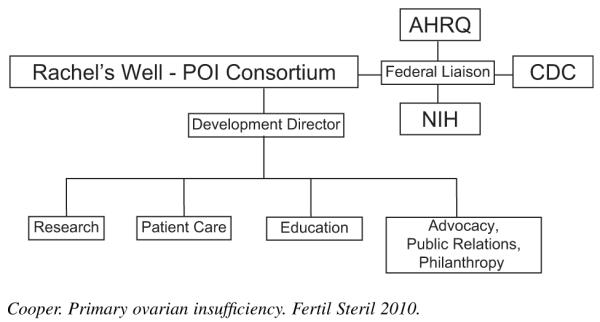
Model involving Rachel’s Well, Inc., a 501(c)(3) nonprofit organization, as the umbrella organization for the primary ovarian insufficiency (POI) consortium. The responsibility of a federal liaison is to formally represent the interests of the government for certain activities with outside organizations. In such a capacity a federal liaison serves in a role as a nonvoting, nonfiduciary agency representative. A federal liaison does not participate in the internal or business affairs or fund-raising activities of the outside organization.
As outlined in Figure 3 there are several governmental agencies that together would play critical roles in creating a research consortium for primary ovarian insufficiency. The NIH is the steward of medical and behavioral research for the United States. In its own words,
Its mission is science in pursuit of fundamental knowledge about the nature and behavior of living systems and the application of that knowledge to extend healthy life and reduce the burdens of illness and disability. The goals of the agency are as follows: foster fundamental creative discoveries, innovative research strategies, and their applications as a basis to advance significantly the Nation’s capacity to protect and improve health; develop, maintain, and renew scientific human and physical resources that will assure the Nation’s capability to prevent disease; expand the knowledge base in medical and associated sciences in order to enhance the Nation’s economic well-being and ensure a continued high return on the public investment in research; and exemplify and promote the highest level of scientific integrity, public accountability, and social responsibility in the conduct of science (38).
The CDC is the premier public health agency of the United States. In its own words, its mission is
Collaborating to create the expertise, information, and tools that people and communities need to protect their health—through health promotion, prevention of disease, injury and disability, and preparedness for new health threats. CDC seeks to accomplish its mission by working with partners throughout the nation and the world to monitor health, detect and investigate health problems, conduct research to enhance prevention, develop and advocate sound public health policies, implement prevention strategies, promote healthy behaviors, foster safe and healthful environments, provide leadership and training (38).
Another governmental agency whose participation would critical is AHRQ. In the words of this agency of the U.S. government,
The mission of the AHRQ is to support, conduct, and disseminate research that improves the outcomes, quality, access to, and cost and utilization of health care services. This mission also encompasses understanding and improving the safety of patient care. The products of the Agency include knowledge that supports decision making to improve health care, as well as tools based upon research that can help improve quality and reduce costs. To fulfill this mission, AHRQ works to foster health care research that helps the American health care system provide access to high-quality, cost-effective services; to be accountable and responsive to patients, consumers, and purchasers; and to improve health status and quality of life. There are three overarching goals that the Agency uses to frame its activities: 1) Support Improvements in Health Out comes, 2) Strengthen Quality Measurement and Improvement, and 3) Identify Strategies to Improve Access, Foster Appropriate Use, and Reduce Unnecessary Expenditures (39).
FORMING A RESEARCH CONSORTIUM AND PATIENT REGISTRY FOR PRIMARY OVARIAN INSUFFICIENCY
Genome-wide association studies, clinical trials of potential therapies, investigation of ultrarare causes of primary ovarian insufficiency, and insights regarding the long-term natural history of the disorder are examples of the types of research that would benefit from the collaborative approach provided by a consortium and patient registry. Investigators and ultimately women and couples who have primary ovarian insufficiency all would benefit immensely by having access to large numbers of patients who would be willing to be included in collaborative efforts. Although nearly all agree that performing studies with a large sample size is important, there are multiple challenges that have hindered efforts to achieving this goal. It is our belief that none of these challenges are insurmountable and that we (investigators, clinicians, industry, and most of all affected women) will have more to gain by working together than by each working on our own.
A major challenge is the hesitancy that some investigators may have to partnering with others. Investigator-initiated research has a long and productive history, and there is no need to diminish this approach. In fact, the development of a research consortium and patient registry for primary ovarian insufficiency well might provide a structure that would support more investigator-initiated projects. Most individual investigators depend on first or last author publications for promotion and may not wish to be involved if they are not in a lead role in a particular study. Although some universities are beginning to recognize the importance of collaboration and to give more “credit” for participation in multicenter efforts, this issue remains a challenge. Our hope is that universities will recognize that being a contributor to a large effort may in fact be more time consuming and more intellectually challenging than being the lead on a small project. As funding is tight, investigators may see a need to become competitive with each other and perhaps in some cases less willing to share resources. Despite these challenges, we believe that it is possible to establish a consortium where the efforts of each investigator are valued and where each investigator has the opportunity to have a lead role on some aspect of the project while serving a supporting role on other aspects. If such a culture can be fostered, the efforts of investigators truly can be synergistic.
Another challenge to conducting studies with sufficient numbers is that some women may be reluctant to participate in research. There may be concerns about the loss of privacy (patients find primary ovarian insufficiency stigmatizing) (18) or the time commitment. Others, especially unaffected women needed to serve as “controls,” may not see the value in the research. Community based groups are working to raise awareness of the importance of participation in research, and safeguards can be put in place to guard against loss of privacy. Women can also choose to participate at a level that is comfortable for them. For example, some women may agree to be followed longitudinally, whereas others may be willing to participate in a clinical trial that could carry some degree of risk or side effects. If systems are set up and credibility of the consortium and registry is established among the community, it is likely that women will be more willing to participate. This is an advantage of the community-based participatory research approach.
Of course limited funding is one of the most significant challenges to establishing a consortium. Organizations such as Rachel’s Well, Inc., are working to establish primary ovarian insufficiency as a funding priority (http://www.rachelswell.org). Small studies appear to be less expensive in the short term because they do not require the infrastructure that is necessary for multicenter efforts. However, in the long run, a multicenter infrastructure likely would be more cost-effective. Study templates could be set up to allow for similar data collection at multiple centers, so that individual centers would not have to expend time and resources in developing data collection systems. Although there may be some individual variance and ongoing modifications, investigators likely could agree on the majority of data that will be collected on a routine basis. Creating a tissue bank that could be accessed by multiple investigators is also likely to be more cost-effective than each center trying to set up a tissue bank on its own. A consortium of committed investigators using the same templates also could form the nucleus for development of clinical trials. If investigators are willing to work together with epidemiologists, statisticians, and members of the community to choose the most important research questions to address, limited resources can be used most efficiently. Funding is not the only resource that is limited. Clinicians, basic scientists, and women with primary ovarian insufficiency all have a limited amount of time. It is likely that the time individual investigators spent writing grant applications and setting up the infrastructure at each center could be reduced if a consortium existed. If such systems were in place, it is likely that efficiency will be improved.
Traditionally, research has been performed in the realm of academic centers that often have limited numbers of patients. Private practitioners may not wish to refer patients to academic centers to be included in research efforts because they wish to continue to care for the patients themselves. However, an effective community-based participatory research would necessarily incorporate the private practice setting as partners into research efforts. Practitioners need to see value in their participation. Their role needs to be more than a source of patients. This would include participation in the development of research questions and ongoing involvement in the processes of the consortium.
STRUCTURE OF THE CONSORTIUM AND PATIENT REGISTRY
To study the onset and progression of primary ovarian insufficiency in girls and young women is currently an intractable problem. The subject must be addressed by a multidisciplinary team engaged in an extensive and far-reaching cohort study of the normal menstrual cycle in women. Basic reproductive scientists must work hand in hand with clinicians and the entire community of primary ovarian insufficiency touched by the disorder. The Oncofertility Consortium is a recently developed model that is challenging old notions about a disease, engaging physicians across disciplinary boarders, and beginning to solve an intractable problem. We believe the Oncofertility Consortium can serve as a template for a primary ovarian insufficiency consortium and patient registry, and the path trod by the research community in oncofertility-related research would be well suited to accelerate activity in primary ovarian insufficiency.
Technologic advances are facilitating the development of research consortia and patient registries. For example, collaborations are now possible that in the past would have been either impossible or, at best, extremely expensive. As a beginning, our group, with assistance from NIH information technology support, has created a wiki site to allow for better communication. Meetings over the Internet are feasible and much less expensive than in-person meetings. We are committed to developing a registry and to using state-of-the-art information systems to aid in efficient collaboration. For example, one system under consideration is the National Institutes of Health Biomedical Translational Research Information System (BTRIS), which is currently in development (40). It is a powerful new tool for investigators to access research data, develop streamlined mechanisms for protocol reporting and data analysis, and reuse data for hypothesis generation and collaboration. One other system under consideration is the caGrid 1.0 (41). Although the caGrid 1.0 is designed for cancer research, it could provide a framework that can benefit the entire biomedical community. Many features of this system could be adapted to allow integration and analysis of large-scale data for the primary ovarian insufficiency community.
MOVING FORWARD
Following the meeting, the community has formed working groups to advance various components of the consortium. One of these, the Primary Ovarian Insufficiency Phenotype and Clinical Trials Database Working Group, took on as its major agenda the development of a network of clinics that will provide integrated care across the United States for these women as part of the proposed patient registry. These patients need help and guidance with their emotional health, their social support structure, their endocrine health, their genetic health, and their reproductive health. This requires integrated care, which the patients who participated in the conference told us is difficult for them to find in the current configuration of our health care system.
The Primary Ovarian Insufficiency Family Planning Working Group, also formed as a result of this meeting, is developing a research agenda to advance projects regarding the emotional health of these women. This team includes representation from positive psychology, spiritual ministry, occupational therapy, and reproductive psychiatry. The Primary Ovarian Insufficiency Genetics and Epidemiology Working Group that formed as a result of this meeting is initiating collaboration between the NIH and the AHRQ. Plans are in the making to hold a follow-up meeting to examine the feasibility of forming a patient registry and research effort that employs the basic principles of community-based participatory research. Finally, lead members of the consortium and working groups have prioritized the involvement and nurturing of young investigators with interests in primary ovarian insufficiency. A consortium creates a professional space that provides such individuals resources beyond what they would be able to generate on their own. Such young investigators can establish themselves and move forward in their career, while sustaining and improving the existing consortium.
As a result of this conference, Orphan Mechanisms of Primary Ovarian Insufficiency: Passion for Participatory Research, a community has formed around primary ovarian insufficiency. Ongoing research in the complex and multifaceted condition of primary ovarian insufficiency is needed in nearly every area including cellular and molecular biology, genetics, diagnostics, basic-clinical-translational research, patient care models, and preventative care. Primary ovarian insufficiency is a rare disease with an incidence of approximately 1% of women by age 40 years. However, primary ovarian insufficiency is in reality a continuum of impaired ovarian function (2). Primary ovarian insufficiency research ultimately may benefit women who undergo menopause at a normal age, women with elevated FSH levels yet regular cycles (occult primary ovarian insufficiency), and women with unexplained infertility who respond poorly to gonadotropin stimulations, ultimately a much larger percentage of the population. By bringing together numerous investigators, medical disciplines, patients, and “stakeholders,” we hope to create synergistic solutions to an unlimited number of issues that remain. The community is working together to raise awareness, remove barriers to care, and stimulate research in primary ovarian insufficiency and the rare disorders that relate to this condition.
CONCLUSION
When the October 2008 meeting Orphan Mechanisms of Primary Ovarian Insufficiency: Passion for Participatory Research convened, the goal was to get the major stakeholders in one room and create the momentum needed to identify common goals and areas for collaborative research and to promote better care for girls and women with primary ovarian insufficiency. An international collaborative approach under the guidance of an umbrella organization such as Rachel’s Well, Inc., would advance the field by combining the structure of a patient registry with the principles of integrative care and community based participatory research. Support in scope and scale similar to the NIH roadmap interdisciplinary consortium grants would facilitate this effort. Our hope is that such a model of integrated care, multidis ciplinary teams, and community-based participation will encourage integration of this model into daily practice in the very near future.
Acknowledgments
The workshop was sponsored in part by Rachel’s Well, Inc., American Society for Reproductive Medicine (ASRM), the National Institutes of Health (NIH), the Intramural Research Program of the Eunice Kennedy Shriver National Institute of Child Health and Human Development (NICHD), the NIH Office of Research on Women’s Health (OWRH), the NIH Office of Rare Diseases (ORD), and the Department of Health and Human Services Office on Women’s Health. L.M.N. is a commissioned officer in the United States Public Health Service. The Oncofertility Consortium is supported by an NIH Roadmap Interdisciplinary Consortium grant mechanism: NIH UL1 DE019587 (to T.K.W.) and was initially fostered through the NICHD SCCPIR program NIH U54-HD41857 (T.K.W.). V.L.B. received research support from Institut Biochimique SA (IBSA).
Footnotes
A.R.C. has nothing to disclose. V.L.B. has nothing to disclose. E.W.S. has nothing to disclose. M.E.R. has nothing to disclose. T.K.W. has nothing to disclose. L.M.N. has nothing to disclose.
REFERENCES
- 1.Rebar RW. Premature ovarian failure. Obstet Gynecol. 2009;113:1355–63. doi: 10.1097/AOG.0b013e3181a66843. [DOI] [PubMed] [Google Scholar]
- 2.Nelson LM. Primary ovarian insufficiency. N Engl J Med. 2009;360:606–14. doi: 10.1056/NEJMcp0808697. [DOI] [PMC free article] [PubMed] [Google Scholar]
- 3.Welt CK. Primary ovarian insufficiency: a more accurate term for premature ovarian failure. Clin Endocrinol. 2008;68:499–509. doi: 10.1111/j.1365-2265.2007.03073.x. [DOI] [PubMed] [Google Scholar]
- 4.Albright F, Smith PH, Fraser R. A syndrome characterized by primary ovarian insufficiency and decreased stature. Am J Med Sci. 1942;204:625–48. [Google Scholar]
- 5.Chemaitilly W, Mertens AC, Mitby P, Whitton J, Stovall M, Yasui Y, et al. Acute ovarian failure in the childhood cancer survivor study. J Clin Endocrinol Metab. 2006;91:1723–8. doi: 10.1210/jc.2006-0020. [DOI] [PubMed] [Google Scholar]
- 6.Sklar CA, Mertens AC, Mitby P, Whitton J, Stovall M, Kasper C, et al. Premature menopause in survivors of childhood cancer: a report from the childhood cancer survivor study. J Natl Cancer Inst. 2006;98:890–6. doi: 10.1093/jnci/djj243. [DOI] [PubMed] [Google Scholar]
- 7.Nieman CL, Kinahan KE, Yount SE, Rosenbloom SK, Yost KJ, Hahn EA, et al. Fertility preservation and adolescent cancer patients: lessons from adult survivors of childhood cancer and their parents. Cancer Treat Res. 2007;138:201–17. doi: 10.1007/978-0-387-72293-1_15. [DOI] [PMC free article] [PubMed] [Google Scholar]
- 8.Woodruff TK. The emergence of a new interdiscipline: oncofertility. Cancer Treat Res. 2007;138:3–11. doi: 10.1007/978-0-387-72293-1_1. [DOI] [PubMed] [Google Scholar]
- 9.Schover LR. Premature ovarian failure and its consequences: vasomotor symptoms, sexuality, and fertility. J Clin Oncol. 2008;26:753–8. doi: 10.1200/JCO.2007.14.1655. [DOI] [PubMed] [Google Scholar]
- 10.Bondy CA. Care of girls and women with Turner syndrome: a guideline of the Turner Syndrome Study Group. J Clin Endocrinol Metab. 2007;92:10–25. doi: 10.1210/jc.2006-1374. [DOI] [PubMed] [Google Scholar]
- 11.Sybert VP, McCauley E. Turner’s syndrome. N Engl J Med. 2004;351:1227–38. doi: 10.1056/NEJMra030360. [DOI] [PubMed] [Google Scholar]
- 12.Wittenberger MD, Hagerman RJ, Sherman SL, Conkie-Rosell A, Welt CK, Rebar RW, et al. The FMR1 premutation and reproduction. Fertil Steril. 2007;87:456–65. doi: 10.1016/j.fertnstert.2006.09.004. [DOI] [PubMed] [Google Scholar]
- 13.Welt CK, Falorni A, Taylor AE, Martin KA, Hall JE. Selective theca cell dysfunction in autoimmune oophoritis results in multifollicular development, decreased estradiol, and elevated inhibin B levels. J Clin Endocrinol Metab. 2005;90:3069–76. doi: 10.1210/jc.2004-1985. [DOI] [PubMed] [Google Scholar]
- 14.Bakalov VK, Anasti JN, Calis KA, Vanderhoof VH, Premkumar A, Chen S, et al. Autoimmune oophoritis as a mechanism of follicular dysfunction in women with 46, XX spontaneous premature ovarian failure. Fertil Steril. 2005;84:958–65. doi: 10.1016/j.fertnstert.2005.04.060. [DOI] [PubMed] [Google Scholar]
- 15.Alzubaidi NH, Chapin HL, Vanderhoof VH, Calis KA, Nelson LM. Meeting the needs of young women with secondary amenorrhea and spontaneous premature ovarian failure. Obstet Gynecol. 2002;99:720–5. doi: 10.1016/s0029-7844(02)01962-2. [DOI] [PubMed] [Google Scholar]
- 16.Popat VB, Calis KA, Vanderhoof VH, Cizza G, Reynolds JC, Sebring N, et al. Bone mineral density in estrogen-deficient young women. J Clin Endocrinol Metab. 2009;94:2277–83. doi: 10.1210/jc.2008-1878. [DOI] [PMC free article] [PubMed] [Google Scholar]
- 17.Groff AA, Covington SN, Halverson LR, Fitzgerald OR, Vanderhoof V, Calis K, et al. Assessing the emotional needs of women with spontaneous premature ovarian failure. Fertil Steril. 2005;83:1734–41. doi: 10.1016/j.fertnstert.2004.11.067. [DOI] [PubMed] [Google Scholar]
- 18.Davis M, Ventura JL, Wieners M, Covington SN, Vanderhoof VH, Ryan ME, et al. The psychosocial transition associated with spontaneous 46, XX primary ovarian insufficiency: illness uncertainty, stigma, goal flexibility, and purpose in life as factors in emotional health. Fertil Steril. doi: 10.1016/j.fertnstert.2008.12.122. doi: 10.1016/j.fertnstert.2008.12.122. [DOI] [PMC free article] [PubMed] [Google Scholar]
- 19.Fisher ES, Berwick DM, Davis K. Achieving health care reform—how physicians can help. N Engl J Med. 2009;360:2495–7. doi: 10.1056/NEJMp0903923. [DOI] [PubMed] [Google Scholar]
- 20.Osler W, Bean RB. Sir William Osler: aphorisms from his bedside teachings and writings. C.C. Thomas; Springfield, IL: 1961. [Google Scholar]
- 21.Li LC, Grimshaw JM, Nielsen C, Judd M, Coyte PC, Graham ID. Evolution of Wenger’s concept of community of practice. Implement Sci. 2009;4:11. doi: 10.1186/1748-5908-4-11. [DOI] [PMC free article] [PubMed] [Google Scholar]
- 22.Ackoff RL. Transformational leadership. Strategy & Leadership. 1999;27:20–6. [Google Scholar]
- 23.Allee V. The knowledge evolution expanding organizational intelligence. Butterworth-Heine-mann; Boston: 1997. [Google Scholar]
- 24.Webster’s ninth new collegiate dictionary. Merriam-Webster; Springfield, MA: 1990. [Google Scholar]
- 25.Gliklich RE, Dreyer NA. U.S. Department of Health and Human Services, Public Health Service, Agency for Healthcare Research and Quality; Rockville, MD: Registries for evaluating patient outcomes: a user’s guide. 2007 [PubMed]
- 26.Hijane K, Heyman C, Bell M, Busby MB. From fire in the belly to a boiling heart: fuel for participatory research. Ann N Y Acad Sci. 2008;1135:1–9. doi: 10.1196/annals.1429.034. [DOI] [PubMed] [Google Scholar]
- 27.Jung CG, Read HE, Fordham M, Adler G. The collected works of C.G. Jung. Pantheon Books; New York: 1953. [Google Scholar]
- 28.Guggenbeuhl-Craig A. Power in the helping professions. Spring Publications; Dallas, TX: 1971. [Google Scholar]
- 29.Daneault S. Thewounded healer: can this idea be of use to family physicians? Can Fam Physician. 2008;54:1218–5. [PMC free article] [PubMed] [Google Scholar]
- 30.Viswanathan M. United States Agency for Healthcare Research and Quality, Research Triangle Institute– University of North Carolina Evidence-based Practice Center. Community-based participatory research assessing the evidence. Agency for Healthcare Research and Quality; Rockville, MD: 2004. [Google Scholar]
- 31.Horowitz CR, Robinson M, Seifer S. Community based participatory research from the margin to the mainstream: are researchers prepared? Circulation. 2009;119:2633–42. doi: 10.1161/CIRCULATIONAHA.107.729863. [DOI] [PMC free article] [PubMed] [Google Scholar]
- 32.Nyden P. Academic incentives for faculty participation in community-based participatory research. J Gen Intern Med. 2003;18:576–85. doi: 10.1046/j.1525-1497.2003.20350.x. [DOI] [PMC free article] [PubMed] [Google Scholar]
- 33.National Institutes of Health Office of Rare Diseases Research [Accessed November 19, 2009]; Available at: http://rarediseases.info. nih.gov/
- 34.Osteogenesis Imperfecta Foundation [Accessed November 19, 2009];2007 Available at: http://www.oif.org/site/PageServer?pagename AB_ AboutOIF.
- 35.International Foundation for Functional Gastrointestinal Disorders [Accessed November 19, 2009]; Available at: http://www.iffgd. org/site/about-iffgd/research/
- 36.National Down Syndrome Society [Accessed45&Itemid November 19, 2009];2009 Available at: http://www.ndss.org/index.php?option com_ content&view=article&id=45&itemid=56.
- 37.Cystic Fibrosis Foundation [Accessed November 19, 2009]; Available at: http:// www.cff.org/
- 38.National Institutes of Health, U.S. Department of Health and Human Services [Accessed June 25, 2009]; Available at: http:// www.nih.gov/
- 39.Agency for Healthcare Research and Quality, U.S. Department of Health and Human Services, 2009 [Accessed June 25, 2009]; Available at: http://www.ahrq.gov/
- 40.Biomedical Translational Research Information System, National Institutes of Health, U.S. Department of Health and Human Services [Accessed June 26, 2009]; Available at: http:// btris.nih.gov/
- 41.Oster S, Langella S, Hastings S, Ervin D, Madduri R, Phillips J, et al. caGrid 1.0: an enterprise grid infrastructure for biomedical research. J Am Med Inform Assoc. 2008;15:138–49. doi: 10.1197/jamia.M2522. [DOI] [PMC free article] [PubMed] [Google Scholar]
- 42.Summit on Integrative Medicine and the Health of the Public. Institute of Medicine; [Accessed May 29, 2009]. [Google Scholar]